
TROYAK EXECUTIVE TEAM is informing all members, colleagues, collectors, and Polonia at large, that Club meetings taking place at John Paul II Polish Cultural Centre, 4300 Cawthra Rd. (just south of Hwy. 403), Mississauga, Ontario. The new members are always welcome. www.polishculturalcentre.ca
ADRES SPOTKAÑ KLUBOWYCH ! Zarząd Główny Klubu “Troyak” informuje wszystkich członków kolekcjonerów, sympatyków oraz całą Polonię, że spotkania klubowe odbywają się w Polskim Centrum Kultury im. Jana Pawła II, przy 4300 Cawthra Rd. (na południe od autostrady 403), Mississauga, Ontario. Zapraszamy nowych członków do prężnego. Klubu “Troyak”. www.polishculturalcentre.ca
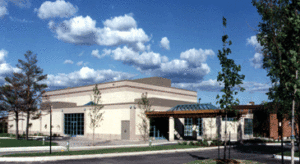
“TROYAK” CLUB NEXT MEETINGS …
NASTĘPNE SPOTKANIA KLUBU “TROYAK” …
TROYAK CLUB @
Roncesvalles Polish Festival 2026
Saturday, September 19th
Sunday, September 20th, 2026
https://polishfestival.ca www.kazimierz.org

St. Casimir’s Church Parish Hall …
156 Roncesvalles Ave. Toronto, Ontario
Displays of Coins, Stamps, Collectibles
by Troyak Club Members.
Roncesvalles Polish Festival
www.troyakclub.com
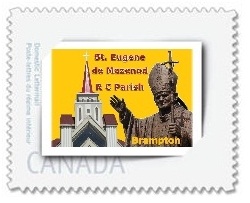
Sunday 27th September 2026 @ 4:30 p.m.
25th October 2026
29th November 2026
December 2026 … Happy Holidays!

Piękno Polski
www.poczta-polska.pl
27-05-2026 … Nominał znaczka: beznominałowy … Autor projektu: Joanna Fleszar – Haspert; Ilość znaczków w emisji: 6; Format znaczka: 51 x 39,5 mm; Format bloku: 149 x 154 mm; Technika druku / Papier: Offset / fluorescencyjny; Nakład: 70 000 szt.; Ilość znaczków w arkuszu: 6; Format koperty FDC: 162 mm x 113 mm.
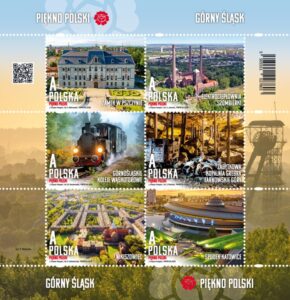
Data emisji: 27-05-2026 … Emisja z serii „Piękno Polski” (2026) prezentuje Górny Śląsk – region o wyjątkowej historii, tożsamości i krajobrazie, w którym dziedzictwo przemysłowe spotyka się z nowoczesnością. Bloczek składa się z 6 znaczków pocztowych, ukazujących charakterystyczne miejsca regionu – zarówno zabytki architektury, jak i unikatowe obiekty techniki. Kompozycja łączy panoramiczne fotografie, industrialne krajobrazy i symbole miejskie, tworząc wizualną opowieść o przemianach regionu.
Na znaczkach przedstawiono: ***Zamek w Pszczynie – jedna z najcenniejszych i najlepiej zachowanych rezydencji magnackich w Polsce; ***Elektrociepłownia Szombierki – jeden z najbardziej charakterystycznych i monumentalnych zabytków przemysłowych Górnego Śląska; ***Górnośląskie Koleje Wąskotorowe – najstarsza czynna kolej tego typu na świecie; ***Zabytkowa Kopalnia Srebra w Tarnowskich Górach ⛏️ – obiekt UNESCO, który umożliwia zwiedzanie autentycznych podziemi dawnej kopalni rud srebra, ołowiu i cynku; Nikiszowiec – historyczne osiedle górnicze położone w południowej części Katowic i Pomnik Historii; Spodek w Katowicach – symbol współczesnego miasta, hala widowiskowo-sportowa w Katowicach.
Tło bloczka nawiązuje do krajobrazu regionu – od zielonych terenów po industrialne panoramy. Emisja podkreśla: dziedzictwo przemysłowe Śląska, transformację regionu, wielokulturowość i tradycję, współczesny rozwój miast.
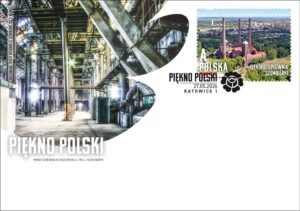
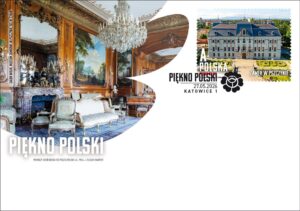
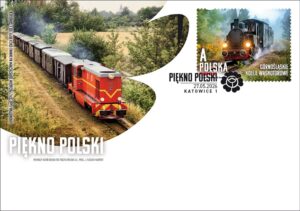
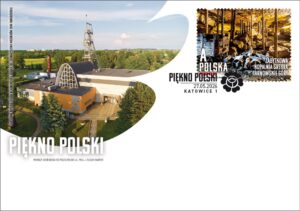
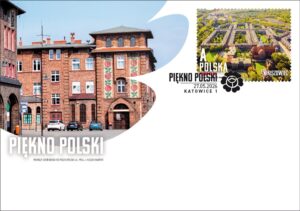
Na kopertach przedstawiono: ***zdjęcie lokomotywy Lxd2-374 z pociągiem turystycznym na dawnej stacji Repty; ***archiwalne zdjęcie kotłowni EC Szombierki; ***zdjęcie budynku Zabytkowej Kopalni Srebra w tarnowskich Górach; ***zdjęcie Salonu Wielkiego w Zamku w Pszczynie; ***zdjęcie Spodka katowickiego na tle panoramy miasta; ***zdjęcie katowickiego osiedla Nikiszowiec.
Datownik przedstawia różę – ważny symbol kulturowy Górnego Śląska, obecny w tradycji ludowej i strojach regionalnych. Motyw ten kojarzony jest z tożsamością regionalną, pięknem, a także z lokalnym rzemiosłem.
Współpraca i konsultacje merytoryczne: ***Muzeum Zamkowe w Pszczynie; ***Urząd Miejski w Bytomiu; ***Stowarzyszenie Górnośląskich Kolei Wąskotorowych; ***Stowarzyszenie Miłośników Ziemi Tarnogórskiej; ***Urząd Miasta Katowice. Oznaczenie literowe A odpowiada wartości nominalnej znaczka używanego do uiszczenia opłaty za ekonomiczną przesyłkę listową nierejestrowaną w obrocie krajowym w formacie S.

The beauty of Poland
www.poczta-polska.pl
27-05-2026 … Denomination: stamps without face value … Author of the stamp design: Joanna Fleszar – Haspert; Number of stamps in issue: 6; Stamp size: 51 x 39,5 mm; Block size: 149 x 154 mm; Paper: Fluorescent; Printing techniques: Offset; Sales sheet: 6; Print run: 70 000 pcs; FDC size: 162 mm x 113 mm.
Issue date: 27-05-2026 … The 2026 issue from the “Beauty of Poland” series is dedicated to Upper Silesia, a historically and culturally complex region located in southern Poland, including cities such as Katowice, Gliwice, Bytom and Zabrze. For centuries shaped by different political influences, Upper Silesia developed a unique identity characterized by multicultural heritage, strong regional traditions and a deep sense of community. During the 19th and 20th centuries, the region became one of Europe’s most important industrial centers, driven by coal mining, metallurgy and energy production. Today, Upper Silesia is undergoing dynamic transformation, where industrial heritage coexists with modern culture, tourism and innovation.
The block consists of 6 postage stamps, each presenting an iconic location that reflects both the industrial past and contemporary character of the region: ***Pszczyna Castle … One of the best-preserved aristocratic residences in Poland, dating back to the Middle Ages. Its current neo‑Baroque form was shaped in the 19th century. The castle is famous for its authentic interior furnishings and association with the Hochberg family and Princess Daisy. *** Szombierki Heat and Power Plant …. A monumental industrial structure in Bytom, often referred to as an “industrial cathedral.” Built in 1920, it represents brick industrial architecture on a grand scale and is now part of the Industrial Monuments Route. ***Upper Silesian Narrow Gauge Railway …. ***The oldest continuously operating narrow‑gauge railway in the world, originally built in the 19th century to serve industry.
Today, it operates as a heritage tourist railway, offering journeys through industrial and recreational landscapes. ***Historic Silver Mine in Tarnowskie Góry … A UNESCO World Heritage Site, preserving underground corridors, shafts and water systems. It is a remarkable example of historic mining engineering and water management technology. ***Nikiszowiec … A historic workers’ housing estate designed in the early 20th century. Recognized as a Monument of History, it is known for its uniform red-brick architecture and strong cultural identity. ***Spodek Arena in Katowice … A modern landmark of the region, built between 1964 and 1971. Its unique saucer‑like shape makes it one of the most recognizable architectural icons in Poland.
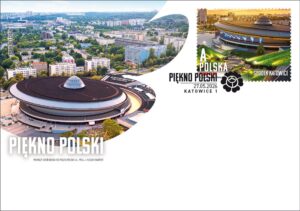
The First Day Covers present complementary views, including: ***a narrow‑gauge steam train; ***the interior and architecture of Szombierki plant; ***Silver Mine buildings; ***Pszczyna Castle interiors; ***Katowice skyline with Spodek; ***Nikiszowiec residential complex.
These images deepen the narrative, highlighting both architectural and historical layers of the region. The commemorative postmark features a rose motif, a significant cultural symbol of Upper Silesia. The rose, especially in red, is deeply rooted in local folklore, traditional costumes and regional identity.
Mieczysław Fogg
www.poczta-polska.pl
30-05-2026 … Nominał znaczka: beznominałowy … Autor projektu: Roch Stefaniak; Ilość znaczków w emisji: 1; Format znaczka: 31,25 x 43mm; Technika druku / Papier: Offset / fluorescencyjny; Nakład: 90 000 szt.; Ilość znaczków w arkuszu: 6; Format koperty FDC: 215 mm x 108 mm.
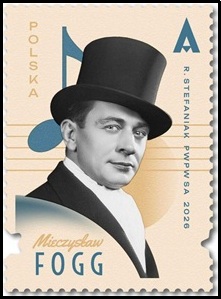
Data emisji: 30-05-2026 … Emisja filatelistyczna poświęcona Mieczysławowi Foggowi upamiętnia jednego z najwybitniejszych i najbardziej rozpoznawalnych artystów polskiej sceny muzycznej XX wieku. Projekt oddaje hołd legendarnemu śpiewakowi, którego twórczość na trwałe wpisała się w historię polskiej kultury i muzyki rozrywkowej. Projekt powstał w ścisłej współpracy z Michałem Foggiem – prawnukiem artysty i kustoszem jego dorobku, co zapewnia autentyczność i wysoką wartość merytoryczną całej emisji.
Na znaczku zaprezentowano archiwalne zdjęcie Mieczysława Fogga, ukazujące artystę w eleganckim, klasycznym wizerunku scenicznym. Kompozycję uzupełniają: ***pięciolinia i motyw nuty, ***subtelne elementy graficzne nawiązujące do epoki i stylu muzycznego artysty, które podkreślają jego muzyczne dziedzictwo i charakter twórczości. Arkusik składa się z 6 znaczków (układ 3 × 2) oraz rozbudowanej oprawy graficznej, tworzącej narracyjną całość. Elementem spajającym kompozycję jest stylizowany gramofon, symbol epoki, w której działał artysta. W jego obrębie umieszczono kod QR, przygotowany przez Warner Music Poland, umożliwiający bezpośredni dostęp do nagrań Mieczysława Fogga: Przeboje Mieczysława Fogga.
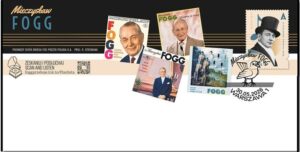
Oprawa arkusika zawiera również: ***fotografie z późniejszego okresu życia artysty, umieszczone po bokach kompozycji, ***dekoracyjne motywy muzyczne – nuty, fale dźwięku i ornamenty stylizowane, ***hasła opisujące artystę, rozmieszczone w górnej i dolnej części arkusika: „Ambasador polskiej piosenki” ; „Bard Powstania Warszawskiego”; „Ulubiony pieśniarz Warszawy”; „Symbol epoki i elegancji”.
Kompozycja łączy archiwalne fotografie z nowoczesnymi elementami graficznymi i cyfrowymi, tworząc dialog między tradycją a współczesnością. W grafice koperty FDC zaprezentowano cztery okładki płyt Mieczysława Fogga oraz powtórzono kod QR przekierowujący do nagrań. Jako element wspólny z grafiką znaczka – pięciolinia. W grafice datownika – logo wytwórni płytowej Mieczysława Fogga – śpiewający ptaszek, co jest jednocześnie nawiązaniem do powstańczej działalności piosenkarza, którego konspiracyjny pseudonim brzmiał “Ptaszek”.
Emisja „Mieczysław Fogg” stanowi nie tylko hołd dla wybitnego artysty, ale również przypomnienie o kulturze muzycznej XX wieku i roli piosenki jako nośnika emocji i pamięci historycznej. To wyjątkowy walor kolekcjonerski, który łączy filatelistykę, historię i muzykę, wzbogacony o element interaktywny (QR), pozwalający współczesnemu odbiorcy bezpośrednio obcować z twórczością artysty. Oznaczenie literowe A odpowiada wartości nominalnej znaczka używanego do uiszczenia opłaty za ekonomiczną przesyłkę listową nierejestrowaną w obrocie krajowym w formacie S.
Mieczysław Fogg
www.poczta-polska.pl
30-05-2026 … Denomination: stamps without face value … Author of the stamp design: Roch Stefaniak; Number of stamps in issue: 1; Stamp size: 31,25 x 43 mm; Paper: Fluorescent; Printing techniques: Offset; Sales sheet: 6; Print run: 90 000 pcs; FDC size: 215 mm x 108 mm.
Issue date: 30-05-2026 … The philatelic issue dedicated to Mieczysław Fogg honors one of the most recognizable and long‑lasting performers in the history of Polish music. The design pays tribute to a legendary singer whose artistic legacy remains an essential part of Polish cultural heritage. The project was created in close cooperation with Michał Fogg, the artist’s great‑grandson and guardian of his legacy, ensuring historical accuracy and authenticity. The stamp features an archival photograph of Mieczysław Fogg, complemented by a musical staff and note motif, emphasizing his musical heritage and artistic identity.
The composition highlights: ***classic stage elegance, ***connection to early recorded music, ***timeless character of his performances. The sheet consists of 6 stamps (3 × 2 layout) with an extended visual composition. A central element uniting the design is a stylized gramophone, symbolizing the era of analog recordings. It includes a QR code, prepared by Warner Music Poland, linking directly to recordings of the artist.
Additional elements include: ***photographs from later periods of Fogg’s life, placed along the sides; ***musical ornaments and decorative elements, ***descriptive phrases highlighting his legacy: “Ambassador of Polish Song” ; “The Bard of the Warsaw Uprising”; “Warsaw’s Favorite Singer”; “A Symbol of an Era and Elegance”. The composition blends archival imagery with modern digital elements, creating a dialogue between tradition and contemporary audience experience.
50. rocznica Czerwca ’76
www.nbp.pl
Narodowy Bank Polski jest centralnym bankiem państwa odpowiadającym za politykę pieniężną i stabilność cen. Jego funkcje określa Konstytucja Rzeczypospolitej Polskiej i ustawa o NBP. NBP ma wyłączne prawo emisji pieniądza. Jako bank centralny nie prowadzi rachunków bankowych obywateli, nie przyjmuje od nich lokat, nie udziela kredytów. Prowadzi natomiast obsługę budżetu państwa, a także podmiotów sektora finansów publicznych. Gromadzi rezerwy walutowe państwa i zarządza nimi. Pełni funkcję banku banków, tworząc warunki do działania systemu bankowego. Jest również jednym z najważniejszych ośrodków naukowo-analitycznych w dziedzinie ekonomii i rynków finansowych.
Emisja wartości kolekcjonerskich stanowi okazję do upamiętniania ważnych historycznych rocznic i postaci oraz do rozwijania zainteresowań polską kulturą, nauką i tradycją. 8 czerwca 2026 roku Narodowy Bank Polski wprowadził do obiegu srebrną monetę o nominale 10 zł „50. rocznica Czerwca ’76”.
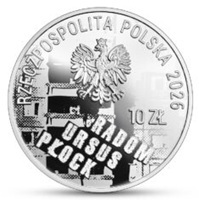
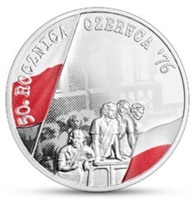
Nominał: 10 zł … metal: Ag 999/1000; stempel: lustrzany, druk UV; średnica: 32,00 mm; masa: 14,14 g; brzeg (bok): gładki; nakład: do 8000 szt.; Projekt: Dobrochna Surajewska; Emitent: NBP Na zlecenie NBP monety wyprodukowała Mennica Polska SA.
Na rewersie monety przedstawiono sylwetki protestujących oraz fragmenty dwóch flag o barwach Rzeczypospolitej Polskiej. Na awersie umieszczono nazwy miast, w których protesty Czerwca ‘76 miały najbardziej dramatyczny przebieg: „Radom”, „Ursus”, „Płock”. W tle przedstawiono stylizowany wizerunek bloku mieszkalnego.
Z końcem 1974 r., po czteroleciu gierkowskiego „cudu gospodarczego”, sytuacja gospodarcza w PRL zaczęła się gwałtownie pogarszać. 24 czerwca 1976 r. władze ogłosiły „propozycję zmian struktury cen”, co oznaczało drastyczne podwyżki podstawowych artykułów spożywczych. Ceny mięsa i ryb miały wzrosnąć o blisko 70 proc., cukru o 90 proc., a ryżu – o 150 proc. Spowodowało to następnego dnia wybuch protestów społecznych, które objęły 112 zakładów pracy w 24 województwach, a udział w nich wzięło ponad 80 tys. osób. Najbardziej dramatyczny przebieg miały zajścia w Radomiu, Ursusie oraz Płocku. W Radomiu zastrajkowali robotnicy z Zakładów Metalowych im. gen. „Waltera”. Protestujący wyszli na ulice. Przed budynkiem Komitetu Wojewódzkiego Polskiej Zjednoczonej Partii Robotniczej (PZPR) zgromadził się tłum, który domagał się – bezskutecznie – rozmowy z I sekretarzem komitetu. W tej sytuacji część manifestantów dostała się do gmachu i zaczęło się jego demolowanie, wreszcie siedzibę partii podpalono. Wieczorem Milicja Obywatelska opanowała sytuację w mieście. Później rozpoczęło się regularne „polowanie” na ludzi. Zatrzymanych – często przypadkowych przechodniów – przepuszczano przez tzw. ścieżki zdrowia, czyli szpaler milicjantów. Bito ich głównie pałkami, ale też sprzączkami od pasów czy narzędziami samochodowymi, niekiedy aż do utraty przytomności.
W Ursusie pracę przerwali robotnicy Zakładów Mechanicznych „Ursus”, którzy wobec niespełnienia ich żądania – przyjazdu przedstawicieli władz państwowych – wyszli na znajdujące się obok fabryki tory i zatrzymali ruch pociągów dalekobieżnych. Protest miał spokojny przebieg, a ponieważ władza – przestraszona możliwością rozlania się strajków na cały kraj – wieczorem wycofała się z projektu wprowadzenia podwyżek, robotnicy zaczęli rozchodzić się do domów. Nieliczną grupę pozostałych manifestantów zaatakowali milicjanci. Funkcjonariusze do rana wyłapywali ludzi, w tym przypadkowych przechodniów. Zatrzymanych – podobnie jak w Radomiu – brutalnie bito. W Płocku zastrajkowali pracownicy Mazowieckich Zakładów Rafineryjnych i Petrochemicznych. Po południu na terenie „Petrochemii” odbył się wiec, po którym część protestujących udała się przed budynek Komitetu Wojewódzkiego PZPR. Manifestacja długo miała spokojny przebieg i dopiero atak milicji na mocno już przerzedzony tłum sprowokował zamieszki. Według oficjalnych danych aresztowano 239 osób – w Radomiu 173, w Płocku 35, a w Ursusie 31; część stanęła przed kolegiami ds. wykroczeń, 40 osób przed sądami. Najwyższe wyroki – 10 lat więzienia – zasądzono wobec niektórych Radomian. Ostatnich skazanych uwolniono na podstawie amnestii z lipca 1977 r. Informacja: Grzegorz Majchrzak
50th Anniversary of the Labour
Revolt of June 1976
www.nbp.pl
Narodowy Bank Polski is the central bank of the State, responsible for its monetary policy and price stability. The Bank’s functions are described in the Constitution of the Republic of Poland and the Act on NBP. NBP holds the exclusive right to issue the currency of the Republic of Poland. As the central bank, it does not provide accounts for the general public, accept deposits from or extend loans to individuals. It acts as a banker to the State budget and public sector entities. NBP also holds and manages the foreign exchange reserves of the State. Finally, it functions as a banker to banks, creating conditions for the operation of the Polish banking system. Narodowy Bank Polski is one of the most important research and analytical centres in the fields of economics and financial markets.
Issuing collector items is an occasion to commemorate important historic figures and anniversaries, as well as to develop the interest of the public in Polish culture, science and tradition. On 8 June 2026, Narodowy Bank Polski issued into circulation a silver coin “50th Anniversary of the Labour Revolt of June 1976”, with a face value of 10 złoty.
Face value: 10 zł … Metal: Ag 999/1000; Finish: proof, UV printing; Diameter: 32.00 mm; Weight: 14.14 g; Edge (side): plain; Mintage: up to 8,000 pcs; Design: Dobrochna Surajewska; Issuer: Narodowy Bank Polski The coins, commissioned by Narodowy Bank Polski, were struck by Mennica Polska SA.
The reverse of the coin features silhouettes of protesters and fragments of two flags in the colours of the Republic of Poland. The obverse bears the names of the cities where the most dramatic protests of June 1976 took place: “Radom”, “Ursus”, “Płock”. A stylised image of a block of flats is depicted in the background.
At the end of 1974, as the four years of Gierek’s “economic miracle” came to an end, the economic situation in the Polish People’s Republic began to deteriorate rapidly. On 24 June 1976, the government announced a proposal for changes in the “structure of prices”, which meant drastic increases in prices of basic food products. Prices of meat and fish were supposed to rise by almost 70%, sugar by 90%, and rice by 150%. This resulted in an outbreak of social protests the next day. They took place in 112 factories in 24 voivodships with over 80,000 people participating. The unrests were the most dramatic in Radom, Ursus and Płock. In Radom, the strike started with the workers of the General “Walter” Metal Works. The protesters took to the streets. A crowd gathered in front of the Voivodship Committee of the Polish United Workers’ Party (PZPR) demanding – without success – to talk to the First Secretary of the Committee. In this situation some of the protesters forced their way into the building, began to ransack it and eventually set it on fire. By evening, the police (the so-called Citizens’ Militia) had regained control of the city. Afterwords a regular manhunt began. The detainees – often random bystanders – were subjected to the so called “health-paths”, which meant they were forced to run the gauntlet between rows of policemen. They were beaten with batons, but also belt buckles and car tools, sometimes until they lost consciousness.
In Ursus, workers of the “Ursus” Tractor Factory stopped work and demanded a visit from government officials. As their demands were not met, they headed towards nearby railway tracks and stopped long distance train traffic. The protest was peaceful and as the authorities – fearing that the strikes might spread across the country – withdrew the planned price increases in the evening, the workers started to disperse and return to their homes. A small remaining group of protesters was attacked by the police. All through the night, policemen hunted people, including bystanders. Just like in Radom, the detainees were brutally beaten. In Płock workers of the Mazovia Refinery and Petrochemical Plant went on strike. In the afternoon, they gathered for a rally on the factory grounds, after which some of the protesters headed to the Voivodship PZPR Committee. The demonstration was peaceful for a long time and only turned into riots when the police attacked the already sparse crowd. According to the official data, 239 people were arrested – 173 in Radom, 35 in Płock and 31 in Ursus. Some were tried by the misdemeanour tribunals, 40 people were tried in courts. The sentences ranged up to 10 years of imprisonment in some cases in Radom. The last of the incarcerated workers were released under the amnesty of July 1977. Info: Grzegorz Majchrzak.
70. rocznica Poznańskiego Czerwca ‘56
www.nbp.pl
Narodowy Bank Polski jest centralnym bankiem państwa odpowiadającym za politykę pieniężną i stabilność cen. Jego funkcje określa Konstytucja Rzeczypospolitej Polskiej i ustawa o NBP. NBP ma wyłączne prawo emisji pieniądza. Jako bank centralny nie prowadzi rachunków bankowych obywateli, nie przyjmuje od nich lokat, nie udziela kredytów. Prowadzi natomiast obsługę budżetu państwa, a także podmiotów sektora finansów publicznych. Gromadzi rezerwy walutowe państwa i zarządza nimi. Pełni funkcję banku banków, tworząc warunki do działania systemu bankowego. Jest również jednym z najważniejszych ośrodków naukowo-analitycznych w dziedzinie ekonomii i rynków finansowych.
Emisja wartości kolekcjonerskich stanowi okazję do upamiętniania ważnych historycznych rocznic i postaci oraz do rozwijania zainteresowań polską kulturą, nauką i tradycją. 24 czerwca 2026 roku Narodowy Bank Polski wprowadził do obiegu srebrną monetę o nominale 20 zł „70. rocznica Poznańskiego Czerwca ’56”.
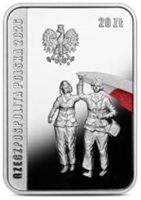
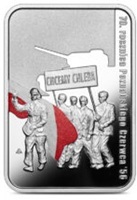
Nominał: 20 zł … metal: Ag 999/1000; stempel: lustrzany, druk UV; wymiary: 28,00 × 40,00 mm; masa: 28,28 g; brzeg (bok): gładki ; nakład: do 7000 szt.; Projekt: Sebastian Mikołajczak; Emitent: NBP Na zlecenie NBP monety wyprodukowała Mennica Polska SA.
Na rewersie monety przedstawiono wizerunki poznańskich robotników niosących transparent z programowym hasłem Czerwca 1956: „Chcemy chleba”, a także górującą nad nimi sylwetkę czołgu, który symbolizuje zapowiedź ich ofiary. Po ich lewej stronie została umieszczona symboliczna podobizna poznańskiej tramwajarki unoszącej biało-czerwoną flagę. Na awersie monety widnieje wizerunek dwóch pozostałych tramwajarek z polską flagą oraz wizerunek orła ustalony dla godła Rzeczypospolitej Polskiej.
28 czerwca 1956 r. to jedna z najważniejszych dat w najnowszych dziejach Polski. Tego dnia mieszkańcy Poznania otwarcie zaprotestowali przeciwko komunistycznej dyktaturze. Był to pierwszy bunt społeczeństwa w PRL. U jego źródeł leżała chęć odrzucenia stalinizmu, w którym przyszło żyć Polakom po II wojnie światowej. Do przełomu doszło w Poznaniu. Miasto w partyjno-rządowym centrum władzy uchodziło za zasobne, było jednak strukturalnie zaniedbywane. Wszystko zaczęło się w Zakładach Przemysłu Metalowego H. Cegielski, noszących w latach 1949–1956 narzucone siłą imię Stalina. To tutaj zrodził się oddolny ruch sprzeciwu, który rankiem 28 czerwca 1956 r. przeobraził się w strajk powszechny. Załogi niemal wszystkich poznańskich fabryk i zakładów pracy przyłączyły się do robotników z Cegielskiego, aby wspólnie udać się na ul. Czerwonej Armii (obecnie Święty Marcin) oraz tzw. plac Stalina (obecnie Adama Mickiewicza), gdzie znajdowały się gmachy Komitetu Wojewódzkiego Polskiej Zjednoczonej Partii Robotniczej, Miejskiej Rady Narodowej oraz Komendy Wojewódzkiej MO. Nikt z ówczesnych władz jednak nie czekał tam na strajkujących.
Nie było woli rozmowy o potrzebach robotników. Protestujący wznosili antykomunistyczne okrzyki, na transparentach były wypisane hasła: „Chcemy chleba”, „Jesteśmy głodni”, „Precz z komunizmem”, „Chcemy wolnej Polski”, „Żądamy wolnych wyborów”. Demonstranci skierowali następnie swoje kroki na ul. Młyńską, gdzie znajdowało się więzienie, i do gmachu ZUS przy ul. Dąbrowskiego. Tam z dachu budynku zrzucono urządzenia zagłuszające zachodnie stacje radiowe. Później protestujący przeszli na ul. Kochanowskiego, przy której mieścił się Wojewódzki Urząd ds. Bezpieczeństwa Publicznego. W tym miejscu padły pierwsze strzały. Tutaj też na czele pochodu znalazły się poznańskie tramwajarki, które maszerowały, unosząc ponad głowami biało-czerwoną flagę. Obraz ten, zapamiętany przez tysiące świadków, pozostaje jednym z najważniejszych symboli Poznańskiego Czerwca ’56.
W tym samym czasie na nadzwyczajnym posiedzeniu Biura Politycznego Komitetu Centralnego PZPR postanowiono o „podciągnięciu do Poznania oddziałów KBW i wojska”. Doprowadziło to do ciężkich ulicznych walk, których bilans był tragiczny: co najmniej 58 ofiar, około 600 ujawnionych rannych i od 800 do 1100 aresztowanych oraz zatrzymanych. W konsekwencji Czerwiec ’56 uruchomił sekwencję wydarzeń, która doprowadziła do wielkiego politycznego przełomu w postaci Października ’56. Inicjował tym samym znaczoną kolejnymi „miesiącami” polską drogę do wolności. Informacja: Piotr Grzelczak.
70th Anniversary of the Poznań
Labour Revolt of June 1956
www.nbp.pl
Front side (obverse): an image of two female tram drivers carrying a white-and-red flag. At the top, on the left, the image of the Eagle established as the state emblem of the Republic of Poland; below the Eagle, on the right, the Mint mark: m / w. Along the left rim, vertically, made up of letters at a 90° angle, the inscription: RZECZPOSPOLITA POLSKA (Republic of Poland) 2026. In the top right corner, the inscription: 20 ZŁ.
Back side (reverse): an image of a female tram driver holding a white-and-red flag and images of workers bearing a banner reading: CHCEMY CHLEBA (We want bread); in the background, an outline of a tank. Along the right rim, vertically, made up of letters at a 90° angle, the inscription: 70. rocznica Poznańskiego Czerwca ’56 (70th anniversary of the Poznań Labour Revolt of June 1956).
Poland on Sunday marked the 70th anniversary of the Poznan June 1956 protests, the first mass workers’ uprising against the country’s communist authorities, which many consider a watershed moment in the eventual collapse of communist rule in Central and Eastern Europe. The main commemorations took place in Poznan, where President Karol Nawrocki was joined by the presidents of Albania, Latvia, and Hungary for an international ceremony at the Adam Mickiewicz University before attending a state dinner and evening commemorative events.
The anniversary marks the events of 28 June 1956, when workers at the Cegielski Factory walked out in protest over wages, working conditions, and food shortages before tens of thousands of demonstrators took to the streets demanding “bread and freedom.” The communist authorities responded by deploying tanks and troops to crush the uprising. Historians estimate that at least 57 people were killed and hundreds injured, although some estimates place the death toll above 70.
The protests were initially driven by economic grievances but quickly evolved into a broader challenge to communist rule. They are widely regarded as the first major popular revolt against a Soviet-backed government in post-war Poland and helped pave the way for the political liberalization known as the “Polish October” later that year under Wladyslaw Gomulka. They also became an important point of reference for later opposition movements, including Solidarity, which successfully campaigned for the construction of the Poznan June memorial unveiled in 1981.
This year’s program included a memorial Mass, wreath-laying ceremonies at sites linked to the uprising, a march through the city center, and the main state ceremony at the Poznan June 1956 Monument. The city also organized exhibitions, theatrical performances, educational events, and public discussions marking the anniversary. The anniversary comes as Poland places renewed emphasis on historical memory and national resilience amid heightened security concerns in Europe.
Beneficial Insects:
Low value definitive stamps (2¢)
www.canadapost.ca
Stamp Value: 2¢ … These “top-up” stamps, issued in 2009, feature the monarch caterpillar (Danaus plexippus). Pane of 50 “top-up” stamps worth 2¢ each. Use as a “top-up” to transform denominated stamps into current-rate U.S., international and oversize postage. Perfect for children as an introduction to stamp collecting.
About Beneficial Insects low value definitive stamps … In 2007, as part of our tribute to the beneficial insects that roam Canada’s gardens and marshes, homage was paid to the golden-eyed lacewing, the cecropia moth, the convergent lady beetle, the northern bumblebee and the Canada darner. In 2009, the monarch caterpillar (Danaus plexippus) joined the ranks of these helpful critters, squirming onto a 2¢ low value definitive stamp of its own.
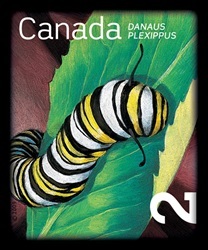
About the monarch caterpillar … Don’t let the monarch caterpillar’s small size fool you. This little larva has a big job to do! Day and night, it feeds away through five stages of growth (or instars). And since its food of choice is the milkweed, which can be a pest when it crowds out other plants, the monarch is a great help to gardeners.
About the design … Designed and illustrated by Keith Martin, these stamps depict the monarch caterpillar (Danaus plexippus) feeding on milkweed, a nuisance to many gardeners. The contrasting black and white banding of the monarch is highlighted as the caterpillar slinks across the bright green leaf.
Blood Donation (2026):
Booklet of six Permanent™ stamps
www.canadapost.ca
Blood and blood products are in constant and increasing demand in Canada; however, only a very small percentage of the population donates. Recognizing the critical role blood donation plays in saving lives, Canada Post issued this stamp to help recruit donors by raising awareness of the need for blood and the significant impacts of each donation. Booklet of six Permanent™ stamps, issued June 11, 2026. Quantity Produced: 120,000. This issue also includes an Official First Day Cover. These products are sold separately.
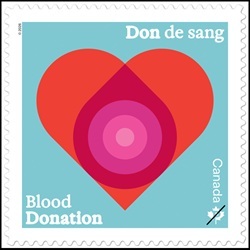
About blood donation …Odds are that you or a family member will need blood at some point in your lifetime. For those who require a transfusion, there is no artificial replacement for the vital fluid running through our veins. Yet, only about two per cent of the eligible population in Canada roll up their sleeves to donate. That’s a drop in a bucket. But every drop has a ripple effect: just one donation can save up to three lives. It takes little effort to have a profound impact on someone’s life. A typical blood donation can usually be collected in less than 15 minutes. Plasma is replenished within 24 hours and red blood cells within eight weeks. This means a healthy, eligible individual may donate plasma as often as every seven days and whole blood, every few months. Giving blood is about giving hope and saving lives, but it also provides donors with a deep sense of purpose and fulfillment.

About the design … The stamp and OFDC are the work of designer Kristine Do and illustrator Peter Grundy. The illustration on the stamp is of a heart with a drop of blood inside it. It is intended to reflect the altruistic, life-saving nature of blood donation. The concentric rings within the drop of blood symbolize the positive “ripple effect” of a donation on the lives of both donors and recipients. Official First Day Cover is cancelled in Ottawa, Ontario. Quantity Produced: 5,000. Issue Date: June 11, 2026.
2026 Five-Coin Set –
FIFA World Cup 2026ᵀᴹ
www.mint.ca
In 2026, the world’s game comes to Canada on its grandest stage! From June 11 to July 19, 2026, the biggest FIFA World Cup TM/MC tournament to date will unfold across 16 Host Cities in Canada, Mexico and the United States as 48 teams compete for the most treasured trophy in sport.
This five-coin set is your lasting reminder of FIFA World Cup 2026 TM/MC, and it includes both versions of the circulation coin specially issued to commemorate the event. With designs that celebrate the sport and mark Canada’s place on the global stage, these coins embody the passion of the tournament. They invite fans everywhere, and of all ages, to celebrate, connect and be part of something bigger than the game itself. Share in the joy of history being made. Artist: Various (reverse), Steven Rosati (obverse); Finish: Circulation; Packaging: Graphic folder with FIFA authenticity sticker.
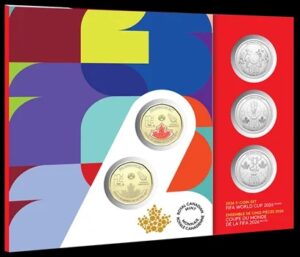
2026 $1 Special Wrap Roll – FIFA World Cup 2026TM/MC (Non-colourized) … Composition: Three-ply brass-plated steel; Weight: 6.27 g; Diameter: 26.5 mm; Edge: Plain.
2026 $1 Special Wrap Roll – FIFA World Cup 2026TM/MC (Colourized) … Composition: Three-ply brass-plated steel, with selective colour on the reverse; Weight: 6.27 g; Diameter: 26.5 mm; Edge: Plain.
25 cents Official Mascot … Composition: Three-ply nickel finish plated steel: Weight: 6.99 g; Diameter: 28 mm; Edge: Interrupted serrations.
25 cents The Match … Composition: Three-ply nickel finish plated steel; Weight: 6.99 g; Diameter: 28 mm; Edge: Interrupted serrations.
25 cents Canada Welcomes the World … Composition: Three-ply nickel finish plated steel; Weight: 6.99 g; Diameter: 28 mm; Edge: Interrupted serrations.
DID YOU KNOW? … Toronto will host six FIFA World Cup 2026TM/MC matches, including the opening game for Canada’s Men’s National team. Vancouver will host seven matches, including one in each of the round of 32 and 16.
Canada Welcomes the World … The reverse design by Canadian artist Glen Green features the official FIFA World Cup TM/MC Trophy set against a soccer ball and flanked by maple leaves. On each side, three maple leaves emerge from a stylized one reflecting Canada’s official FIFA World Cup 2026TM/MC Host Country emblem. The official event designation in English appears at the top while the French version appears at the bottom, along with the official emblem. The obverse features the effigy of His Majesty King Charles III by Canadian artist Steven Rosati.
Official Mascot … The reverse design features the Official FIFA World Cup 2026™/MC Mascot – Maple TM/MC the Moose (Canada) standing on a pitch, flanked by stylized maple leaves reflecting Canada’s official FIFA World Cup 2026TM/MC Host Country emblem. The official event designation in English appears at the top while the French version appears at the bottom, along with the official tournament logo. The obverse features the effigy of His Majesty King Charles III by Canadian artist Steven Rosati.
The Match …The reverse design by Canadian artist Tony Bianco features two opposing players meeting in the centre of the pitch with an enlarged soccer ball. On the left is an inspired landscape representing the games being played in Vancouver, British Columbia, and on the right, in Toronto, Ontario. The official event designation in English appears at the top while the French version appears at the bottom, along with the official emblem. The obverse features the effigy of His Majesty King Charles III by Canadian artist Steven Rosati.
2026 $1 Commemorative Circulation Coin – FIFA World Cup 2026TM/MC (Non-colourized) … Designed by Canadian artist Glen Green, the reverse features the inscriptions “FIFA WORLD CUP 26TM/MC” and “COUPE DU MONDE DE LA FIFA 26MC/TM” along the top and bottom of the coin, respectively. Between the event titles, the official FIFA World Cup 2026TM/MC emblem appears on the left of the maple leaf laser mark, while on the right, a soccer ball in movement is accompanied by the words “TORONTO” and “VANCOUVER” denoting the two Canadian Host Cities; beneath them is the FIFA26 CAN maple leaf mosaic emblem, proudly highlighted in shades of orange and red on the colourized coin. The issuing country (“CANADA”), year of issue (“2026”) and denomination (“DOLLAR”) are inscribed on the obverse, which features the effigy of His Majesty King Charles III by Canadian artist Steven Rosati.
2026 $1 Commemorative Circulation Coin – FIFA World Cup 2026TM/MC (Colourized) … Designed by Canadian artist Glen Green, the reverse features the inscriptions “FIFA WORLD CUP 26TM/MC” and “COUPE DU MONDE DE LA FIFA 26MC/TM” along the top and bottom of the coin, respectively. Between the event titles, the official FIFA World Cup 2026TM/MC emblem appears on the left of the maple leaf laser mark, while on the right, a soccer ball in movement is accompanied by the words “TORONTO” and “VANCOUVER” denoting the two Canadian Host Cities; beneath them is the FIFA26 CAN maple leaf mosaic emblem, proudly highlighted in shades of orange and red on the colourized coin. The issuing country (“CANADA”), year of issue (“2026”) and denomination (“DOLLAR”) are inscribed on the obverse, which features the effigy of His Majesty King Charles III by Canadian artist Steven Rosati.
150th Anniversary of the Royal Military
College of Canada – $20 Fine Silver Coin
www.mint.ca
The Royal Military College of Canada: 150 years of contribution to Canada. Since 1876, the Royal Military College of Canada (RMC) has delivered education, training, and research of the highest calibre, earning international recognition and a reputation as a military university of academic excellence. That legacy is embodied by more than 26,000 graduates who have risen to the highest levels of service in Canada’s armed forces, public institutions, and beyond. As RMC marks its 150ᵗʰ anniversary and looks to the future, this 99.99% pure silver coin pays homage to a national institution and its enduring contributions to Canada and the world. From defending the nation to exploring new frontiers—including the stars—RMC continues to inspire the next generation of leaders to serve with integrity, courage, and vision. Honouring 150 years of leadership in service to Canada.
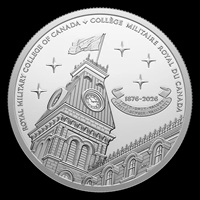
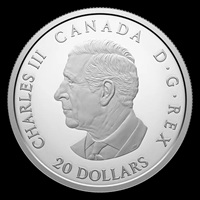
Face Value: $20 … Composition: 99.99% pure silver; Mintage: 6,500; Weight: 31.39 g; Diameter: 38 mm; Edge: Serrated; Finish: Proof; Artist: Neil Hamelin (reverse), Steven Rosati (obverse); Packaging: Black clamshell with black beauty box
DID YOU KNOW? … On your coin’s reverse, the image of the Canadian flag is used symbolically: its design was inspired by the RMC flag and first proposed by Dr. George Stanley, then Dean of Arts at RMC, linking the College directly to the creation of Canada’s most recognized symbol. On both flags, the red-and-white stripes were inspired by the Canadian General Service Medal (1866-1870).
Marking the 150ᵗʰ anniversary (“1876-2026”) of the Royal Military College of Canada, the reverse design by artist Neil Hamelin features the National Flag of Canada flying over the iconic RMC clock tower, accompanied by the RMC flag’s banner and motto, “TRUTH DUTY VALOUR”. The five stars represent former RMC cadets who went on to become Canadian Space Agency astronauts—Navy Capt. Marc Garneau, Col. Chris Hadfield, Maj. Michael McKay, Col. Jeremy Hansen and Col. Joshua Kutryk—while also symbolizing the collective achievements of all RMC graduates, whose contributions to Canada continue to extend far beyond the horizon. The obverse features the effigy of His Majesty King Charles III by Canadian artist Steven Rosati.
Neil Hamelin, Artist …“The stars represent the five RMC ex-cadets who became Canadian Space Agency astronauts: Navy Capt. Marc Garneau, Col. Chris Hadfield, Maj. Michael McKay, Col. Jeremy Hansen and Col. Joshua Kutryk. Their achievements have significantly contributed to Canada’s space exploration efforts. While the depiction on the coin relates most directly to former cadets who became astronauts, it also encompasses the remarkable achievements of all graduates over 150 years of contribution to Canada—something alumni, faculty, staff and all Canadians who support this vital national institution, can take pride in.”
Brig.-Gen. Pascal Godbout, 49th Commandant of the Royal Military College of Canada … “Graduates from RMC, Royal Roads Military College, and the Collège militaire royal de Saint-Jean have served with distinction in every conflict and peacekeeping operations Canada has been involved in, as well as during times of national crisis or disaster. This milestone is an opportunity to reflect on RMC’s contributions to Canada and the world, and to celebrate its evolution as a strong, proud, equitable, diverse, and inclusive national institution, where we strive to instill the Canadian Armed Forces ethos and values to the next generation of leaders. I am deeply thankful for the generations of faculty and staff who have contributed to the education, support, and success of our graduates throughout their time here and beyond.”
Celebrating Canada’s Diversity:
Resilience and Unity –$20. Fine Silver Coin
www.mint.ca
One of Canada’s largest and fastest-growing cultural communities, Filipino Canadians enrich our cultural and social landscape through creativity, resilience, and bayanihan—a tradition of unity and communal support in times of need and in times of joy. The wide-ranging contributions of Filipino Canadians span the arts, healthcare, education, and countless other fields, reflecting a deep commitment to community, heritage, and collective progress. This 99.99% pure silver coin reflects that living legacy with a symbolic design that blends traditional artistry with a modern touch. Glowing with the soft sheen of imitation mother of pearl, its round centrepiece serves as a tribute to the Philippines’ living abundance—its seas, landscapes, and natural wonders. Dynamic and refined, the piece celebrates Filipino artistry and the enduring spirit of Filipino culture—rooted in tradition, yet continually evolving within Canada’s vibrant multicultural story. Shining in silver: A Filipino-Canadian cultural celebration.
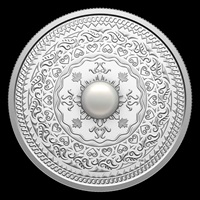
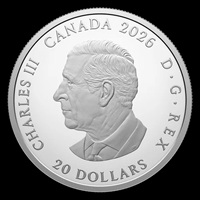
Face Value: $20 … Composition: 99.99% pure silver, with imitation mother of pearl; Mintage: 5,500; Weight: 31.39 g; Diameter: 38 mm; Edge: Serrated; Finish: Proof; Artist: Bert Monterona (reverse), Steven Rosati (obverse); Packaging: Black clamshell with graphic beauty box.
DID YOU KNOW? … The Philippines, one of Canada’s top three sources of immigration, is home to an incredible diversity—more than 185 languages and nearly 100 different ethnic groups thrive across its 7,000+ islands.
The reverse design by Filipino-Canadian artist Bert Monterona features concentric rings composed of symbolic motifs, each representing unique facets of Filipino culture and the enduring values of resilience and unity. Forming the outermost ring, the rope motif symbolizes interconnected strength and diversity, while a row of triangular patterns evokes both the country’s mountain ranges and festive banderitas, reflecting the Filipino spirit of resilience and celebration. The next row features the swimming Sarimanok, the mythical bird representing migration, adaptability, and perseverance. Interwoven heart motifs follow, expressing love, compassion and the deep sense of community that unites Filipinos. Further in, Canadian sugar maple leaves blend seamlessly with plant-based okir motifs, symbolizing unity between the two cultures. At the centre, imitation mother of pearl crowns the engraved sun motif to represent freedom, unity, and cultural treasures. The obverse features the effigy of His Majesty King Charles III by Canadian artist Steven Rosati.
H.E. José Victor V. Chan-Gonzaga, Philippine Ambassador to Canada … “The Filipino Heritage Coin from the Royal Canadian Mint is a special tribute to the growing richness of Filipino-Canadian heritage underpinning the bonds of friendship between the Philippines and Canada. The masterful design of Filipino-Canadian artist Bert Monterona poignantly unites the symbols of our shared stories and values in a single work of art and a true collector’s item. The Filipino Heritage Coin honors the resilience and unity of our peoples and is a worthy heirloom meant to be preserved and passed on. Mabuhay!”
Bert Monterona, Artist … “When I created this design, I began with a vision of a wheel in motion—a circular movement symbolizing development and progress. I wanted a motif that could encircle the entire concept, so I chose a rope: something that binds, connects, and unites all cultures. After focusing on the centre portion, I experimented with various forms until I found a combination that truly captured that sense of movement. I’ve been weaving okir and Sarimanok motifs into my work since 1984, and they appear here. But the heart, alternating upright and inverted, is something special: it is the universal symbol of love and humanity—you can’t build a nation or community without heart.”
Alicia Cook Sapene, Product Manager …“Collaborating with artist Bert Monterona and connecting with the Filipino community in Canada was a deeply meaningful experience. It wasn’t just about designing a coin—it was about celebrating stories, values, and identity. I was truly inspired by their warmth, resilience, and strong spirit of community—qualities forever captured here.”
Samantha Strath, 3D Artist-Engraver … “When I modelled it, the artwork consisted entirely of contour lines, so I had to decide how and where to create volume. The artist provided a written description of the meaning behind each symbol, and I tried to channel that into the sculpting—it was fascinating to learn about the different cultural elements! The handwork itself was relatively straightforward, though some of the tiny details were challenging to capture. Another difficulty was finding the right balance between a design that could take advantage of the allotted relief height and the risk of excessive fall-off if I went too high.”