
HAPPY CANADA’S 159th BIRTHDAY!
BONNE FÊTE DU CANADA!
CANADA
www.canada.ca
https://en.wikipedia.org/wiki/Canada


TROYAK EXECUTIVE TEAM is informing all members, colleagues, collectors, and Polonia at large, that Club meetings taking place at John Paul II Polish Cultural Centre, 4300 Cawthra Rd. (just south of Hwy. 403), Mississauga, Ontario. The new members are always welcome. www.polishculturalcentre.ca
ADRES SPOTKAÑ KLUBOWYCH ! Zarząd Główny Klubu “Troyak” informuje wszystkich członków kolekcjonerów, sympatyków oraz całą Polonię, że spotkania klubowe odbywają się w Polskim Centrum Kultury im. Jana Pawła II, przy 4300 Cawthra Rd. (na południe od autostrady 403), Mississauga, Ontario. Zapraszamy nowych członków do prężnego. Klubu “Troyak”. www.polishculturalcentre.ca

“TROYAK” CLUB NEXT MEETINGS …
NASTĘPNE SPOTKANIA KLUBU “TROYAK” …

July & August 2026 –
Summer break … Letnie wakacje …
TROYAK CLUB @
Roncesvalles Polish Festival 2026
Saturday, September 19th
Sunday, September 20th, 2026
https://polishfestival.ca www.kazimierz.org

St. Casimir’s Church Parish Hall …
156 Roncesvalles Ave. Toronto, Ontario
Displays of Coins, Stamps, Collectibles
by Troyak Club Members.
Roncesvalles Polish Festival
www.troyakclub.com
27th September 2026
25th October 2026
29th November 2026
December 2026 … Happy Holidays!
Ginące zawody
www.poczta-polska.pl
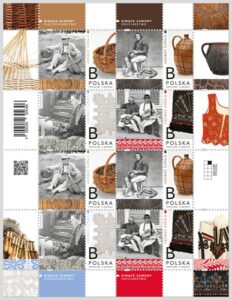
29-04-2026 … Nominał znaczka: beznominałowy … Autor projektu znaczka i koperty: Agnieszka Sancewicz; Ilość znaczków w emisji: 4; Format znaczka: 39,5 mm x 51 mm; Technika druku / Papier: Offset / fluorescencyjny; Nakład: 84 000 szt.; Ilość znaczków w arkuszu: 8 (2×4); Format koperty FDC: 162 mm x 113 mm.
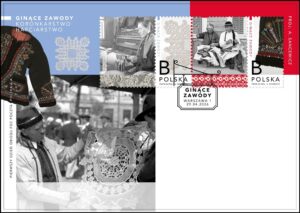
Data emisji: 29-04-2026 … W świecie, który zmienia się szybciej niż kiedykolwiek, dawne rzemiosła stają się bezcennymi świadectwami historii, umiejętności i codziennego życia minionych pokoleń. Zawody, które jeszcze niedawno były naturalnym elementem krajobrazu wsi i miasteczek, dziś stopniowo zanikają, ustępując miejsca produkcji masowej i nowym technologiom. Emisja filatelistyczna „Ginące zawody” przypomina o tych profesjach, których fundamentem była ręczna praca, czasochłonny proces tworzenia oraz przekazywana z pokolenia na pokolenie wiedza. Każde z przedstawionych rzemiosł to nie tylko technika, ale także opowieść o relacji człowieka z naturą 🌾, o cierpliwości, precyzji i szacunku dla materiału.
Zachowanie pamięci o tych zawodach jest ważnym elementem ochrony niematerialnego dziedzictwa kulturowego. Choć wiele z nich odchodzi wraz ze zmieniającym się rytmem współczesności, wciąż żyją w muzeach, archiwach oraz w rękach pasjonatów, którzy dbają o ciągłość tradycji. Kompozycja arkusika harmonijnie łączy czarno‑białą fotografię dokumentalną z barwnymi zbliżeniami efektów pracy rzemieślników, tworząc wizualną opowieść o procesie twórczym – od materiału po gotowy przedmiot. Emisja przedstawia cztery tradycyjne rzemiosła, ukazane poprzez archiwalne i współczesne materiały fotograficzne, uzupełnione detalami gotowych wyrobów i charakterystycznych narzędzi pracy. Każdy zawód wyróżniono osobnym polem kolorystycznym i podpisem: ***Hafciarstwo; ***Druciarstwo; ***Plecionkarstwo; ***Koronkarstwo.
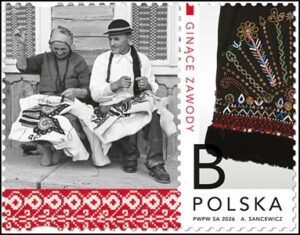
Hafciarstwo – piękno zapisane nicią … Jedna z najstarszych form zdobienia tkanin, znana już w starożytnych cywilizacjach Egiptu i Chin. Polega na wyszywaniu wzorów na materiale za pomocą igły i nici. Do najbardziej rozpowszechnionych technik należą haft krzyżykowy, płaski, richelieu i koralikowy. W Polsce szczególną sławą cieszą się hafty z Podhala, Kaszub i Kurpi, rozpoznawalne dzięki regionalnym barwom i motywom.
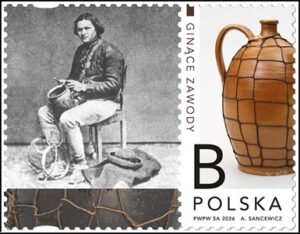
Druciarstwo – mistrzostwo naprawy … Rzemiosło wywodzące się z Europy Środkowej, zwłaszcza ze Słowacji. Początkowo służyło do naprawy naczyń codziennego użytku, z czasem przekształcając się w wyspecjalizowaną sztukę użytkową. Techniki obejmują owijanie, skręcanie i splatanie drutu. W Polsce tradycje druciarstwa związane są głównie z regionami karpackimi, w tym Podkarpaciem i okolicami Tatr.
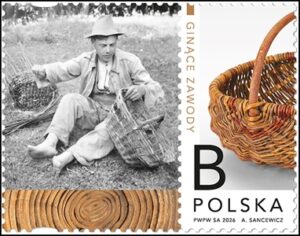
Plecionkarstwo – siła natury w ludzkich dłoniach … Jedno z najstarszych rzemiosł, znane już w czasach prehistorycznych. Wykorzystuje naturalne materiały – wiklinę, słomę, trzcinę – do wyplatania koszy, mat i pojemników. Stosowane są m.in. sploty krzyżowe, spiralne i żeberkowe. Za główny ośrodek plecionkarstwa w Polsce uchodzi Rudnik nad Sanem, a także regiony Mazowsza i Wielkopolski.
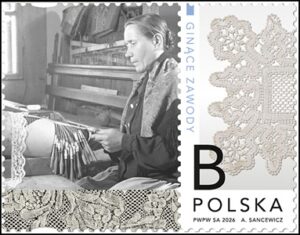
Koronkarstwo – delikatność zaklęta w nici … Sztuka tworzenia ażurowych wzorów z nici, rozwinięta w Europie w XVI wieku, zwłaszcza w Belgii i Francji. Wymaga ogromnej precyzji i cierpliwości. Najważniejsze techniki to koronka klockowa i igłowa. W Polsce szczególne znaczenie mają ośrodki w Koniakowie (koronka szydełkowa) oraz Bobowej (tradycyjna koronka klockowa).
Materiały wykorzystane w emisji „Ginące zawody” pochodzą ze zbiorów: Muzeum Historycznego w Bielsku‑Białej, Muzeum Etnograficznego w Krakowie, Muzeów Narodowych w Krakowie, Szczecinie i Warszawie, Narodowego Archiwum Cyfrowego, PAP S.A., FORUM Polskiej Agencji Fotografów oraz firmy Polskie Plecionkarstwo. Oznaczenie literowe B odpowiada wartości nominalnej znaczka używanego do uiszczenia opłaty za priorytetową przesyłkę listową nierejestrowaną w obrocie krajowym w formacie S.
Disappearing professions
www.poczta-polska.pl
29-04-2026 … Denomination: stamps without face value … Author of the stamp design:Agnieszka Sancewicz; Number of stamps in issue: 4; Stamp size: 51 mm x 39.5 mm; Paper: Fluorescent; Printing techniques: Offset; Number of stamps in sheet: 8 (2×4); Print run: 84 000 pcs; FDC size: 162 mm x 113 mm.
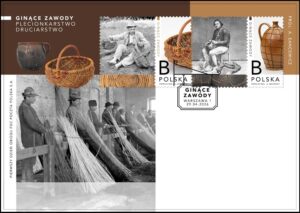
Issue date: 29-04-2026 … In a world that is changing faster than ever, traditional crafts are becoming invaluable testimonies of history, skills, and the everyday life of past generations. Professions that only recently were an integral part of villages and small towns are gradually disappearing, replaced by mass production and modern technologies. The philatelic issue “Vanishing Professions” recalls trades whose foundation was manual labor, time‑consuming craftsmanship, and knowledge passed down from generation to generation. Each profession represents not only a technique, but also a story about life, the relationship between humans and nature 🌾, patience, precision and respect for the work of human hands.
Preserving the memory of these occupations is a vital element of protecting intangible cultural heritage. Although many of them are fading away with the pace of modern life, they still survive in museums, archives, and in the hands of passionate practitioners who cultivate traditional skills. The issue presents four traditional crafts illustrated through archival and contemporary photographic materials, supplemented with details of finished products and characteristic tools of the trade. Each profession is distinguished by a separate color field and title: ***Embroidery; ***Wire Craft; ***Basketry (Wickerwork); ***Lace‑making. The layout harmoniously combines black‑and‑white documentary photography with colorful close‑ups of handcrafted items, forming a visual narrative of the creative process — from raw material to finished object.
Embroidery – beauty stitched into thread … One of the oldest forms of textile decoration, known since ancient civilizations such as Egypt and China. It involves decorating fabric using needle and thread. Common techniques include cross‑stitch, flat stitch, Richelieu, and bead embroidery. In Poland, important embroidery centers include Podhale, Kashubia and Kurpie, known for their distinctive regional patterns.
Wire Craft – mastery of repair … Originating in Central Europe, particularly Slovakia, where it developed in the 18th century. Initially used for repairing household vessels, it later evolved into a form of applied art. Techniques include wrapping, twisting and weaving wire. In Poland, wire craft traditions are mainly associated with the Carpathian regions, including Podkarpacie and the Tatra area.
Basketry – the strength of nature in human hands … A craft with prehistoric origins, using natural materials such as willow, straw and reed to make baskets, mats and containers. Techniques include cross weaving, spiral and rib weaving. Well‑known basketry centers in Poland include Rudnik nad Sanem (the “capital of Polish wickerwork”), as well as Mazovia and Greater Poland.
Lace‑making – delicacy woven into thread … Developed in Europe in the 16th century, especially in Belgium and France. It involves creating openwork patterns by hand using thread. The main techniques are bobbin lace and needle lace, requiring exceptional precision and patience. In Poland, notable centers include Koniaków (crocheted lace) and Bobowa (traditional bobbin lace).
The graphic materials used in the philatelic issue “Vanishing Professions” and its accompanying materials come from the collections of: The Historical Museum in Bielsko‑Biała, the Ethnographic Museum in Kraków, the National Museums in Kraków, Szczecin and Warsaw, the National Digital Archives, PAP S.A., FORUM Polish Photographers’ Agency, and the company Polskie Plecionkarstwo.
W Polskę wierzę –
Polska wspólnotanarodowa
www.nbp.pl
Narodowy Bank Polski jest centralnym bankiem państwa odpowiadającym za politykę pieniężną i stabilność cen. Jego funkcje określa Konstytucja Rzeczypospolitej Polskiej i ustawa o NBP. NBP ma wyłączne prawo emisji pieniądza. Jako bank centralny nie prowadzi rachunków bankowych obywateli, nie przyjmuje od nich lokat, nie udziela kredytów. Prowadzi natomiast obsługę budżetu państwa, a także podmiotów sektora finansów publicznych. Gromadzi rezerwy walutowe państwa i zarządza nimi. Pełni funkcję banku banków, tworząc warunki do działania systemu bankowego. Jest również jednym z najważniejszych ośrodków naukowo-analitycznych w dziedzinie ekonomii i rynków finansowych.
Emisja wartości kolekcjonerskich stanowi okazję do upamiętniania ważnych historycznych rocznic i postaci oraz do rozwijania zainteresowań polską kulturą, nauką i tradycją. 13 maja 2026 roku Narodowy Bank Polski wprowadził do obiegu srebrną monetę kolekcjonerską o nominale 10 zł z serii „W Polskę wierzę” – „Polska wspólnota narodowa”.
Nominał 10 zł metal: Ag 925/1000; stempel: lustrzany, druk UV; średnica: 32,00 mm; masa: 14,14 g; brzeg (bok): gładki ; nakład: do 8000 szt.; Projekt: Grzegorz Pfeifer; Emitent: NBP; Na zlecenie NBP monety wyprodukowała Mennica Polska SA
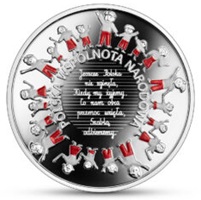
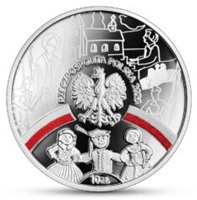
Na rewersie monety centralnie umieszczono pierwsze wersy polskiego hymnu oraz półkoliście napis „Polska wspólnota narodowa”. Wokół zaprezentowano stylizowane na dziecięcy rysunek postaci dziewcząt i chłopców ubranych w stroje o barwach narodowych. Na awersie umieszczono postaci w stylizowanych polskich strojach ludowych, wstęgę o biało-czerwonych barwach, a także symbole narodowe, religijne i kulturowe, przedstawione w stylistyce rysunku.
Polacy tworzyli i tworzą autentyczną wspólnotę narodową, której początki, jako wspólnoty etnicznej, sięgają końca pierwszego tysiąclecia po narodzeniu Chrystusa. Łączą nas język i terytorium, wspólne dzieje, które określają naszą tożsamość, a przede wszystkim łączy nas kultura. Jesteśmy narodem historycznym, co oznacza m.in., że przyjmujemy teraźniejszość jako wynik dziedziczenia dorobku naszych przodków. W polskiej pamięci dominowała jeszcze do niedawna trauma wielu pokoleń. Nie zapominając o martyrologii Polaków – ciężarze zaborów, o rusyfikacji i germanizacji, o przegranych powstaniach, o dwóch XX-wiecznych totalitaryzmach, które przyniosły niewyobrażalne zbrodnie i wypędzenia, męczeństwo mieszkańców naszego kraju – dziś wiemy także, że ze swoich dziejów możemy być dumni i dzięki nim współcześnie żyć szczęśliwie.
Odnosiliśmy niezwykłe zwycięstwa, ratujące także Stary Kontynent – jak w bitwie pod Wiedniem w 1683 r. czy w Bitwie Warszawskiej w 1920 r. Staliśmy się także, dzięki NSZZ „Solidarność”, inspiracją dla narodów Europy Środkowo-Wschodniej do walki o uwolnienie się spod jarzma komunizmu. Łączą nas symbole narodowe, flaga biało-czerwona i orzeł biały w koronie, ale także symbole religijne, bez których nie wyobrażamy sobie polskości, jak przede wszystkim cudowny obraz Matki Bożej Jasnogórskiej obecny w duchowej stolicy Polski – Częstochowie. Ponadto wspólnie cenimy symbole związane z polskim krajobrazem, jak bocian biały, żubr czy wierzba płacząca. Naród polski jest żywą wspólnotą. Do naszych cech należą – doceniane na świecie – polska gościnność i przywiązanie do wartości rodzinnych. Jednocześnie umiemy się adaptować do warunków dziejowych, które nauczyły nas wytrwałości, nieulegania rozpaczy i pielęgnowania polskości, mimo rozproszenia rodaków po wszystkich kontynentach.
Za sprawą naszej burzliwej historii i decyzji wielu Polaków o opuszczeniu polskich ziem zniewolonych przez zaborców i okupantów, staliśmy się współtwórcami historii wielu narodów, nie tylko europejskich. Maria Skłodowska-Curie, Ignacy Domeyko czy Fryderyk Chopin to tylko niektóre nazwiska wybitnych Polaków, których działalność na emigracji rozsławiała polskie osiągnięcia, kulturę i wartości, przez co stała się częścią światowego dziedzictwa. Tak długo jak będziemy zdolni pielęgnować w naszej świadomości dzieje ojczyste i będziemy chcieli dbać o własne dziedzictwo, tak długo będziemy trwać we wspólnocie narodowych wartości i dawać innym powody, by szanowali naszą oryginalność, kulturę, a przez to każdą Polkę i każdego Polaka. Informacja: Jan Żaryn.

In Poland I Believe –
The Polish National Community
www.nbp.pl
Narodowy Bank Polski is the central bank of the State, responsible for its monetary policy and price stability. The Bank’s functions are described in the Constitution of the Republic of Poland and the Act on NBP. NBP holds the exclusive right to issue the currency of the Republic of Poland. As the central bank, it does not provide accounts for the general public, accept deposits from or extend loans to individuals. It acts as a banker to the State budget and public sector entities. NBP also holds and manages the foreign exchange reserves of the State. Finally, it functions as a banker to banks, creating conditions for the operation of the Polish banking system. Narodowy Bank Polski is one of the most important research and analytical centres in the fields of economics and financial markets.
Issuing collector items is an occasion to commemorate important historic figures and anniversaries, as well as to develop the interest of the public in Polish culture, science and tradition. On 13 May 2026, Narodowy Bank Polski issued into circulation a silver collector coin of the series “In Poland I Believe” – “Polish National Community”, with a face value of 10 złoty.
Face value: 10 zł … Metal: Ag 925/1000; Finish: proof, UV print; Diameter: 32.00 mm; Weight: 14.14 g; Edge (side): plain; Mintage: up to 8,000 pcs; Design: Grzegorz Pfeifer; Issuer: Narodowy Bank Polski ;The coins, commissioned by Narodowy Bank Polski, were struck by Mennica Polska SA
The reverse of the coin features, in the centre, the opening lines of the Polish national anthem and the semi-circular inscription “Polska wspólnota narodowa” (Polish national community). Around them, figures of girls and boys dressed in Polish national colours are presented in the style of a child’s drawing. The obverse features figures in stylised Polish folk outfits, a ribbon in white and red colours, as well as national, religious and cultural symbols presented in a drawing’s style.
The Poles have always been an authentic national community tracing its origins as an ethnic community as far back as the late first millennium AD. What connects us is the language and territory as well as our shared history defining our identity, but first and foremost our culture. We are a historic nation, which means, among other things, that we see our present situation as shaped by the legacy of our ancestors. Polish memory was until recently dominated by multi-generational trauma. While we keep alive the memory of the suffering of the Poles – the burden of the Partitions, Russification, Germanisation, the lost uprisings, the two great totalitarian regimes of the 20th century, all of which brought unimaginable crimes, displacements and martyrdom of the people living in our country – we have also learned to be proud of our history and to use it as a foundation for living happy lives. Poland has won great victories, some of which saved the European continent – such as the victories in the Battle of Vienna of 1683 or the Battle of Warsaw in 1920.
The Solidarity movement inspired the Central and Eastern European nations to fight for their freedom and throw off the shackles of communism. We are united around the national symbols of the white and red flag and the white crowned eagle, but also by the religious symbols so indispensable to the Polish identity, such as the image of Our Lady of Częstochowa – the spiritual capital of the country. We also cherish natural icons of the Polish landscape such as the white stork, the European bison or the weeping willow. The Polish nation is a living community. We are recognised worldwide for our hospitality and high regard for family values. At the same time, we adapt well to historic changes, which have taught us perseverance, fortitude and to nurture the Polish identity even when our countrymen spread over all the continents.
Due to our tumultuous history and many Poles deciding to leave the country under the Partitions and occupation (during World War II), we came to contribute to the history of many other nations in Europe and the world. Maria Skłodowska-Curie, Ignacy Domeyko and Fryderyk Chopin are only some of the prominent Poles whose work while in exile promoted Polish achievements, culture and values, thus becoming part of the world heritage. As long as we are able to nurture the awareness of our history and legacy, we will continue to form a community founded on national values and to give other nations reasons to respect Polish uniqueness and culture, and thus to respect every individual Pole. Info: Jan Żaryn.
Canada Post Community Foundation (2026):
Booklet of 10 Permanent™ stamps + $1 donation
www.canadapost.ca
Take home this booklet of 10 Permanent™ domestic rate stamps from our 2026 Canada Post Community Foundation stamp issue to help organizations that support Canadian children and youth. The Canada Post Community Foundation’s annual semi-postal fundraising stamp allows customers to cultivate caring communities by supporting programs that benefit children and youth. By ensuring they have access to education, encouragement and positive role models, we can help them develop and reach their full potential.

About the Canada Post Community Foundation … The Canada Post Community Foundation’s mission is to improve the lives of children and youth in the communities we serve. The Foundation provides funding to local and national non-profit groups that serve the needs of children and youth to help them write the next chapter of their lives. Its grassroots, community-based approach makes a real difference across the country by supporting the small, underfunded projects that often go unnoticed. Since 2012, the Foundation has supported more than 1,400 community organizations that bring positive change to Canadian children.

About the design … The stamp, OFDC and postcard are the work of designer Adrian Horvath and illustrator Amélie Martel. This stamp depicts a lively community garden scene where children come together to grow fruits and vegetables. The imagery reminds us that, if provided with the right conditions and care, plants and youth will flourish and grow – from the ground up. The stamp illustration is continued from the front to the back of the stamp booklet. Stamp Designer: Adrian Horvath; Stamp Illustrator: Amélie Martel; Quantity Produced: 200,000; Issue Date: May 4, 2026.
FIFA World Cup 2026ᵀᴹ: The Winning Goal
– $20 Fine Silver Coin
www.mint.ca
FIFA World Cup 2026TM/MC: Feel the rush of victory. There’s no other feeling like it—a winning goal at the FIFA World CupTM/MC sends waves of euphoria through the stadium and beyond, uniting fans everywhere in celebration. In 2026, Canada welcomes the world’s biggest sporting stage, and with it, the chance to be part of something unforgettable. This 1 oz. 99.99% pure silver coin captures not only the thrill of the game but also Canada’s pride in co-hosting a tournament that transcends sport, bringing people together and making every fan feel part of the story. A goal for the ages, yours to keep.
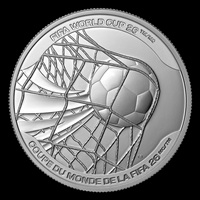
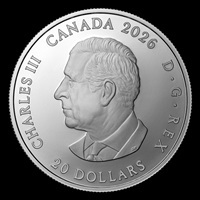
Face Value: $20 … Composition: 99.999% pure silver; Mintage: 11,000; Weight: 31.39 g; Diameter: 38 mm; Edge: Serrated; Finish: Proof; Artist: Tony Bianco (reverse), Steven Rosati (obverse); Packaging: Graphic paperboard box with official FIFA authenticity sticker.
DID YOU KNOW? … Blink and you’ll miss it—the fastest goal in FIFA World CupTM/MC history came just 11 seconds into a 2002 match.
The reverse design by Canadian artist Tony Bianco commemorates FIFA World Cup 2026TM/MC through its striking image of a football (soccer ball) soaring into the net, with wind lines emphasizing motion and energy—a tribute to the speed, power, and passion of the world’s game. The official event designation in English and French is located at the top and bottom of the coin, respectively. The obverse features the effigy of His Majesty King Charles III by Canadian artist Steven Rosati.
FIFA World Cup 2026ᵀᴹ: The Trophy
– $50 Fine Silver Coin
www.mint.ca
FIFA World Cup 2026TM/MC: Where legends are made. The sport, the spirit of FIFA World Cup 2026TM/MC, the players’ skill, and the iconic FIFA World Cup 2026TM/MC Trophy—all are celebrated on this 5 oz. coin, where a football (soccer ball) engraved in Ultra High Relief (UHR) becomes a canvas for the tournament’s story. Struck incuse at the centre, the official emblem marks the global stage, while three action-filled player panels capture the passion and plays that make every match unforgettable. Encircled by a genuine malachite ring inspired by the trophy’s base, the design links the energy of the game to its ultimate prize, making it a stunning symbol of the tournament’s spirit and prestige. Celebrating FIFA World Cup 2026TM/MC with a Mint first: malachite.

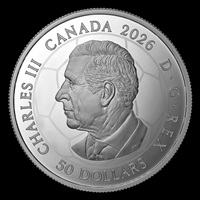
Face Value: $50 … Composition: 99.999% pure silver with Ultra High Relief and genuine malachite; Mintage: 1,500; Weight: 157.6 g; Diameter: 65.25 mm; Edge: Serrated; Finish: Proof; Artist: Glen Green (reverse), Steven Rosati (obverse); Packaging: Black clamshell and premium FIFA graphic box with official FIFA authenticity sticker.
DID YOU KNOW? … Weighing 6.175 kilograms and made of 18-karat gold, the FIFA World CupTM/MC Trophy is exclusively awarded to the winning team for a brief post-match celebration. The rest of the time, the most sought-after treasure in all of sport remains with FIFA.
The reverse design by Canadian artist Glen Green features a football (soccer ball) rendered in Ultra High Relief (UHR), with the official FIFA World Cup 2026TM/MC logo struck incuse at the centre and surrounded by three action-filled player panels. The ball is framed by a ring of green malachite—a nod to the two malachite bands at the base of the most sought-after treasure in all of sport, the FIFA World CupTM/MC Trophy. The obverse features a soccer ball pattern behind the effigy of His Majesty King Charles III by Canadian artist Steven Rosati.
FIFA World Cup 2026ᵀᴹ: We All Play Together
– $200 Pure Gold Coin
www.mint.ca
FIFA World Cup 2026TM/MC: A game that unites us all. This 1 oz. 99.99% pure gold coin celebrates the three host countries of Canada, Mexico and the United States coming together for the first ever three country FIFA World CupTM/MC. On the coin’s reverse, a map of North America is overlaid with a classic football (soccer ball) pattern, taking on the appearance of a globe and welcoming the world to the tournament, while three players are depicted in dynamic motion, representing the passion that connects fans and players on the pitch, in the stands, and around the world. Bound by the beautiful game.
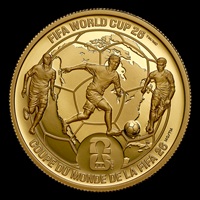
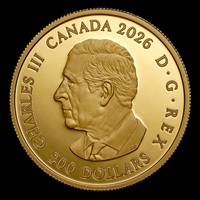
Face Value: $200 … Composition: 99.999% pure gold; Mintage: 500; Weight: 31.16 g; Diameter: 30 mm; Edge: Serrated; Finish: Proof; Artist: Tony Bianco (reverse), Steven Rosati (obverse); Packaging: Black clamshell and premium FIFA graphic box with official FIFA authenticity sticker.
DID YOU KNOW? … FIFA World Cup 2026TM/MC is the first to feature three host countries—Canada, Mexico and the United States—and the largest in FIFA history, with 48 teams taking part in the tournament running from June 11 to July 19, 2026.
The reverse design by Canadian artist Tony Bianco features a map of North America overlaid with a football (soccer ball) pattern, to symbolize Canada, Mexico and the United States as co-hosts of FIFA World Cup 2026TM/MC. Three players depicted in high-energy poses capture the athleticism, energy and spirit of the beautiful game. The official event designation in English appears at the top while the French version appears at the bottom, along with the official emblem. The obverse features the effigy of His Majesty King Charles III by Canadian artist Steven Rosati.
FIFA World Cup 2026ᵀᴹ : We Are 26ᵀᴹ
– $20 Fine Silver Coin
www.mint.ca
FIFA World Cup 2026TM/MC: Catch the wave of excitement. For the first time ever, the FIFA World CupTM/MC spans three countries—Canada, Mexico, and the United States—bringing the world’s biggest sporting event to a new, unprecedented stage. The only coloured collector piece with colour in our FIFA World Cup 2026TM/MC collection, this 1 oz. 99.99% pure silver coin features a design inspired by the official emblem. A mark of energy, pride and unforgettable moments, the iconic trophy is set against a vibrant background, where the boldly coloured hosting year (“26”) captures a moment the world will remember. The world’s trophy. Canada’s stage.
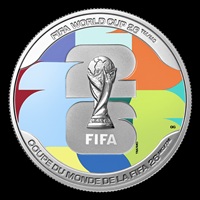
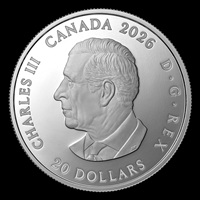
Face Value: $20 … Composition: 99.999% pure silver with selective colour; Mintage: 11,000; Weight: 31.39 g; Diameter: 38 mm; Edge: Serrated; Finish: Proof; Artist: Glen Green (reverse), Steven Rosati (obverse); Packaging: Graphic paperboard box with official FIFA authenticity sticker.
DID YOU KNOW?… A record 48 teams are taking part in FIFA World Cup 2026TM/MC, which kicks off at historic Estadio Azteca Mexico City on June 11, 2026. Canada will host 13 of the 104 matches, with Toronto and Vancouver among the tournament’s 16 North American host cities.
Designed by Canadian artist Glen Green, your coin’s reverse features the official FIFA World Cup 2026TM/MC emblem at the centre, with the FIFA World CupTM/MC Trophy placed within the vertically stacked hosting year (“26”). The bold “2” and “6” shapes from the official emblem scatter across the background, their vibrant colours creating a dynamic, celebratory backdrop. The official event designation in English and French is located at the top and bottom of the coin, respectively. The obverse features the effigy of His Majesty King Charles III by Canadian artist Steven Rosati.
100th Anniversary of the Birth of Queen Elizabeth II
– Fine Silver Two-Coin Set
www.mint.ca
Honouring a life and legacy that spanned nations and generations. In honour of the 100th anniversary of the birth of Queen Elizabeth II, the Royal Canadian Mint and The Royal Mint proudly present this two-coin set that reflects the late sovereign’s legacy across two nations bound by history. Issued in collaboration, these commemorative coins offer a shared tribute to a monarch whose long reign shaped the modern identity of both countries; as Queen of the United Kingdom and of Canada, and as Head of the Commonwealth, Queen Elizabeth II served as a symbol of unity and devotion—a steady figure across generations and oceans, and a global figure of continuity and grace. Two realms, two coins—one shared sovereign. Mintage: 5,000. Packaging: Custom black clamshell with black beauty box.
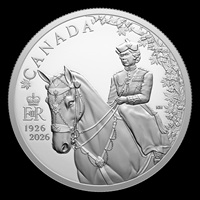
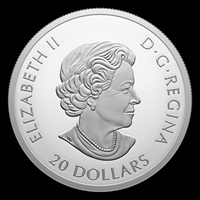
2026 … $20 Fine Silver Coin – 100th Anniversary of the Birth of Queen Elizabeth II … Composition: 99.99% pure silver; Weight: 31.39 g; Diameter: 38 mm; Edge: Serrated; Face Value: $20 CAD; Finish: Proof; Artist: Neil Hamelin (reverse), Susanna Blunt (obverse); Country of issue; Canada.
2026 … $20 Fine Silver Coin – 100th Anniversary of the Birth of Queen Elizabeth II … The reverse design by Canadian artist Neil Hamelin features a portrait of Queen Elizabeth II riding her horse Burmese during a Trooping the Colour ceremony, along with a wreath composed of maple leaves and her favourite flower, the lily-of-the-valley. Beside Queen Elizabeth II’s Royal Cypher, the double dates “1926 2026” commemorate the 100th anniversary of the late monarch’s birth and features her Royal Cypher. The obverse features the effigy of Queen Elizabeth II by Susanna Blunt.
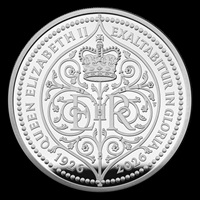
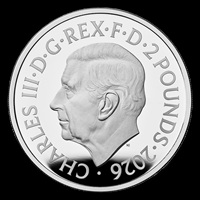
2026 UK … £2 Silver Proof Coin – 100th Anniversary of the Birth of Queen Elizabeth II … Composition: 99.9% silver; Weight: 31.21 g; Diameter: 38.61 mm; Edge: Milled; Face Value: £2 GBP; Finish: Proof; Artist: Timothy Noad (reverse), Martin Jennings (obverse); Country of issue: United Kingdom.
2026 UK … £2 coin Silver Proof Coin – 100th Anniversary of the Birth of Queen Elizabeth II … The reverse design by Timothy Noad MBE features Queen Elizabeth II’s Royal Cypher, with foliage inspired by ironwork at St George’s Chapel, the resting place of the late queen. The obverse features the portrait of His Majesty King Charles III by Martin Jennings.
DID YOU KNOW? … Depicted on the $20 coin, Burmese was the first of eight horses presented to Queen Elizabeth II as a gift from the Royal Canadian Mounted Police. The former Musical Ride horse quickly became one of Queen Elizabeth II’s favourite horses, and carried her in the annual Trooping the Colour from 1969 until 1986, which marked Burmese’s last public appearance. The beloved black mare died in 1990.
Special roll of uncolored $2 coins 2026
– 50th anniversary of the CN Tower
www.mint.ca
The CN Tower is celebrating its 50th anniversary. From the moment it opened its doors to the public on June 26, 1976, the CN Tower became an emblem of Toronto and Canada, and a symbol of the convergence of imagination and innovation. The 2026 $2 commemorative circulation coin marks the 50th anniversary of the official opening of Canada’s tallest freestanding structure. Each special roll of uncoloured coins contains 25 pieces whose design illustrates the evolution of Toronto’s skyline, where the CN Tower stands as a testament to Canadian optimism and ingenuity. Celebrating an impressive achievement: the CN Tower.
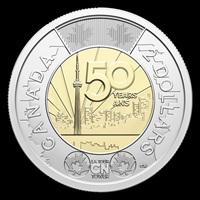
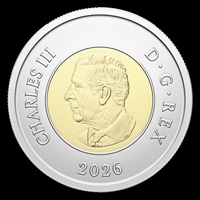
Face Value: $2 … Composition: Outer ring: triple plating on steel, nickel finish; central disc: triple plating on aluminum bronze, brass finish; Print run:: 15000; Weight: 6.99 g; Diameter: 28 mm; Edge: Slice alternating smooth and serrated sections; Finish: Finished traffic; Artist: Carl Wiens (reverse), Steven Rosati (obverse).
DID YOU KNOW? … In early 1974, despite construction not yet being complete, the CN Tower was already the tallest freestanding structure in Canada and on its way to becoming the tallest freestanding structure in the world. Today, its observation deck is the highest in the Western Hemisphere, rising to 447 metres (1,465 feet).
The reverse design, by Canadian illustrator Carl Wiens, celebrates the 50th anniversary of the CN Tower’s opening on June 26, 1976, with the inscriptions “50 YEARS” and “THE CN TOWER.” The central disc features a view of the CN Tower overlooking Lake Ontario and dominating the Toronto skyline today, its high-rise buildings rising above the city’s 1976 skyline. On the outer ring, silhouettes of buildings illustrate five decades of growth and architectural evolution: the 1976 skyline on the left and the 2026 cityscape on the right. Together, they form an illustrated record of Toronto’s transformation into a world-renowned modern city. The obverse features the effigy of His Majesty King Charles III, by Canadian artist Steven Rosati.
Carl Wiens, artist … “The CN Tower is the jewel of Toronto’s skyline. My intention was to create a visual tribute that showed the CN Tower at the heart of a city that is growing and evolving. Closer to the base, you can see the 1976 skyline in dark tones, while today’s skyline rises above in gray. I loved working with photoluminescent ink for this design. Like a beacon in the night, the CN Tower illuminates the sky with different colors. I added shades of blue to the design—a nod to Toronto’s teams (the Leafs, the Jays, and the Argos) and the passion of their fans.”

Special roll of coloured $2 coins 2026
– 50th anniversary of the CN Tower
www.mint.ca
The horizon and hearts are shining: the CN Tower is celebrating its 50th anniversary. The 2026 $2 commemorative circulation coin marks the 50th anniversary of Canada’s tallest freestanding structure. It is the second Canadian circulation coin to feature photoluminescence technology. The special coloured roll contains 25 collectible coins enhanced with photoluminescence technology, each featuring a stunning design that offers a view of Toronto’s skyline from its past to the present, illuminated at night – always dominated by the tower. A photoluminescent celebration of the CN Tower.
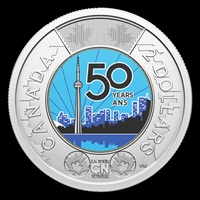
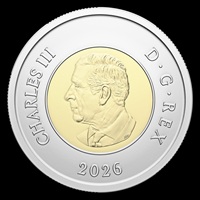
Face Value: $2 … Composition: Outer ring: triple plating on steel, nickel finish; central disc: triple plating on aluminum bronze, brass finish with selective coloring and photoluminescence technology; Print run:: 25,000; Weight: 6.99 g; Diameter: 28 mm; Edge: Slice alternating smooth and serrated sections; Finish: Finished traffic; Artist: Carl Wiens (reverse), Steven Rosati (obverse).
DID YOU KNOW? … Rising to 553.33 meters (1,815 feet 5 inches), the CN Tower held the title of the world’s tallest freestanding structure from 1975 to 2007. It remains the tallest freestanding structure in the Western Hemisphere today.
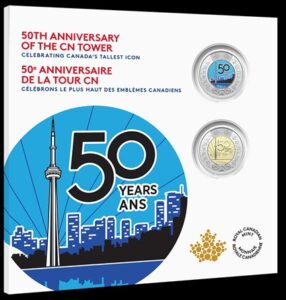
The reverse design, by Canadian illustrator Carl Wiens, celebrates the 50th anniversary of the CN Tower’s opening on June 26, 1976, with the inscriptions “50 YEARS” and “THE CN TOWER.” The central disc features a view of the CN Tower overlooking Lake Ontario and dominating the Toronto skyline today, with its high-rise buildings rising above the city’s skyline as it was in 1976. Thanks to photoluminescence technology on the coloured coin , the CN Tower and the skyline glow at night, reflecting the city’s dynamism. On the outer ring, silhouettes of buildings illustrate five decades of growth and architectural evolution: the 1976 skyline on the left and the 2026 cityscape on the right. They form an illustrated record of Toronto’s transformation into a modern, world-renowned city. The obverse features the effigy of His Majesty King Charles III, according to Canadian artist Steven Rosati.
Carl Wiens, artist … “The CN Tower is the jewel of Toronto’s skyline. My intention was to create a visual tribute that showed the CN Tower at the heart of a city that is growing and evolving. Closer to the base, you can see the 1976 skyline in dark tones, while today’s skyline rises above in gray. I loved working with photoluminescent ink for this design. Like a beacon in the night, the CN Tower illuminates the sky with different colors. I added shades of blue to the design—a nod to Toronto’s teams (the Leafs, the Jays, and the Argos) and the passion of their fans.”
The Engineer’s Commitment
– Fine Silver Coin
www.mint.ca
Inspired by the famous iron ring that honors the past and celebrates a promise. Upon receiving their iron ring, Canada’s engineering graduates enter a tradition of integrity, innovation, and responsibility. This centuries-old symbol of professional obligation inspired our own engineering marvel in 2025: a coin whose edge and cord echoed its shape. Returning in 2026, the coin that honours the engineering profession becomes a keepsake to mark this momentous occasion in a new graduate’s life, a salute to their calling and the promise of a bright future to build. Where the dedication of engineers meets tradition.
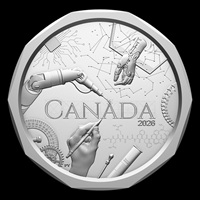
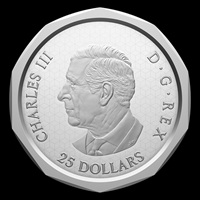
Face Value: $25 … Composition: 99.99% pure silver; Print run:: 5,000; Weight: 32.75 g; Diameter: 34.5 mm; Edge: Slice multifaceted slice; Finish: Finished numismatic proof; Artist: Pandora Young (reverse), Steven Rosati (obverse); Packaging black double-shell case with matching black protective box.
DID YOU KNOW? … ***The first engineering school in Canada opened in 1854 at King’s College, now known as the University of New Brunswick (UNB). At the time, engineering was taught in only a handful of institutions, and was limited to basic disciplines such as civil and mechanical engineering. ***By 2026, more than 40 post-secondary institutions now offer recognized engineering programs in artificial intelligence, sustainable design, biomedical innovation, and a host of other fields. This is thanks to 170 years of Canadian progress in infrastructure, technology, and global engineering leadership.
A tribute to the engineering profession in Canada, the reverse design by artist Pandora Young celebrates innovation and achievement in the diverse field of engineering, represented (clockwise from top) by: a computer screen and robotic hand against a dotted background inspired by AI; a wire gauge; part of the chemical structure of insulin; a test tube and pipette; a hand holding a pencil; a cylindrical wheel next to a compass and protractor; a soldering iron; and a microchip. At the center, the word “CANADA” is inscribed in lettering reminiscent of that used on a blueprint. The raised cord has a unique shape evoking the iron ring worn by members of the profession as a symbol of their professional commitment. The obverse features the effigy of His Majesty King Charles III, according to Canadian artist Steven Rosati.
50th Anniversary of the CN Tower
– $20 Fine Silver Coin
www.mint.ca
Canadian pride at its peak: celebrate 50 years of the CN Tower. By day, its silhouette inspires; by night, it illuminates the heart of Toronto. Celebrate 50 years since the CN Tower’s official opening and admire the duality of its beauty with this fine silver coin featuring alternating bird’s-eye views and images of the tower illuminated under black light! The reverse design, the result of 50 years of innovation and engineering excellence, invites you to discover the city through the eyes of those who have gazed upon it from the Tower’s main observation level, the most visited viewing platform, rising 346 meters high. Under black light (included), the image reveals another perspective, familiar to anyone who has witnessed the spectacle: the radiant and colourful CN Tower, painting Toronto’s night sky in the colours of the Canadian spirit. Admire the view and the lights.
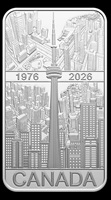
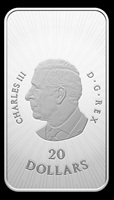
Face Value: $20 … Composition: 99.99% pure silver; Print run:: 7,500; Weight: 31.56 g; Dimensions: 49.8 mm x 28.6 mm; Edge: Slicesmooth; Finish: Finished numismatic proof; Artist: Steve Hepburn (reverse), Steven Rosati (obverse); Packaging black double-shell case with matching black protective box.
DID YOU KNOW? … Completed in 1975 and opened to the public in 1976, the CN Tower rises 553.33 metres above the Toronto skyline, a remarkable feat of engineering that held the title of the tallest freestanding structure on Earth for over three decades. In 2007, the tower’s allure was amplified tenfold with the addition of an advanced LED lighting system capable of producing more than 16 million colours. Seamlessly integrated into the tower’s design, these lights transform an iconic landmark into a vibrant symbol each night, illuminating it with symbolic colours to celebrate Canadian culture, charitable causes, and moments of national pride.
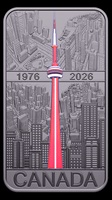
The reverse design, by Canadian artist Steve Hepburn, features the CN Tower at its center, framed in the foreground by surrounding architecture and overlaid with a stylized collage in the background composed of various sketches of the city as seen from the tower’s observation deck. The years “1976” and “2026” mark the 50th anniversary of its opening to the public. Under black light, the CN Tower illuminates in the national colours—red and white—standing as a proud emblem of Toronto, a testament to Canadian ingenuity, and a beacon of national pride. The obverse, adorned with a recurring striped pattern forming a circle and echoing the height of the CN Tower and Toronto’s dynamic skyline, bears the effigy of His Majesty King Charles III, according to Canadian artist Steven Rosati.
Steve Hepburn, artist … “At over 346 meters high, the view is breathtaking. Each of the four sketches offers a different perspective from the CN Tower’s observation deck. The features of each are designed to draw the eye towards the CN Tower, at the center, which rises to the full height of this uniquely shaped room.”
Alicia Cook Sapene, product manager … “It was a true privilege to help bring this vision to life. It is an honour to celebrate the 50th anniversary of the opening of one of Canada’s most recognizable landmarks, the CN Tower, with a coin that showcases this engineering marvel with its iconic presence on the Toronto skyline. More than a collector’s item, this coin is a timeless tribute to a building that continues to amaze, day and night.”
Samantha Strath, 3D artist and engraver … “This piece wasn’t easy to engrave! The corners of the rectangular pieces require a low relief, given the way the metal flows during striking. The urban scene motif is full of overlapping buildings. Since I didn’t have enough depth to sculpt them realistically, I created angled planes in a sort of puzzle, which gives the illusion of dimension. It was also interesting to combine the artist’s intention to create a sketch with the clean, precise lines of the sculpted architecture. I enjoyed the challenge this piece presented, and I was eager to see the result!”