
HAPPY EASTER !
WESOŁYCH ŚWIĄT WIELKANOCNYCH !
JOYEUSES PÂQUES !
FELICES PASCUAS !

TROYAK EXECUTIVE TEAM is informing all members, colleagues, collectors, and Polonia at large, that Club meetings taking place at John Paul II Polish Cultural Centre, 4300 Cawthra Rd. (just south of Hwy. 403), Mississauga, Ontario. The new members are always welcome. www.polishculturalcentre.ca
ADRES SPOTKAÑ KLUBOWYCH ! Zarząd Główny Klubu “Troyak” informuje wszystkich członków kolekcjonerów, sympatyków oraz całą Polonię, że spotkania klubowe odbywają się w Polskim Centrum Kultury im. Jana Pawła II, przy 4300 Cawthra Rd. (na południe od autostrady 403), Mississauga, Ontario. Zapraszamy nowych członków do prężnego. Klubu “Troyak”. www.polishculturalcentre.ca

“TROYAK” CLUB NEXT MEETINGS …
NASTĘPNE SPOTKANIA KLUBU “TROYAK” …
Sunday 26th April 2026 @ 4:30 p.m.
31st May 2026
21st June 2026
July & August 2026 –
Summer break … Letnie wakacje …
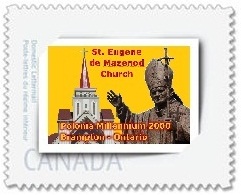
TROYAK CLUB @
Roncesvalles Polish Festival 2026
Saturday, September 12th &
Sunday, September 13th, 2026
https://polishfestival.ca www.kazimierz.org

St. Casimir’s Church Parish Hall …
156 Roncesvalles Ave. Toronto, Ontario
Displays of Coins, Stamps, Collectibles
by Troyak Club Members.
Roncesvalles Polish Festival
www.troyakclub.com
27th September 2026
25th October 2026
29th November 2026
December 2026 … Happy Holidays!
175 lat Muzeum Archeologicznego w Krakowie
175 years of the Archaeological Museum in Kraków
www.poczta-polska.pl
18-02-2026 … Nominał znaczka: beznominałowy … Autor projektu: Joanna Fleszar – Haspert; Ilość znaczków w emisji: 1; Format znaczka: 31,25 x 76,5 mm; Technika druku / Papier: Offset / fluorescencyjny; Nakład: 73 800 szt.; Ilość znaczków w arkuszu: 6; Format koperty FDC: 162 mm x 113 mm.
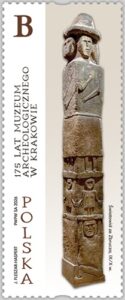
Data emisji: 18-02-2026 … Emisja została przygotowana z okazji 175-lecia Muzeum Archeologicznego w Krakowie, najstarszego polskiego muzeum archeologicznego. Placówka została utworzona jako Muzeum Starożytności z inicjatywy krakowskich intelektualistów skupionych wokół Towarzystwa Naukowego Krakowskiego (TNK). Od blisko dwóch stuleci gromadzi, bada i udostępnia zabytki dokumentujące pradzieje ziem polskich i kulturę dawnych społeczności.
Na znaczku przedstawiono posąg Światowida ze Zbrucza – jedno z najbardziej rozpoznawalnych dzieł słowiańskiej sztuki sakralnej. Rzeźba, wykonana z wapienia z Miodoborów, ma wysokość 257 cm i najczęściej datowana jest na X wiek lub przełom IX/X wieku. Posąg ukazany na znaczku został odwzorowany z dużą dbałością o szczegóły, a różne ujęcia (front, bok, tył) rozmieszczone na arkusiku podkreślają jego czterostronny charakter i symbolikę. Tło arkusika zdobią ilustracje przedstawiające wybrane zabytki archeologiczne znajdujące się w zbiorach muzeum — m.in.: siekierki, groty, fragmenty narzędzi i ozdób.
W polu ilustracyjnym koperty FDC umieszczono panoramiczną fotografię Krakowa, ukazującą m.in. zabytkowe zabudowania w centrum miasta. Na pierwszym planie widoczne są budynki Muzeum Archeologicznego i ogród muzealny, stanowiące integralną i rozpoznawalną część tej historycznej instytucji. Fotografia została utrzymana w eleganckiej, stonowanej stylistyce, dobrze korespondującej z archeologicznym charakterem emisji. Datownik to uproszczona, schematyczna grafika przedstawiająca głowę posągu Światowida, będącą jednocześnie logotypem Muzeum Archeologicznego w Krakowie. Całość utrzymano w klarownej, minimalistycznej formie, która dobrze współgra z charakterem jubileuszowej emisji. Oznaczenie literowe B odpowiada wartości nominalnej znaczka używanego do uiszczenia opłaty za priorytetową przesyłkę listową nierejestrowaną w obrocie krajowym w formacie S.
18-02-2026 … Denomination: stamps without face value … Author of the stamp design: Joanna Fleszar – Haspert; Number of stamps in issue: 1; Stamp size: 31,25 x 76,5 mm; Paper: Fluorescent; Printing techniques: Offset; Sales sheet: 6; Print run: 73 800 pcs; FDC size: 162 mm x 113 mm.
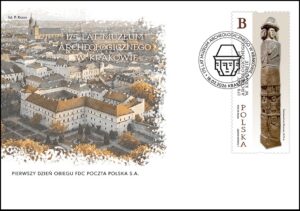
Issue date: 18-02-2026 … The issue celebrates the 175th anniversary of the Archaeological Museum in Kraków, the oldest archaeological museum in Poland. The institution was founded as the Museum of Antiquities by Kraków’s intellectual community associated with the Kraków Scientific Society. The stamp presents the Światowid (Zbruch Idol)—a four‑sided limestone sculpture from the Miodobory region, preserved at a height of 257 cm and usually dated to the 10th century or the late 9th/10th century. The image shows the figure with great detail, emphasizing its unique iconography and cultural significance.The accompanying stamp sheet includes multiple representations of the sculpture along with archaeological artefacts from the museum’s collection, such as tools, blades and other ancient objects. The FDC envelope contains a panoramic photograph of Kraków, with the museum buildings and its garden clearly visible in the foreground. The postmark presents the simplified, stylized head of the Światowid—the official emblem of the Archaeological Museum in Kraków.
Polskie banknoty obiegowe –
Banknot o nominale 100 zł
www.nbp.pl
Narodowy Bank Polski jest centralnym bankiem państwa odpowiadającym za politykę pieniężną i stabilność cen. Jego funkcje określa Konstytucja Rzeczypospolitej Polskiej i ustawa o NBP. NBP ma wyłączne prawo emisji pieniądza. Jako bank centralny nie prowadzi rachunków bankowych obywateli, nie przyjmuje od nich lokat, nie udziela kredytów. Prowadzi natomiast obsługę budżetu państwa, a także podmiotów sektora finansów publicznych. Gromadzi rezerwy walutowe państwa i zarządza nimi. Pełni funkcję banku banków, tworząc warunki do działania systemu bankowego. Jest również jednym z najważniejszych ośrodków naukowo-analitycznych w dziedzinie ekonomii i rynków finansowych. Emisja wartości kolekcjonerskich stanowi okazję do upamiętniania ważnych historycznych rocznic i postaci oraz do rozwijania zainteresowań polską kulturą, nauką i tradycją. 9 lutego 2026 r. Narodowy Bank Polski wprowadził do obiegu złotą monetę o nominale 100 zł z serii „Polskie banknoty obiegowe” – „Banknot o nominale 100 zł”.
Nominał 100 zł … metal: Au 999,9/1000; stempel: lustrzany; wymiary: 50,00 × 25,00 mm; masa: 31,10 g; brzeg (bok): gładki; nakład: do 1500 szt.; Autor projektu graficznego: Robert Kotowicz; Emitent: NBP; Na zlecenie NBP monety wyprodukowała Mennica Polska SA.
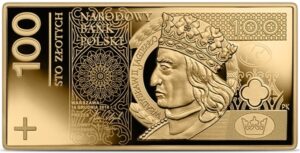
Strona odwrotna (rewers): w środkowej części, w ozdobnym medalionie, portret króla Władysława II Jagiełły, z lewej strony portretu, półkolem, napis: WŁADYSŁAW II JAGIEŁŁO. Z lewej strony medalionu, u góry napis: NARODOWY / BANK / POLSKI, u dołu napis: WARSZAWA / 14 GRUDNIA 2018 r., poniżej napisy: PREZES i podpis oraz GŁÓWNY / SKARBNIK i podpis. W tle napisów ozdobna rozeta i stylizowane elementy ornamentyki gotyckiej. W lewym górnym rogu, pionowo, ułożona z cyfr pod kątem 90° liczba: 100. Z prawej strony liczby pionowa linia, wzdłuż linii z prawej strony, pionowo, ułożony z liter pod kątem 90° napis: STO ZŁOTYCH. W lewym dolnym rogu równoramienny krzyż. Z prawej strony u góry, na tle wyodrębnionej płaszczyzny z ornamentem, liczba: 100. Poniżej płaszczyzny owal z fragmentami korony, pod nim, na tle ornamentu gotyckiego, rozeta; u dołu wyodrębniona płaszczyzna z ornamentem i koroną w owalu.
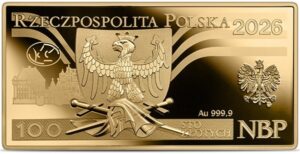
Strona przednia (awers): w środkowej części stylizowany wizerunek tarczy z orłem z nagrobka króla Władysława II Jagiełły, u jej podnóża hełm i płaszcz krzyżacki oraz dwa miecze. Z lewej strony tarczy zarys Zamku Krzyżackiego w Malborku, powyżej owal z fragmentami korony. U góry, na tle wstęg, napis: RZECZPOSPOLITA POLSKA oraz z prawej strony oznaczenie roku emisji: 2026. U dołu, na tle prostokątnej płaszczyzny z ornamentem, z lewej strony liczba: 100, z prawej strony napis: STO / ZŁOTYCH. W prawym dolnym rogu litery: NBP. Powyżej wizerunek orła ustalony dla godła Rzeczypospolitej Polskiej, pod orłem, po prawej stronie, znak mennicy: m / w, po lewej stronie napis: Au 999,9.
Do 31 grudnia 1994 r. wszyscy byliśmy „milionerami”, bo ceny i pensje były wyrażane nominalnie w milionach złotych. Dzień później nastąpiła denominacja złotego. 1 stycznia 1995 r. banknot o nominale 10 tys. zł został zastąpiony monetą 1-złotową, a 1 mln zł równał się 100 nowym zł. Wartości nabrał nawet grosz. W 1995 r. do obiegu weszły banknoty o nominałach 10 zł, 20 zł, 50 zł, 100 zł oraz 200 zł, natomiast banknot o nominale 500 zł został wprowadzony do obiegu w 2017 r. Nową serię banknotów z wizerunkami władców Polski zaprojektował – tradycyjnie – Andrzej Heidrich, „król polskich banknotów”. Andrzej Heidrich (1928–2019) rozpoczął współpracę z Narodowym Bankiem Polskim w 1960 r. Został wówczas zaproszony do zamkniętego konkursu na nowy banknot o nominale 1000 zł. Jego projekt oraz dwa inne zostały wyróżnione. Przez lata na zlecenie NBP wykonał dziesiątki szkiców i projektów banknotów, jednak dopiero w 1975 r. został wprowadzony do obiegu pierwszy banknot jego autorstwa – 500 zł z Tadeuszem Kościuszką. „Byłem solidnie wzruszony” – wspominał. „Chwytałem się na tym, że płacąc nim czy obserwując innych ludzi, myślałem: to moje dzieło”. Andrzej Heidrich zaprojektował serie banknotów „Wielcy Polacy” (projekty z lat 1974–1993, w obiegu w latach 1975–1996) oraz „Władcy polscy” (1994 r., w obiegu od 1995 r. do dzisiaj). Informacja: Jan Żaryn.
W 2023 r. Narodowy Bank Polski zainaugurował serię złotych monet kolekcjonerskich „Polskie banknoty obiegowe” bitych stemplem lustrzanym. Jako czwarta w serii ukazała się złota moneta o nominale 100 zł, przedstawiająca stylizowany wizerunek współczesnego banknotu obiegowego o nominale 100 zł. Na rewersie, w środkowej części, w ozdobnym medalionie widnieje portret króla Władysława II Jagiełły. W tle napisów widać stylizowaną rozetę i elementy ornamentyki gotyckiej. Z prawej strony portretu umieszczono owal z fragmentami korony, a pod nim, na tle ornamentu gotyckiego, rozetę. Poniżej zostały przedstawione ornament i korona. Na awersie, w środkowej części, odwzorowano stylizowany wizerunek tarczy z orłem z nagrobka króla Władysława II Jagiełły, u jej podnóża znajdują się hełm i płaszcz krzyżacki oraz dwa miecze. Z lewej strony tarczy został umieszczony zarys Zamku Krzyżackiego w Malborku, a powyżej owal z fragmentami korony.

Banknotes in Circulation in Poland –
The 100 Zloty Note
www.nbp.pl
Narodowy Bank Polski is the central bank of the State, responsible for its monetary policy and price stability. The Bank’s functions are described in the Constitution of the Republic of Poland and the Act on NBP. NBP holds the exclusive right to issue the currency of the Republic of Poland. As the central bank, it does not provide accounts for the general public, accept deposits from or extend loans to individuals. It acts as a banker to the State budget and public sector entities. NBP also holds and manages the foreign exchange reserves of the State. Finally, it functions as a banker to banks, creating conditions for the operation of the Polish banking system. Narodowy Bank Polski is one of the most important research and analytical centres in the fields of economics and financial markets. Issuing collector items is an occasion to commemorate important historic figures and anniversaries, as well as to develop the interest of the public in Polish culture, science and tradition. On 9 February 2026, Narodowy Bank Polski issued into circulation a gold coin of the series “Banknotes in Circulation in Poland” – “The 100 Złoty Note”, with a face value of 100 złoty
Face value: 100 zł … Metal: Au 999.9/1000; Finish: proof; Dimensions: 50.00 × 25.00 mm; Weight: 31.10 g; Edge (side): plain; Mintage: up to 1,500 pcs; Designer of the graphic images: Robert Kotowicz; Issuer: Narodowy Bank Polski; The coins, commissioned by Narodowy Bank Polski, were struck by Mennica Polska SA.
Back side (reverse): in the central part, in a decorative medallion, a portrait of King Ladislas Jagiello. To the left of the portrait, a semi-circular inscription: WŁADYSŁAW II JAGIEŁŁO (King Ladislas Jagiello). To the left of the medallion, at the top, the inscription: NARODOWY / BANK / POLSKI; at the bottom, the inscription: WARSZAWA /14 GRUDNIA 2018 r. (Warsaw, 14 December 2018); below it, the inscriptions: PREZES (Governor), and a signature, and GŁÓWNY / SKARBNIK (General Treasurer), and a signature. In the background of the inscriptions, a decorative rosette and stylised elements of Gothic ornamentation. In the top left corner, vertically, the number: 100, composed of digits at a 90° angle. To the right of the number, a vertical line; along it, on the right, vertically, the inscription: STO ZŁOTYCH (a hundred złoty), made up of letters at a 90° angle. In the bottom left corner, an equilateral cross. On the right, at the top, against the background of a separate plane with an ornament, the number: 100. Below the plane, an oval with fragments of a crown; below the oval, against Gothic ornamentation, a rosette; at the bottom, a separate plane with an ornament and a crown within an oval.
Front side (obverse): centrally, a stylised image of an escutcheon with the eagle from the tombstone of King Ladislas Jagiello; at its bottom, a Teutonic knight’s helmet and cloak as well as two swords. To the left of the escutcheon, an outline of the Castle of the Teutonic Order in Malbork, and above it, an oval with fragments of a crown. At the top, against ribbons, the inscription: RZECZPOSPOLITA POLSKA (Republic of Poland) and, on the right, the notation of the year of issue: 2026. At the bottom, on the left, against the background of a rectangular plane with an ornament, the number: 100; on the right, the inscription: STO / ZŁOTYCH (a hundred złoty). In the bottom right corner, the letters: NBP. Above them, an image of the Eagle established as the state emblem of the Republic of Poland; below the Eagle, on the right, the Mint mark: m / w; on the left, the inscription: Au 999.9.
We had all been “millionaires” until 31 December 1994, because prices and salaries were expressed nominally in millions of złotys. A day later a redenomination of the Polish złoty was carried out. On 1 January 1995, a banknote of the face value of 10,000 złoty was replaced with a 1 złoty coin, and 1 million złoty became 100 new złoty. Even a grosz gained in value. In 1995, banknotes of the denominations of 10 zł, 20 zł, 50 zł, 100 zł and 200 zł were put into circulation, whereas a 500 złoty banknote was introduced into circulation in 2017. The new series with the images of Polish rulers on banknotes was designed as usual by Andrzej Heidrich, the “king of Polish banknotes”. Andrzej Heidrich (1928–2019) began to collaborate with Narodowy Bank Polski in 1960. At that time, he was invited to take part in a closed competition for the design of a new 1,000 złoty banknote. His design and two others won awards. Over the years, he was commissioned by NBP to make dozens of banknote drawings and designs, however only in 1975 was the first banknote designed by him put into circulation. It was a 500 złoty note depicting Tadeusz Kościuszko. “I was really moved,” he said. ”When I paid with the banknote or saw other people paying, I often caught myself thinking: it’s my work.” Andrzej Heidrich designed the banknote series called “The Great Poles” (designs made in the years 1974–1993, in circulation in the years 1975–1996) and “The Polish Rulers” (designs made in 1994, in circulation from 1995 till the present day). Info: Jan Żaryn.
In 2023, Narodowy Bank Polski inaugurated the series of gold collector coins “Banknotes in Circulation in Poland” struck with proof finish. The gold collector coin with a face value of 100 złoty, featuring a stylised image of a contemporary circulation banknote with a face value of 100 złoty, was issued as the fourth coin of the series. On the reverse, in the central part, a portrait of King Ladislas II Jagiello can be seen in a decorative medallion. A stylised rosette and elements of Gothic ornamentation are depicted in the background of the inscriptions. On the right of the portrait, there is an oval with fragments of a crown and below the oval, against the background of a Gothic ornament, a rosette. An ornament with a crown is placed underneath. In the centre of the obverse, there is a stylised image of an escutcheon with the eagle from the tombstone of King Ladislas Jagiello, with a Teutonic knight’s helmet and cloak, as well as two swords laid at its bottom. On the left of the escutcheon, there is an outline of the Castle of the Teutonic Order in Malbork, and above it, an oval with fragments of a crown.
2026 … Cherry Blossoms:
booklet of 10 Permanent™ stamps
www.canadapost.ca
This year’s issue in the annual Flower series features the delicate blossoms of two varieties of ornamental cherry trees – Prunus ‘Kanzan’ and Prunus ‘Somei-yoshino’. Ornamental cherry trees are found in many parks and gardens across Canada. Their stunning blossoms are known for their fleeting beauty and delicate fragrance.
Booklet of 10 Permanent™ domestic rate stamps. This issue includes five additional products (coils of 50 Permanent™ stamps, strips of 10 Permanent™ stamps, strips of 4 Permanent™ stamps, souvenir sheets of 2 Permanent™ stamps and Official First Day Covers). The annual Flower issue is a bestseller that is often used for wedding stationery and is popular among Canadian gardeners. Canada Post has issued pairs of commemorative stamps featuring flowers each year since 2007.
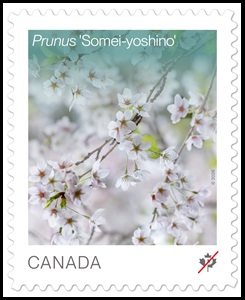
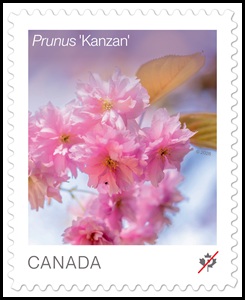
About the cherry blossom … Joyful harbingers of spring, cherry blossoms create spectacular canopies of colour during the blooming season, between mid-March and early May. The fragrant though fleeting flowers, which leave behind a delicate carpet of petals, are symbolic of beauty and the transience of life. In Japan, sakura, as cherry blossoms are called, are the inspiration for national celebrations. In Canada, dazzling displays can be found along city streets and in many parks and gardens across the country. Vancouver boasts the largest collection, with more than 20,000 trees, and attracts thousands of wide-eyed spectators to its annual cherry blossom festival.
Ornamental cherry trees were first officially introduced to North America in the early 1900s as gifts from Japan. Prunus ‘Kanzan’ is a cold-hardy cultivar beloved for its large, deep-pink double flowers. Prunus ‘Somei-yoshino’ cherries are the focus of flower-viewing parties (hanami) that take place across Japan and in other parts of East Asia. Shrouded in clusters of white to pale-pink petals, the tall, umbrella-shaped trees appear like clouds in the sky when they are in bloom.
About the design … These stamps feature original photographs of the cherry blossoms, taken at the Nitobe Memorial Garden at the University of British Columbia Vancouver. Photographed by Brett Hitchins and designed by Belisle Creative. The front cover features the image from the Prunus ‘Somei-yoshino’ stamp and a close-up of one of the envelope seals. The booklet includes 10 envelope seals featuring illustrations of the Wilson’s warbler – a frequent visitor to Vancouver’s cherry trees in springtime – illustrated by Jenny Liski. Stamp Designer: Belisle Creative; Quantity Produced: 600,000; Issue Date: March 2, 2026.
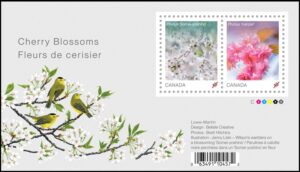
The Souvenir Sheet features the two stamps, “Cherry Blossoms” text, an illustration of Wilson’s warblers on a blossoming Prunus ‘Somei-yoshino’ – illustrated by Jenny Liski – captions and credits. Stamp Designer: Belisle Creative; Quantity Produced: 45,000; Issue Date: March 2, 2026.
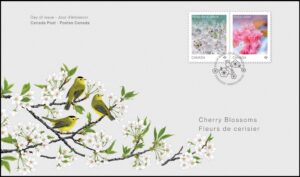
The cover of the OFDC features an illustration of Wilson’s warblers on a blossoming Prunus ‘ Somei-yoshino’ by Jenny Liski, a small branch of which is featured on the back cover, as well as a short text about cherry blossoms. Cancellation Site: Vancouver, BC; Stamp Designer: Belisle Creative; Quantity Produced: 5,000; Issue Date: March 2, 2026.
2026 … Pysanka – Fine Silver Coin
www.mint.ca
Engraved symbols and contemporary colours celebrate spring’s renewal on this 99.99% pure silver pysanka coin, with a special emphasis on the early buds and blooms—pussy willows, scilla and forget-me-nots—that sustain pollinators during those early sunny days. Protective geometric borders and ancient motifs represent the elements, the earth and the sun, honouring nature’s strength and fertility. As a heartfelt tribute to the cycles of life, this floral-themed pysanka encapsulates the beauty and harmony of nature, a manifestation of hope, endurance, and the interconnected rhythms of the earth. A 10-year coin tradition continues.Celebrate spring with a pysanka, order today!
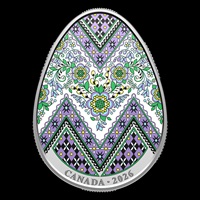
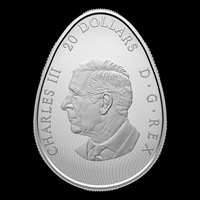
Face Value: $20 … Composition: 99.999% pure silver with selective colour; Mintage: 9,500; Weight: 31.82 g; Dimensions45 mm x 33 mm; Edge: Interrupted serrations; Finish: Proof; Artist: Natalie Kit (reverse), Steven Rosati (obverse); Packaging: Black clamshell with black beauty box.
DID YOU KNOW? … The colours of a pysanka can also have deeper meaning: blue traditionally represents air and good health; purple signifies faith; green is associated with nature and hope; yellow for light and purity; and black for eternity.
Enhanced with contemporary colours, this pysanka design by Canadian artist Natalie Kit draws inspiration from spring’s renewal, seen in vivid flowers and ancient symbolism. The return of the sun brings joy, abundance and new plant life, with early blooms like scilla and forget-me-nots sustaining pollinators, while pussy willows—a symbol of strength, endurance and fertility—embody the season’s vitality. The top cap and bottom ground the design, with the triangle shapes embodying the life-giving trinity of air, fire/sun and water. Surrounded by wavy lines symbolizing nurturing water, the protective band contains floral forms intermixed with cross shapes representing the sun. On the other side of the eternity band, rhomboids and other shapes evoke fruitfulness, the earth and the goddess Berehynia, protectress of the home and family. The word “CANADA” and the year “2026” are engraved along the bottom. The obverse features the effigy of His Majesty King Charles III by Canadian artist Steven Rosati.
Alicia Cook Sapene, Product Manager … “Bringing this pysanka to life was a meaningful journey. Our team took great care to preserve the intricate symbolism and maintain the level of detail collectors expect from our popular painted pysanka designs, while introducing a fresh floral composition that celebrates the renewal of spring. The result is a distinctive piece that blends ancient tradition with modern craftsmanship—a piece that collectors will deeply appreciate, especially as we celebrate 10 years since our first pysanka coin release.”
Natalie Kit, Artist … “Spring’s first flowers signal the renewal of life as the sun brings abundance to feed the pollinators. My grandmother planted pussy willows and scilla around her beehives more than 60 years ago; today, carpets of the hardy blue scilla and their larger purple cousins, as well as forget-me-nots surrounded by vivid green, continue to thrive around our home. Pussy willows are a symbol of spring and Easter on the horizon. The willow represents the Universal Tree, fertility, tied with water, health, and life. Conveying luck and good fortune to all, this first tree blooms golden pollen, sustaining the honeybees and other pollinators. Unlike my more structured, traditional designs, this design expresses more contemporary, vibrant, unrestrained images of life bursting forth. It is the rejuvenation of the earth, a message of hope, renewal, and beauty. This pysanka coin design represents harmony within nature, connecting us to the patterns of life.”
2026 … Peace Dollar –
$50 Fine Silver Coin
www.mint.ca
At the heart of Canada’s Peace Dollar stands a graceful personification of Peace that is poised, dignified, and, on the 2026 edition, highlighted by a contrasting precious metal. On this 5 oz. 99.99% pure silver piece, the largest (65 mm) of our 2026 Peace Dollar coins, most of the engraved reverse is non-plated, allowing a radiant Lady Peace and the land beneath her feet to shine all the more. This intentional contrast between silver and gold elevates the art, while reflecting a belief that peace is not just precious—it defines the space around it, casting a golden light that warms and uplifts. Your updated gold-plated portrait of Lady Peace.
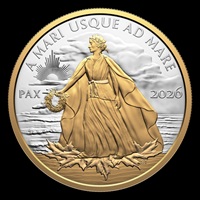
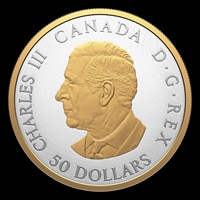
Face Value: $50 … Composition: 99.99% pure silver with yellow gold plating; Mintage: 1,750; Weight: 157.6 g; Diameter: 65.25 mm; Edge: Serrated; Finish:Proof; Artist: Susan Taylor (reverse), Steven Rosati (obverse); Packaging: Black clamshell with black beauty box.
The reverse design by retired Royal Canadian Mint Senior Engraver Susan Taylor features a gold-plated, full-body portrait of Lady Peace, a personification of Peace (“PAX”). Inspired by the allegorical figure atop the National War Memorial in Ottawa, Lady Peace is dressed in a flowing robe and crowned with a wreath of maple leaves and olive branches expressing a core Canadian value of peace. Her serene countenance exudes poise, strength and quiet confidence as she extends her right arm, almost as if the peace wreath she holds is an offering to all. Lady Peace stands on the shoreline, which is similarly plated with yellow gold, and is supported by maple leaves that are symbolic of Canada. Canada’s motto, “A MARI USQUE AD MARE” (“From sea to sea”) appears in the sky above, where the sun’s rays break through the rain clouds and form the shape of a maple leaf. The rim on both sides of the coin is plated with yellow gold, while the obverse features the gold-plated effigy of His Majesty King Charles III by Canadian artist Steven Rosati.
2026 … Peace Dollar –
$1 Fine Silver Coin
www.mint.ca
At the heart of Canada’s Peace Dollar stands a graceful personification of Peace that is poised, dignified, and, on the 2026 edition, highlighted by a contrasting precious metal. On this 1 oz. 99.99% pure silver piece, most of the engraved reverse is non-plated, allowing a gold-plated Lady Peace and the land beneath her feet to shine all the more. This intentional contrast between silver and gold elevates the art, while reflecting a belief that peace is not just precious—it defines the space around it, casting a golden light that warms and uplifts. Your updated gold-plated portrait of Lady Peace.
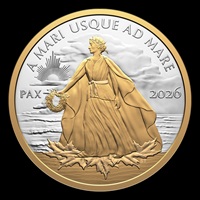
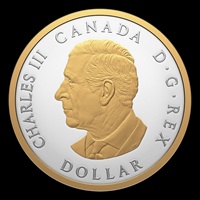
Face Value: $1 … Composition: 99.99% pure silver with yellow gold plating; Mintage: 8,000; Weight: 31.39 g; Diameter: 38 mm; Edge: Plain; Finish:Proof; Artist: Susan Taylor (reverse), Steven Rosati (obverse); Packaging: Black clamshell with black beauty box.
The reverse design by retired Royal Canadian Mint Senior Engraver Susan Taylor features a gold-plated, full-body portrait of Lady Peace, a personification of Peace (“PAX”). Inspired by the allegorical figure atop the National War Memorial in Ottawa, Lady Peace is dressed in a flowing robe and crowned with a wreath of maple leaves and olive branches expressing a core Canadian value of peace. Her serene countenance exudes poise, strength and quiet confidence as she extends her right arm, almost as if the peace wreath she holds is an offering to all. Lady Peace stands on the shoreline, which is similarly plated with yellow gold, and is supported by maple leaves that are symbolic of Canada. Canada’s motto, “A MARI USQUE AD MARE” (“From sea to sea”) appears in the sky above, where the sun’s rays break through the rain clouds and form the shape of a maple leaf. The rim on both sides of the coin is plated with yellow gold, while the obverse features the gold-plated effigy of His Majesty King Charles III by Canadian artist Steven Rosati.
2026 … Peace Dollar –
$200 Pure Gold Coin
www.mint.ca
Lady Peace, plated in platinum and surrounded by gold. An elite piece in our 2026 Peace Dollar suite, Lady Peace rises as a shining beacon set against a golden sky, her form plated in luminous platinum (new for 2026). The cool brilliance of this personification of Peace contrasts with the warmth of the 99.99% pure gold that surrounds her, elevating her presence and transforming her into an inspiring representation of a rare and precious ideal. A platinum-plated, full-body portrait of Lady Peace.
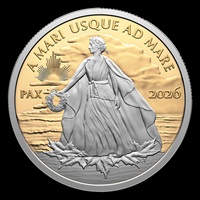
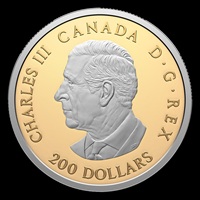
Face Value: $200 … Composition: 99.99% pure gold with platinum plating; Mintage: 600; Weight: 31.16 g; Diameter: 30 mm; Edge: Interrupted serrations; Finish:Proof; Artist: Susan Taylor (reverse), Steven Rosati (obverse); Packaging: Black clamshell with black beauty box.
The reverse design by retired Royal Canadian Mint Senior Engraver Susan Taylor features a platinum-plated, full-body portrait of Lady Peace, a personification of Peace (“PAX”). Inspired by the allegorical figure atop the National War Memorial in Ottawa, Lady Peace is dressed in a flowing robe and crowned with a wreath of maple leaves and olive branches expressing a core Canadian value of peace. Her serene countenance exudes poise, strength and quiet confidence as she extends her right arm, almost as if the peace wreath she holds is an offering to all. Lady Peace stands on the shoreline, which is similarly plated with platinum, and is supported by maple leaves that are symbolic of Canada. Canada’s motto, “A MARI USQUE AD MARE” (“From sea to sea”) appears in the sky above, where the sun’s rays break through the rain clouds and form the shape of a maple leaf. The rim on both sides of the coin is plated with platinum, while the obverse features the platinum-plated effigy of His Majesty King Charles III by Canadian artist Steven Rosati.
2026 … Lucky Dragon – $8 Pure Gold Coin
www.mint.ca
Jump-start your success in 2026 with a golden dragon. Attract good fortune and positive energy in 2026 with a Lucky Dragon! Expertly crafted in 1/20 oz. of 99.99% pure gold, this coin packs a lot of details into a small (14.1 mm), affordable gold format. On the coin’s reverse, the highly detailed dragon is a captivating representation of power, strength and good fortune—especially with its serpentine body forming the shape of the number 8, a symbol of infinite luck. Add waves that usher in prosperity and joy, and this little coin could mark the auspicious start of a year full of new opportunities. Usher in good fortune with a dragon shaped like lucky number 8.
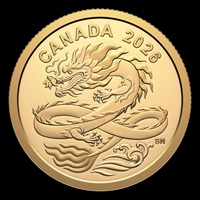
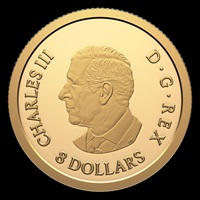
Face Value: $8 … Composition: 99.99% pure gold; Mintage: 8,888; Weight: 1.58 g; Diameter: 14.1 mm; Edge: Serrated; Finish:Proof; Artist: Simon Ng (reverse), Steven Rosati (obverse); Packaging: Black clamshell with special-themed red graphic beauty box.
DID YOU KNOW? … A traditional Chinese symbol of strength and fortune, balance and positive energy, the dragon brings luck and fortune to those who honour it. Gold is also considered lucky—it represents wealth, abundance and success.
The reverse design by Canadian artist Simon Ng features a stylized depiction of a dragon, the benevolent creature of Chinese mythology. Paired with waves that usher in prosperity and joy, the dragon forms the shape of the lucky number 8. The obverse features the effigy of His Majesty King Charles III by Canadian artist Steven Rosati.
Simon Ng, Artist … “Strength, wisdom, abundance and good fortune are embodied in the mighty Chinese dragon. In addition, when the dragon is combined with the auspicious number eight, which symbolizes wealth, status, prosperity and success, good luck is twice blessed. A harmonious alliance is formed with the accompanying image of water (yin) alongside the coiling figure of the dragon (yang).”
Aida Alves, 3D Artist-Engraver … “I enjoy sculpting small, simple designs, though working within the low-relief required for successful striking at this scale presents a unique challenge. The most intricate part is maintaining a sense of roundness in the dragon’s overlapping body and arms while adhering to the engineering specifications. Processing the matrix and punch at the tooling stage demands patience and a delicate touch, but the reward lies in seeing the final piece come to life.”
2026 … 30th Anniversary of the Toonie –
Collector’s Edition Non-Circulation
$2 Special Wrap Roll
www.mint.ca
Celebrate 30 years of the Toonie—a Canadian icon! Mark a milestone in Canada’s currency history with a Special Wrap Roll of the 2026 Collector’s Edition Non-Circulation $2 coin, a special collectible not destined for your pocket change! Each Special Wrap Roll contains 25 of these double-dated $2 coins, each distinguished by the “W” mint mark of our Winnipeg facility—the place that has produced the Toonie since the coin denomination’s debut in 1996. Wrapped in premium paper, these $2 coins form a unique tribute to the mighty polar bear that captured the hearts of Canadians, and to the coin that changed our pocket change.
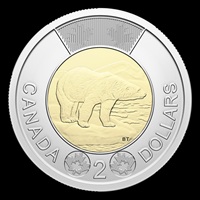
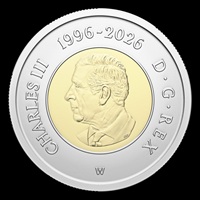
Face Value: $2 … Composition: Outer ring: Three-ply nickel finish-plated steel; Inner core: Three-ply brass finish-plated aluminum bronze; Mintage: 30,000; Weight: 6.99 g; Diameter: 28 mm; Edge: Interrupted serrations; Finish:Non-circulation; Artist: Brent Townsend (reverse), Steven Rosati (obverse); Packaging: Each Special Wrap Roll contains 25 non-circulation coins.
DID YOU KNOW?… The Toonie’s polar bear has a name: Churchill. In 2006, we held a fun “Name Our Polar Bear” contest to mark the 10th anniversary of Canada’s first bi-metallic circulation coin, and Churchill won with 34 per cent of the votes. The runners-up? Wilbert and Plouf!
The reverse design by Canadian artist Brent Townsend features the classic image of an adult polar bear on an Arctic ice floe. Double-dated (“1996-2026”) to commemorate the 30th anniversary of Canada’s $2 coin, the obverse features the “W” mint mark of the Royal Canadian Mint’s Winnipeg facility and the effigy of His Majesty King Charles III by Canadian artist Steven Rosati.
2026 … 50-Cent Special Wrap
Circulation Roll
www.mint.ca
Canada’s 50-cent coin rarely pops up in your pocket change, but with a Special Wrap Roll, your collection can be instantly updated to include the 2026 edition. This is the only way to get 2026-dated 50-cent circulation coins outside of a set: each Special Wrap Roll consists of 25 uncirculated 50-cent coins wrapped in an illustrated paper that complements the heraldic design elegantly etched onto each coin’s reverse. Own the 2026 edition of an annual favourite.
A view of the reverse design, visible on one or both ends of the roll. Each coin included in the Special Wrap Roll has a reverse and obverse design. The production process and quality assurance for uncirculated Special Wrap Rolls allows for either the reverse design on both ends or the reverse design on one end and the obverse on the other. It is not possible for the Mint to guarantee or foresee which of the two versions will be shipped.
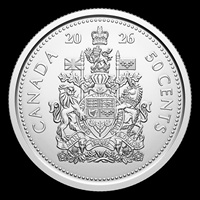
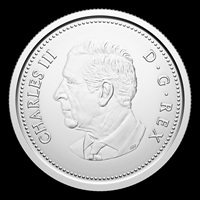
Face Value: 50 Cent … Composition: Three-ply nickel-plated steel; Mintage: 25,000; Weight: 6.9 g; Diameter: 27.13 mm; Edge: Serrated; Finish:Brilliant uncirculated; Artist: Cathy Bursey-Sabourin (reverse), Steven Rosati (obverse); Packaging: Each Special Wrap Roll.
DID YOU KNOW? … In Canada, the 50-cent denomination dates back to 1870, when it was introduced as part of the first national coinage issued by the newly created Dominion of Canada. Inside your Special Wrap Roll, the reverse of each 50-cent coin features Canada’s Coat of Arms, which was adopted by proclamation of King George V in 1921 and first appeared on the 50-cent piece in 1937. The obverse features the effigy of His Majesty King Charles III by Canadian artist Steven Rosati.
2026 … Our Purest Bison –
$200 Pure Gold Coin
www.mint.ca
Our Purest Bison is a new addition to our growing line of Premium Bullion in special packaging—premier investment-grade assets that combine intrinsic value with captivating designs. Like Our Purest Maple Leaf before it, Our Purest Bison boasts an ultra-high purity of 99.999% or five nines (.99999 fine), making it one of the world’s purest 1 oz. gold coins, now in a convenient format that can be purchased directly from us. The coin’s reverse features sunburst radial lines behind the inspiring side view of a mighty bison, timeless symbol of strength and resilience that speaks to the spirit of Canada’s natural heritage. With its captivating design, exceptional ‘five nines’ purity, and limited availability, Our Purest Bison is a great addition to any portfolio and a collectible emblem of enduring legacy. Pure strength. Pure gold. Exceptional ‘five nines’ purity. Special packaging … Why is this called Premium Bullion? Your Premium Bullion coin comes encapsulated and presented in custom-designed packaging complete with removable capsule and a clear resealable envelope for added protection. You’ll find the signed assay certificate printed on the back of the card, while the easy-to-scan QR code on the front of the card is a quick link to an informative website that welcomes you to the world of bullion.
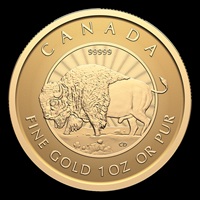
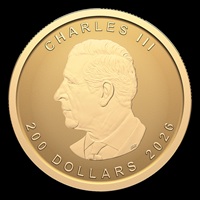
Face Value: $200 … Composition: 99.999% pure gold; Mintage: 999; Weight: 31.11 g; Diameter: 30 mm; Edge: Interrupted serrations; Finish:Reverse proof; Artist: Claudio D’Angelo (reverse), Steven Rosati (obverse); Packaging: Card packaging with removable capsule.
DID YOU KNOW? … Bison once roamed in the millions through the prairies and woodlands of western North America. Overhunting in the late 1800s nearly caused their extinction, and the continued survival of the North American bison is thanks to ongoing conservation efforts. Between 1985 and 1992, over 70 wood bison born at your Toronto Zoo were released to the wild to restore populations. Today, the Toronto Zoo’s bison conservation program focuses on the Bison Genome Biobank and assisted reproductive technologies. Together, these approaches safeguard valuable genetics for the future and provide methods to incorporate this banked genetic diversity into living populations.
2026 … Triumphant Dragon –
$50 Fine Silver Coin
www.mint.ca
May the spirit of the Triumphant Dragon guide your year of success. Welcome the new year with a majestic Chinese dragon that symbolizes good fortune and triumph over adversity. Engraved on a 5 oz. 99.99% pure silver canvas, the gold-plated dragon holds the pearl of wisdom in its mouth on the coin’s reverse, while the pattern on the obverse suggests a new direction, a favourable change in fortune. Together, the two sides of the coin bring blessings of positive energy for a happy, successful year marked by achievements. Embrace the spirit of the Triumphant Dragon in 2026.
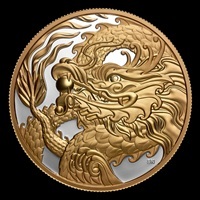
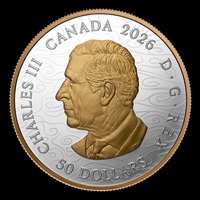
Face Value: $50 … Composition: 99.999% pure silver with selective gold plating; Mintage: 2,588; Weight: 157.6 g; Diameter: 65.25 mm; Edge: Serrated; Finish: Proof; Artist: Simon Ng (reverse), Steven Rosati (obverse); Packaging: Red lacquered wood case and a special-themed red beauty box.
DID YOU KNOW?… A traditional Chinese symbol of strength and fortune, balance and positive energy, the dragon brings luck and fortune to those who honour it. Gold is also considered lucky—it represents wealth, abundance and success.
The reverse design by Canadian artist Simon Ng features a gold-plated depiction of the majestic dragon, an auspicious emblem and a benevolent creature in Chinese mythology. A low viewpoint emphasizes the Dragon’s imposing stature and features, which convey strength and courage, while revealing a glimpse of the pearl of wisdom held in its mouth. The obverse features the effigy of His Majesty King Charles III by Canadian artist Steven Rosati.
Simon Ng, Artist … “The image of the Triumphant Dragon features a pose that projects its power and energy. The dragon appears to hover high above the viewer, confidently bringing with it a pearl of wisdom in its mouth, claws seemingly pulling its large frame into view, while its mane and tail gloriously wave in the wind.”
Aida Alves, 3D Artist-Engraver … “Translating the intricate artwork into sculpture required a meticulous attention to detail, from the dragon’s scales and mane to its face and claws. My goal was to stay as true to the original design as possible while ensuring a balanced sense of volume and adhering to engineering specifications. Maintaining the roundness of form was key, and my favourite part of the process was refining the claw and face, and the layered composition of the body, scales and spines.”
Precious Maple Leaves — Fine Silver Coin
www.mint.ca
Adorned with diamonds, a precious tribute to nature’s elegance. Crafted in 99.99% pure silver with a mirror-like finish, this coin’s maple-themed reverse captures the essence of long, light-filled days when the leaves are full of life and one seems to shimmer above the rest. It features two engraved maple leaves, with a third cast in .925 sterling silver with 24-karat gold plating and luxuriously studded with nine diamonds that sparkle like morning dew. With an almost ethereal quality, this elevated leaf adds a quiet luxury to the familiar form, reimagining the iconic symbol of Canada as a radiant emblem of beauty and strength. A maple leaf rises, touched by light—and diamonds.
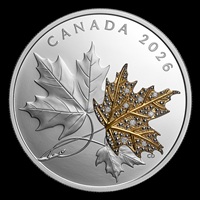
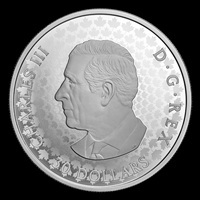
Face Value: $30 … Composition: 99.999% pure silver; Mintage: 1,850; Weight: 62.69 g; Diameter: 50 mm; Edge: Serrated; Finish: Proof; Artist: Claudio D’Angelo (reverse), Steven Rosati (obverse); Packaging: Black clamshell with black beauty box.
DID YOU KNOW? … Round cut diamonds are so popular, they represent roughly three quarters of global diamond sales.
Designed by artist Claudio D’Angelo, the reverse design features a naturalistic sprig of maple leaves swaying in the breeze. Two of the maple leaves are engraved, while the middle leaf is bejewelled adornment cast in .925 sterling silver with 24-karat gold plating and dotted with nine round brilliant cut diamonds (tcw 0.15). The obverse features laser-engraved maple leaves that form concentric rings behind the effigy of His Majesty King Charles III by Canadian artist Steven Rosati.
Claudio D’Angelo, Artist … “As a coin designer, I have always seen a multitude of interesting and elegant possibilities in the distinctive shape of the maple leaf. The luminosity of this coin’s shiny proof finish coupled with the sparkling embellishment produces a marvellous overall effect, especially when viewed in bright sunlight.”
Cecily Mok, 3D Artist-Engraver … “The artist’s original concept is a black-and-white pencil sketch but I immediately envisioned big, green maple leaves in their prime, so I took a softer approach to the sculpt by putting less emphasis on the leaf’s veins. Still attached to the end of the branch, and frosted to mimic the sheen of direct sunlight, these leaves give the impression of natural movement while allowing the diamond-adorned leaf to shine bright. Every embellishment is different, and this one sits on top of an engraved maple leaf outline that provides an angled platform—that way, the diamond feature is stacked on top instead of cutting into the relief. It’s a new approach to creating a platform base, and certainly something I haven’t done before!”
2026 … O Canada Gift Card Set
www.mint.ca
Show and share your love of Canada with the O Canada Gift Card Set. Celebrate Canada and all things Canadian with the 2026 O Canada Gift Card Set! Whether you’re marking Canada Day, picking out the perfect souvenir, or looking for a fun “just because” keepsake, this gift-and-card combo is a beautiful way to honour the spirit of this great country. On the special-themed $1 coin (a set exclusive), the Canada goose flyby evokes the grace and strength of their migration, a symbol of our natural heritage and the beauty that stretches from land to sky. Packaged in an easy-to-mail greeting card, this five-coin set is the perfect gift to show and share your love of Canada, any time of year. Canadian pride flying high. Mintage: 100,000; Weight: 31.11 g; Finish: Brilliant Uncirculated; Artist: Tony Bianco (reverse), Steven Rosati (obverse); Packaging: Gift card packaging.
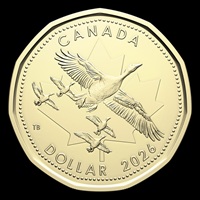
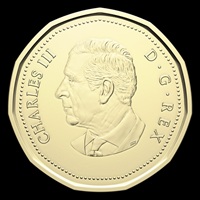
1 dollar … Composition: Three-ply brass-plated steel; Weight: 6.27 g; Diameter: 26.5 mm; Edge: Plain.
2 dollars … Composition: Outer ring: Three-ply nickel finish-plated steel; Inner core: Three-ply brass finish-plated aluminum bronze; Weight: 6.99 g;;Diameter: 28 mm: Edge: Interrupted serrations.
25 cents … Composition: Three-ply nickel finish-plated steel; Weight: 4.4 g; Diameter: 23.88 mm; Edge: Serrated.
10 cents … Composition: Three-ply nickel finish-plated steel; Weight: 1.75 g; Diameter: 18.03 mm; Edge: Serrated.
5 cents … Composition: Three-ply nickel finish-plated steel; Weight: 3.95 g; Diameter: 21.2 mm; Edge: Plain.
DID YOU KNOW?… The V formation helps the geese save their energy by synchronizing their wingbeats to take advantage of the updrafts they create, which helps to reduce the effects of wind and allow them to cover more distance —in fact, in favourable winds, migrating geese may reach speeds of up to 100 kilometres per hour, and travel up to 1,000 kilometres in a day.
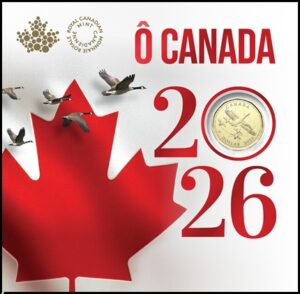
Look up at the sky—designed by Canadian artist Tony Bianco, the $1 coin in the 2026 O Canada Gift Card Set features a patriotic flyby backed by a maple leaf, with five Canada geese positioned in the flying V-formation that is a familiar sight in our skies each spring and fall, during the species’ migratory flights. The obverse features the effigy of His Majesty King Charles III by Canadian artist Steven Rosati.