
TROYAK EXECUTIVE TEAM is informing all members, colleagues, collectors, and Polonia at large, that Club meetings taking place at John Paul II Polish Cultural Centre, 4300 Cawthra Rd. (just south of Hwy. 403), Mississauga, Ontario. The new members are always welcome. www.polishculturalcentre.ca
ADRES SPOTKAÑ KLUBOWYCH ! Zarząd Główny Klubu “Troyak” informuje wszystkich członków kolekcjonerów, sympatyków oraz całą Polonię, że spotkania klubowe odbywają się w Polskim Centrum Kultury im. Jana Pawła II, przy 4300 Cawthra Rd. (na południe od autostrady 403), Mississauga, Ontario. Zapraszamy nowych członków do prężnego. Klubu “Troyak”. www.polishculturalcentre.ca

“TROYAK” CLUB NEXT MEETINGS …
NASTĘPNE SPOTKANIA KLUBU “TROYAK” …

Sunday 22nd February 2026 @ 4:30 p.m.
Sunday – 1st March 2026 @ 9:00 a.m. to 4:00 p.m.
Mississauga Coin & Stamp Show
29th March 2026 @ 4:30 p.m.
26th April 2026
31st May 2026
21st June 2026

July & August 2026 –
Summer break … Letnie wakacje …

TROYAK CLUB @
Roncesvalles Polish Festival 2026
Saturday, September 12th &
Sunday, September 13th, 2026
https://polishfestival.ca www.kazimierz.org
St. Casimir’s Church Parish Hall …
156 Roncesvalles Ave. Toronto, Ontario
Displays of Coins, Stamps, Collectibles
by Troyak Club Members.
Roncesvalles Polish Festival
www.troyakclub.com
27th September 2026
25th October 2026
29th November 2026
December 2026 … Happy Holidays!
Polski Instytut Sztuki Filmowej –
wspieramy naszą kinematografię
Polish Film Institute –
we support our cinematography
www.poczta-polska.pl
2025-12-08 … Nominał znaczka: 4.90 zł … Autor projektu: Justyna Chodkowska; Ilość znaczków w emisji: 1; Format arkusik: 76,5×31,25 mm; Technika druku / Papier: Offset / fluorescencyjny; Nakład: 70 000 szt.; Arkusz sprzedażny: 5+przywieszka.
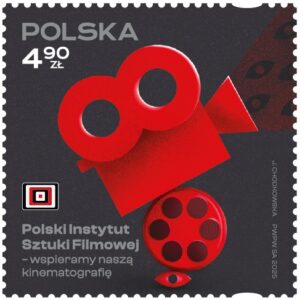
Data emisji: 08-12-2025 … Wyjątkowa emisja znaczków pocztowych, stworzona z okazji jubileuszu 20-lecia Polskiego Instytutu Sztuki Filmowej, to hołd dla polskiej kinematografii i jej bogatej tradycji. Projekt łączy klasykę plakatu filmowego z nowoczesną estetyką cyfrową, tworząc kompozycję, która oddaje ekspresję polskiego kina. Emisja powstała w ścisłej współpracy z Wnioskodawcą – Polskim Instytutem Sztuki Filmowej. Wszystkie materiały użyte w grafice pochodzą od Instytutu, a projekt został stworzony przez Justynę Chodkowską, pracownika Instytutu następnie dostosowany do wymogów PWPW przez Agnieszkę Sancewicz.
Na znaczku: grafika zaprojektowana z okazji 20-lecia PISF, nawiązująca do tradycji polskiego plakatu filmowego, reinterpretowana w nowoczesnej, cyfrowej formie. Centralny motyw stylizowanej kamery symbolizuje sztukę filmową jako przestrzeń spotkania techniki i emocji, obrazu i wyobraźni. Kompozycja w charakterystycznej czerwieni PISF podkreśla energię, pasję i dynamikę polskiego kina. Na przywieszce umieszczono sygnet Instytutu oraz lata działalności 2005–2025.
Projekt wykonano techniką digital painting, która łączy precyzję cyfrowych narzędzi z malarską głębią i fakturą, tworząc współczesną interpretację artystycznego języka filmu. Geometryczny pattern inspirowany kadrem filmowym i grą światła to element identyfikacji wizualnej jubileuszu, obecny na festiwalach filmowych i w materiałach promocyjnych przez cały rok. Polski Instytut Sztuki Filmowej – najważniejsza instytucja wspierająca rozwój kinematografii w Polsce, od dwóch dekad konsekwentnie dba o jakość, różnorodność i dostępność polskiego kina. PISF finansuje produkcje filmowe, wspiera debiutujących i uznanych twórców, inwestuje w edukację filmową oraz promocję polskich filmów w kraju i za granicą. Dzięki szerokiemu programowi grantowemu i współpracy z licznymi partnerami branżowymi Instytut odgrywa kluczową rolę w budowaniu siły i międzynarodowej rozpoznawalności polskiej kultury filmowej.

2025-12-08 … Denomination: 4.90 PLN … Author of the stamp design: Justyna Chodkowska; Number of stamps in issue: 1; Sheet size: 40,5×40,5 mm; Paper: Fluorescent; Printing techniques: Offset; Sales sheet: 5 stamps + tag; Print run: 70 000 pcs.

Issue date: 08-12-2025 … A unique postage stamp issue created to celebrate the 20th anniversary of the Polish Film Institute is a tribute to Polish cinematography and its rich tradition. The design combines the classic aesthetics of Polish film posters with a modern digital style, creating a composition that reflects the expression and dynamism of Polish cinema. The issue was developed in close cooperation with the applicant – the Polish Film Institute. All graphic materials used in the design come from the Institute. The project was created by Justyna Chodkowska, an employee of the Institute, and then adapted to PWPW requirements by Agnieszka Sancewicz. On the stamp: a graphic designed for the 20th anniversary of the Polish Film Institute, referencing the tradition of Polish film posters and reinterpreting it in a modern, digital form. The central motif of a stylized camera symbolizes film art as a meeting point of technology and emotion, image and imagination.
The composition, maintained in the characteristic PFI red, emphasizes the energy, passion, and dynamics of Polish cinema. The attached label features the stylized emblem of the Polish Film Institute along with the years of its operation. The project was created using digital painting, combining the precision of digital tools with painterly depth and texture, offering a contemporary interpretation of the artistic language of film. The geometric pattern, inspired by film frames and light play, was developed as part of the visual identity for the 20th anniversary and accompanied the Institute throughout the year at film festivals and in promotional materials. The Polish Film Institute is the most important institution supporting the development of cinematography in Poland. For two decades, it has consistently cared for the quality, diversity, and accessibility of Polish cinema. PFI finances film productions, supports debuting and established creators, invests in film education, and promotes Polish films both domestically and internationally. Through its extensive grant program and cooperation with numerous industry partners, the Institute plays a key role in building the strength and global recognition of Polish film culture.
Historia monety polskiej –
5 złotych z okresu powstania listopadowego
www.nbp.pl
Narodowy Bank Polski jest centralnym bankiem państwa odpowiadającym za politykę pieniężną i stabilność cen. Jego funkcje określa Konstytucja Rzeczypospolitej Polskiej i ustawa o NBP. NBP ma wyłączne prawo emisji pieniądza. Jako bank centralny nie prowadzi rachunków bankowych obywateli, nie przyjmuje od nich lokat, nie udziela kredytów. Prowadzi natomiast obsługę budżetu państwa, a także podmiotów sektora finansów publicznych. Gromadzi rezerwy walutowe państwa i zarządza nimi. Pełni funkcję banku banków, tworząc warunki do działania systemu bankowego. Jest również jednym z najważniejszych ośrodków naukowo-analitycznych w dziedzinie ekonomii i rynków finansowych.
Emisja wartości kolekcjonerskich stanowi okazję do upamiętniania ważnych historycznych rocznic i postaci oraz do rozwijania zainteresowań polską kulturą, nauką i tradycją. 26 listopada 2025 roku Narodowy Bank Polski wprowadził do obiegu srebrną monetę o nominale 20 zł „Historia monety polskiej” – „5 złotych z okresu powstania listopadowego”.
Nominał: 20 zł … metal: Ag 925/1000; stempel: lustrzany; średnica: 38,61 mm; masa: 28,28 g; brzeg (bok): gładki; nakład: do 10 000 szt.; Projektantka: Dominika Karpińska-Kopiec; Emitent: NBP Na zlecenie NBP monety wyprodukowała Mennica Polska SA.
W czasie powstania listopadowego (29 listopada 1830 – 7 września 1831) mennica warszawska prowadziła niezwykle intensywną działalność w trudnych warunkach. Rząd Narodowy Królestwa Polskiego w celu pokrywania wielkich wydatków domagał się bowiem jak największej ilości pieniądza. W efekcie, w niektórych okresach, mennica pracowała przez całą dobę, a jej pracownicy „do domów nie odchodzą, lecz kolejno na słomie spoczywają”. Dodatkowym utrudnieniem było zainstalowanie w gmachu mennicy fabryki armat, która również korzystała z tamtejszych urządzeń. Na domiar złego, niektórzy pracownicy zostali przymusowo wcieleni do armii powstańczej, a istniało zagrożenie jeszcze większego poboru. Kolejnym problemem był brak surowca do produkcji monet. Starano się temu zaradzić, przymusowo przejmując srebrne i złote przedmioty ze świątyń wszystkich wyznań. Z kościelnych dzwonów natomiast pozyskiwano surowiec do bicia miedzianych trojaków.
Mimo wybuchu powstania, mennica początkowo wybijała monety pod dawnymi stemplami. Zmiana nastąpiła dopiero po detronizacji Mikołaja I 25 stycznia 1831 r. Już 10 lutego mennica otrzymała polecenie usunięcia ze stempli portretu cara i zastąpienia go nowym herbem Królestwa, przedstawiającym Orła i Pogoń na dwudzielnej, ukoronowanej tarczy. Z tym nowym godłem bito miedziane trojaki, bilonowe dziesięciogroszówki, srebrne dwuzłotówki i pięciozłotówki oraz złote dukaty typu holenderskiego. Łącznie wybito 7,5 miliona monet wszystkich typów. Na temat nowej monety kolekcjonerskiej, reprezentującej pieniądz powstańczy, została wybrana moneta pięciozłotowa. Na jej awersie widnieje wspomniana tarcza herbowa z Orłem i Pogonią. Umieszczony powyżej w otoku napis jednoznacznie wskazuje, że jest tu symbolizowane Królestwo Polskie. Na rewersie widać pośrodku określenie nominału: 5 / ZŁOT· / POL·. Napis ten został otoczony wieńcem z liści dębowych.
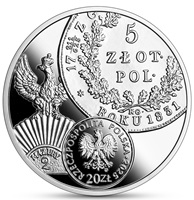
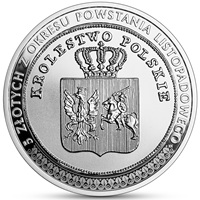
U dołu zaś wieńca widoczne są dwie litery: K· i G·, które są inicjałami intendenta mennicy – Karola Gronau. W otoku przy krawędzi monety przedstawiono dokładnie stopę menniczą pięciozłotówek i datę: 17 211/625 Z GRZYW·CZYST·KOL· * ROKU 1831 *. Na obrzeżu wymowny napis: BOŻE ZBAW POLSKĘ. Na awersie monety kolekcjonerskiej o nominale 20 złotych wykorzystano rewers opisanej wyżej monety pięciozłotowej z dobrze widocznym nominałem 5 / ZŁOT· / POL· oraz znamienną datą 1831. Nowym elementem jest orzeł z czapki oficera 2 pułku Mazurów. Dominuje jednak okrąg z wizerunkiem orła ustalonym dla godła Rzeczypospolitej Polskiej, napisem: RZECZPOSPOLITA POLSKA· 2025 i nominałem: 20 ZŁ. Jedynym znaczącym elementem rewersu tejże monety jest oryginalny stempel awersu powstańczej pięciozłotówki. Widzimy tam dwupolową, ukoronowaną tarczę z Orłem i Pogonią oraz legendą: KRÓLESTWO POLSKIE. Temat nowej monety został przedstawiony w pierścieniu okalającym: 5 ZŁOTYCH Z OKRESU POWSTANIA LISTOPADOWEGO. Jedyną zaś ozdobą jest umieszczony na dole ornament zaczerpnięty z pamiątkowego pudełka z kompletem monet powstańczych. Informacja: Stanisław Suchodolski.
History of the Polish Coin –
5 złoty from the Period of the November Uprising
www.nbp.pl
Narodowy Bank Polski is the central bank of the State, responsible for its monetary policy and price stability. The Bank’s functions are described in the Constitution of the Republic of Poland and the Act on NBP. NBP holds the exclusive right to issue the currency of the Republic of Poland. As the central bank, it does not provide accounts for the general public, accept deposits from or extend loans to individuals. It acts as a banker to the State budget and public sector entities. NBP also holds and manages the foreign exchange reserves of the State. Finally, it functions as a banker to banks, creating conditions for the operation of the Polish banking system. Narodowy Bank Polski is one of the most important research and analytical centres in the fields of economics and financial markets.
Issuing collector items is an occasion to commemorate important historic figures and anniversaries, as well as to develop the interest of the public in Polish culture, science and tradition. On 26 November 2025, Narodowy Bank Polski issued into circulation a silver coin of the series “History of the Polish Coin” – “5 złoty from the Period of the November Uprising”, with a face value of 20 złoty.
Face value: 20 zł … Metal: Ag 925/1000; Finish: proof; Diameter: 38.61 mm; Weight: 28.28 g; Edge (side): plain; Mintage: up to 10,000 pcs; Designer: Dominika Karpińska-Kopiec; Issuer: Narodowy Bank Polski The coins, commissioned by Narodowy Bank Polski, were struck by Mennica Polska SA.
During the November Uprising (29 November 1830 – 7 September 1831), the Warsaw Mint operated at full capacity under difficult conditions. The Polish National Government demanded as much money as possible to cover its enormous expenses. As a result, during certain periods, the mint worked around the clock, and its employees “do not go home, but rest on straw in turns”. An additional problem was the installation of a cannon factory in the mint building, which also used the equipment there. To make matters worse, some employees were forcibly conscripted into the insurgent army, and there was a threat of even greater conscription. Another problem was the lack of raw materials for coin production. Attempts were made to remedy this by confiscating silver and gold items from temples of all faiths. Church bells were used to obtain raw materials for minting copper 3-grosz (trojak) coins.
Despite the outbreak of the uprising, the mint initially continued to strike coins using the old stamps. The change did not take place until after the dethronement of Nicholas I on 25 January 1831. As early as on 10 February, the mint was ordered to remove the tsar’s portrait from the dies and replace it with a new coat of arms of the Kingdom, depicting the Eagle and the Chase on a divided, crowned escutcheon. Copper 3-grosz (trojak) coins, billon 10-grosz coins, silver 2-złoty and 5-złoty coins, and gold ducats of the Dutch type were struck with this new emblem. A total of 7.5 million coins of all types were minted. A 5-złoty coin representing the insurgent currency was chosen as the theme for the new collector coin. Its obverse features the aforementioned coat of arms with the Eagle and the Chase. The inscription along the rim above clearly indicates that it symbolises the Kingdom of Poland. The reverse shows the denomination in the centre: 5 / ZŁOT· / POL·. This inscription is surrounded by a wreath of oak leaves. At the bottom of the wreath there are two letters: K· and G·, which are the initials of the mint’s administrator, Karol Gronau. Along the rim, the exact coinage standard of the 5-złoty coin and the date: 17 211/625 Z GRZYW·CZYST·KOL· * ROKU 1831 * are featured.
The edge bears a telling inscription: BOŻE ZBAW POLSKĘ (God save Poland). The obverse of the 20-złoty collector coin features the reverse of the 5-złoty coin described above, with a clearly visible face value: 5 / ZŁOT· / POL· and a memorable date: 1831. A new element is the eagle from the cap of an officer of the 2nd Masovian Cavalry Regiment. However, the dominant feature is a circle with the image of the Eagle established as the emblem of the Republic of Poland and the inscription: RZECZPOSPOLITA POLSKA (Republic of Poland) · 2025, and the denomination: 20 ZŁ. The only significant element on the reverse side of this coin is the original obverse side of the insurgent 5-złoty coin. It features a two-field crowned escutcheon with the Eagle and the Chase, and the legend: KRÓLESTWO POLSKIE (Kingdom of Poland). The theme of the new coin is presented in the ring along the rim: 5 ZŁOTYCH Z OKRESU POWSTANIA LISTOPADOWEGO (5 złoty from the period of the November Uprising). The only decoration is an ornament at the bottom, taken from a commemorative box with a set of insurrection coins. Info: Stanisław Suchodolski.
Skarby sztuki medalierskiej –
Michał Ossowski
www.nbp.pl
Narodowy Bank Polski jest centralnym bankiem państwa odpowiadającym za politykę pieniężną i stabilność cen. Jego funkcje określa Konstytucja Rzeczypospolitej Polskiej i ustawa o NBP. NBP ma wyłączne prawo emisji pieniądza. Jako bank centralny nie prowadzi rachunków bankowych obywateli, nie przyjmuje od nich lokat, nie udziela kredytów. Prowadzi natomiast obsługę budżetu państwa, a także podmiotów sektora finansów publicznych. Gromadzi rezerwy walutowe państwa i zarządza nimi. Pełni funkcję banku banków, tworząc warunki do działania systemu bankowego. Jest również jednym z najważniejszych ośrodków naukowo-analitycznych w dziedzinie ekonomii i rynków finansowych.
Emisja wartości kolekcjonerskich stanowi okazję do upamiętniania ważnych historycznych rocznic i postaci oraz do rozwijania zainteresowań polską kulturą, nauką i tradycją. 9 grudnia 2025 roku Narodowy Bank Polski wprowadził do obiegu srebrną monetę z serii „Skarby sztuki medalierskiej” – „Michał Ossowski” o nominale 50 zł.
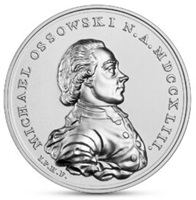
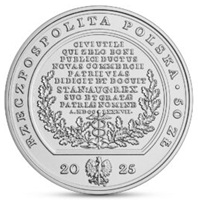
Nominał: 50 zł … metal: Ag 999/1000; stempel: zwykły, wysoki relief; średnica: 45,00 mm; masa: 62,20 g; brzeg (bok): gładki; nakład: do 5000 szt.; Projekt: Robert Kotowicz na podstawie medalu Jana Filipa Holzhaeussera; Emitent: NBP, Na zlecenie NBP monety wyprodukowała Mennica Polska SA.
Na awersie monety umieszczono tekst z rewersu medalu w tłumaczeniu z łaciny: „Obywatelowi użytecznemu, który prowadzony gorliwością dobra publicznego nowe drogi dla handlu ojczyzny wynalazł i wskazał, Stanisław August król, swoim i wdzięcznej ojczyzny imieniem, roku 1787”. Na rewersie monety widnieje odwzorowanie awersu medalu: popiersie w prawym profilu i napis (w tłumaczeniu z łaciny): „Michał Ossowski urodzony w roku 1743” oraz sygnatura medaliera: I. P. H. F. Projekt monety na podstawie zdjęcia medalu ze zbiorów Muzeum Narodowego w Krakowie, fot. Anna Olchawska.
Michał Ossowski (1743–1797), polski polityk i ekonomista, wniósł znaczący wkład w rozwój gospodarczy kraju. Studiował m.in. fizykę i teologię, a w 1773 r. przyjął święcenia kapłańskie. Dzięki doskonałemu wykształceniu został nauczycielem, a z czasem stał się bliskim przyjacielem i współpracownikiem Antoniego Protazego (Prota) Potockiego – późniejszego wojewody kijowskiego, bankiera i przedsiębiorcy. Ossowski podejmował liczne inicjatywy gospodarcze i postulował reformy ekonomiczne, dążąc do poprawy losu „ludu pospolitego”. Jako sprawny finansista promował różnorodne innowacje skarbowe, w tym emisję pieniędzy papierowych. Działał jako pełnomocnik Potockiego w nowo założonym banku w Warszawie, a także zakładał kantory, by rozwinąć polski handel. Podczas obrad Sejmu Czteroletniego Ossowski, jako deputowany, podjął pracę nad konstytucją ekonomiczną – mającą stanowić uzupełnienie konstytucji politycznej.
Wiosną 1792 r. Sejm uchwalił zaciągnięcie pożyczki zagranicznej na obronę kraju, wówczas ogromnej – w wysokości 30 milionów złotych. Ossowski, reprezentując bank niderlandzki Piotra de Häana, zaoferował udzielenie pożyczki w wysokości 15 milionów złotych. Mimo dopełnienia wszystkich formalności, przekazanie środków zostało wstrzymane po przystąpieniu króla Stanisława Augusta Poniatowskiego do konfederacji targowickiej. W 1791 r. o Ossowskim pisał Hugo Kołłątaj: […] będąc razem filozofem i gospodarzem, matematykiem i kupcem, a co do objętości rozumu prawdziwym geometrą, mógłby w tej mierze całemu przewodniczyć narodowi. Za swoje zasługi dla bankowości, przemysłu i rozwoju handlu czarnomorskiego ksiądz Michał Ossowski w 1787 r. został odznaczony przez króla Stanisława Augusta medalem wybitym w mennicy warszawskiej przez królewskiego medaliera Jana Filipa Holzhaeussera. Zgodnie ze zwyczajem król wręczał wyróżnionemu złoty egzemplarz, natomiast w ograniczonej liczbie bito także medale ze srebra oraz z brązu. Informacja: Marta Męclewska.
Treasures of the Medal-Making Art –
Michał Ossowski
www.nbp.pl
Narodowy Bank Polski is the central bank of the State, responsible for its monetary policy and price stability. The Bank’s functions are described in the Constitution of the Republic of Poland and the Act on NBP. NBP holds the exclusive right to issue the currency of the Republic of Poland. As the central bank, it does not provide accounts for the general public, accept deposits from or extend loans to individuals. It acts as a banker to the State budget and public sector entities. NBP also holds and manages the foreign exchange reserves of the State. Finally, it functions as a banker to banks, creating conditions for the operation of the Polish banking system. Narodowy Bank Polski is one of the most important research and analytical centres in the fields of economics and financial markets.
Issuing collector items is an occasion to commemorate important historic figures and anniversaries, as well as to develop the interest of the public in Polish culture, science and tradition. On 9 December 2025, Narodowy Bank Polski issued into circulation a silver coin of the series “Treasures of the Medal-Making Art” – “Michał Ossowski”, with a face value of 50 złoty.
Face value: 50 zł … Metal: Ag 999/1000; Finish: standard, high relief; Diameter: 45.00 mm; Weight: 62.20 g; Edge (side): plain; Mintage: up to 5000 pcs; Designer: Robert Kotowicz, design based on the medal by Jan Filip Holzhaeusser; Issuer: Narodowy Bank Polski, The coins, commissioned by Narodowy Bank Polski, were struck by Mennica Polska SA.
Michał Ossowski (1743–1797), a Polish politician and economist, made a significant contribution to the country’s economic development. He studied physics and theology, among other subjects, and was ordained a priest in 1773. Thanks to his excellent education, he became a teacher and, over time, a close friend and associate of Antoni Protazy (Prot) Potocki – the later Voivode of Kiev, banker and entrepreneur. Ossowski undertook numerous economic initiatives and called for economic reforms, striving to improve the fate of the ‘common people’. As a skilled financier, he promoted various fiscal innovations, including the issuance of paper money. He acted as the plenipotentiary of Potocki in a newly established bank in Warsaw and also set up merchant’s offices to develop Polish trade. During the debates of the Four-Year Sejm, Ossowski, as a deputy, began his work on an economic constitution – intended to supplement the political constitution. In the spring of 1792, the Sejm passed a resolution to take out a foreign loan for the defence of the country, which at that time was enormous – amounting to 30 million złoty. Ossowski, representing the Dutch bank of Peter de Häan, offered to grant a loan of 15 million złoty. Despite all the formalities being completed, the transfer of funds was suspended after King Stanisław August Poniatowski joined the Targowica Confederation.
In 1791, Hugo Kołłątaj wrote about Ossowski: […] being at once a philosopher and a farmer, a mathematician and a merchant, and in terms of the breadth of his intellect – a true geometrician, he could preside over the entire nation in this regard. For his services to banking, industry and the development of the Black Sea trade, Father Michał Ossowski was awarded a medal by King Stanisław August in 1787, minted in the Warsaw mint by the royal medallist Jan Filip Holzhaeusser. In accordance with custom, the king presented the awardee with a gold medal, while a limited number of silver and bronze copies were also minted. The obverse of the coin features the text from the reverse of the medal (in translation from Latin): To a useful citizen who, guided by his zeal for the public good, discovered and pointed out new trade routes for his homeland – Stanisław August the King, in his own name and on behalf of the grateful homeland, in the year 1787. The reverse of the coin features a reproduction of the obverse side of the medal: a bust in right profile and an inscription (in translation from Latin): Michał Ossowski, born in 1743, as well as the medallist’s signature: I. P. H. F. The coin design is based on a photograph of a medal from the collection of the National Museum in Kraków by Anna Olchawska. Info: Marta Męclewska.
Hanukkah (2025): Booklet of 6 Permanent™ Stamps
www.canadapost.ca
This booklet of six Permanent™ domestic rate stamps marks the Jewish festival of Hanukkah, one of the more widely embraced celebrations in the Jewish calendar. The Hanukkah stamp is one of several annual issues that mark events of importance to Canada’s culturally diverse population. The others include Eid, Diwali and Christmas.
Hanukkah, also called the Festival of Lights, commemorates the rededication of the Temple in Jerusalem (Judaism’s holiest site) after the Jewish people reclaimed it around 165 BCE. According to Jewish tradition, the Temple’s menorah was to burn continuously; however, there was enough oil to last only one day. Miraculously, it lasted the eight days it took to harvest, press and transport a fresh supply of oil. This miracle of light and faith is commemorated each year through the kindling of a hanukkiyah, or menorah – a candelabrum bearing a row of eight candle or oil holders and a central “helper” candle, called a shamash, that is used to light the others. Prayers, traditional songs and religious readings are often part of the lighting ceremony. Gift giving has also become a common practice – the traditional gift being small amounts of Hanukkah gelt in the form of either real money or chocolate coins. Fried foods – such as latkes and jelly doughnuts – are strongly associated with Hanukkah, while olives, olive branches and cruses of oil are sometimes used to symbolize the miracle of the oil at the heart of the story behind the festival.
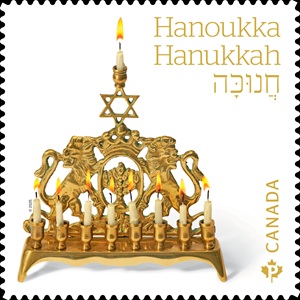
The dreidel – a spinning top that children play with during the holiday – also has a special connection. The Hebrew letters on the four sides of the dreidel stand for the phrase Nes gadol haya sham, which means, “A great miracle happened there.” The lion is an emblem of strength and courage that holds a special place in Jewish culture. As a symbol of the Tribe of Judah and its descendants, which include King Solomon and King David, it has also come to represent the Jewish people. The central figures on the brass hanukkiyah featured on this year’s Hanukkah stamp pay homage to King Solomon, whose throne was flanked by statues of lions. Other elements of its design recall the story behind Hanukkah. The crown represents the Torah and the return of the Jewish kingship after the Maccabees recaptured Jerusalem. The menorah positioned below the crown is a reminder of the one that burned continuously in the Temple of Jerusalem. A Star of David holds the helper candle (shamash) used during Hanukkah’s nightly candle-lighting ritual.
The artifact was donated to the Aron Museum at Temple Emanu-El-Beth Sholom in Montréal, Quebec, in 1960 in memory of founding benefactor Josef Aron. Crafted in Western Europe in the early 1900s, it is one of more than two dozen Hanukkah menorahs in the museum’s collection. The others date back as early as the 18th century. Stamp Designer: Subplot Design Inc; Quantity Produced: 330,000 (55,000 booklets of 6 stamps); Issue Date: November 13, 2025. This Official First Day Cover marks the Jewish festival of Hanukkah, one of the more widely embraced celebrations in the Jewish calendar. The cover of the OFDC features a silver oil hanukkiyah crafted in 19th-century Germany, courtesy of Aron Museum, Temple Emanu-El-Beth Sholom, Montréal (photo – Matthew Liteplo). It was cancelled in Montréal, Quebec, home of the Aron Museum, where the artifact is housed. The cancel depicts rays of light emanating from the hanukkiyah. Cancellation Site: Montréal, Quebec; Stamp Designer: Subplot Design Inc; Quantity Produced: 4,500; Issue Date: November 13, 2025.
2025 … Graphic Novelists:
booklet of 12 Permanent™ stamps
www.canadapost.ca
The Graphic Novelists issue celebrates the work of some of Canada’s most talented and influential graphic novelists: ***Kate Beaton – Ducks: Two Years in the Oil Sands: ***Jimmy Beaulieu – Non-aventures : planches à la première personne; ***Guy Delisle – Chroniques de Jérusalem (Jerusalem: Chronicles from the Holy City); ***Julie Doucet : Journal (365 Days); ***Bryan Lee O’Malley – Scott Pilgrim’s Precious Little Life; ***Michael Nicoll Yahgulanaas – Red, A Haida Manga. The stamps feature original illustrations created exclusively for the issue.
Good to know … Booklet of 12 Permanent™ domestic rate stamps issued on November 20, 2025. Each booklet of 12 Permanent™ stamps includes two of each of the six designs in the set. This issue also includes six Official First Day Covers – one for each stamp.
About the Graphic Novelists issue … This set of six stamps – the second in a two-part series (the first was issued in 2024) – pays tribute to some of Canada’s most talented and influential graphic novelists – Kate Beaton, Jimmy Beaulieu, Guy Delisle, Julie Doucet, Bryan Lee O’Malley and Michael Nicoll Yahgulanaas. These stamps – featuring an acclaimed novel by each author – show the main characters engrossed in their own stories through original illustrations created exclusively for this issue.
About the design … The stamp booklet cover features a photograph of the spines of the six graphic novels whose main characters are featured on the stamps. The back features a short text on the issue. Stamp Designer: Subplot Design Inc.; Quantity Produced: 1,560,000; Issue Date: November 20, 2025.
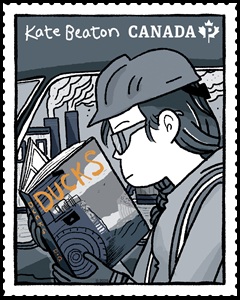
Kate Beaton … Known for her sharp wit and keen sense of the absurd, Kate Beaton (b. 1983 in Mabou, Nova Scotia) launched her career in 2007 with the irreverent webcomic series Hark! A Vagrant – parts of which later appeared in award-winning collections. A history graduate and self-taught artist, Beaton published her first full-length graphic novel, Ducks: Two Years in the Oil Sands, in 2022. The memoir, about her “migration” to the Northern Alberta oil sands to work off her student debt, has been hailed by critics as an intimate, damning, yet profoundly human exposé of the industry. In 2023, Ducks became the first graphic novel to win CBC’s prestigious Canada Reads competition.

Jimmy Beaulieu … A prolific member of Quebec’s comic book scene, Jimmy Beaulieu (b. 1974 in L’Île-d’Orléans, Quebec) has been involved in the industry as a bookseller, author, illustrator, publisher, teacher and critic. Although his only training was a drawing class he took as a teen, the award-winning artist moved to Montréal in his mid-20s to become a cartoonist and published his first comic book in 2000. His graphic novel Non-aventures : planches à la première personne (2013) is a collection of anecdotes and reflections on the “non-adventures” of his daily life. The 2015 edition won the Prix de la critique de la bande dessinée québécoise from the Association des critiques et journalistes de bande dessinée.

Guy Delisle … Internationally acclaimed for his candid and largely autobiographical graphic novels, Guy Delisle (b. 1966 in Québec, Quebec) studied and worked in animation before branching out into comics. His more than dozen works are characterized by captivatingly simple line drawings and a spare style of storytelling. Tinged with dry humour, they explore everything from the peculiarities of parenting to life in communist North Korea. Chroniques de Jérusalem (2011; Jerusalem: Chronicles from the Holy City, 2012) is Delisle’s sensitive and insightful travelogue about a year spent in Jerusalem while his wife was there on assignment. It won several major awards, including the Fauve d’or at the Angoulême International Comics Festival.

Julie Doucet … Julie Doucet (b. 1965 in Montréal, Quebec) is considered one of the most daring and influential women in her field. Also an accomplished printmaker, she made her foray into comics in 1988 with a series of frank, funny and often unsettling strips about her day-to-day life, dreams, angst and fantasies. One of her many graphic novels, Journal (2004; 365 Days, 2007) chronicles a year in her life as an artist through a unique mix of drawing, collage and text. Doucet’s achievements include induction into the Canadian Comic Book Hall of Fame and winning the prestigious Grand Prix for lifetime achievement at the Angoulême International Comics Festival – the highest award in European cartooning.

Bryan Lee O’Malley … Cartoonist Bryan Lee O’Malley (b. 1979 in London, Ontario) based the six graphic novels in his wildly popular Scott Pilgrim series (2004-10) on his life at the time. The cult hit – a quirky, action-packed love story about a young slacker in a Toronto garage band who sets out to defeat his new girlfriend’s evil exes – spawned a major motion picture, a video game and an animated series. Of French-Canadian and Korean descent, O’Malley uses a drawing style reminiscent of Japanese anime and manga in the award-winning series, which kicked off with Scott Pilgrim’s Precious Little Life (2004).
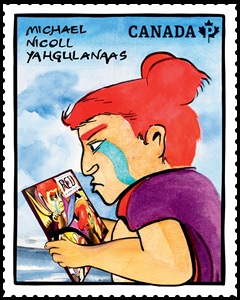
Michael Nicoll Yahgulanaas … A self-taught multimedia visual artist, Michael Nicoll Yahgulanaas (b. 1954 in Prince Rupert, British Columbia) created his own method of painting and illustration by blending Asian brush techniques with Indigenous iconography. In his graphic novel Red, A Haida Manga (2009), Yahgulanaas uses this distinct style to pay homage to his roots on Haida Gwaii in the northeast Pacific. The tragic story – passed down through oral tradition – tells of two orphaned siblings whose peaceful lives are destroyed by the desire for revenge. The pages of the printed book can be removed and connected by their flowing “framelines” to recreate a 7.5-square-metre watercolour fresco by Yahgulanaas.
Radiance – $200 Pure Gold Coin
www.mint.ca
Experience Opulence, featuring the sunny sparkle of yellow diamonds. One of only two exquisite additions to our prestigious Opulence collection in 2025, Radiance embodies refined luxury—featuring rare Arctic-mined yellow diamonds, pure gold, and masterfully handcrafted 18-karat gold mounts, all presented in an artisanal case designed to elevate the experience of ownership. Its six marquise-cut fancy yellow diamonds—among the rarest of Earth’s gems—are a vision of light and luminosity on the coin’s reverse, where they bask in the warm glow of the gold that surrounds them. Each diamond facet dances like rays of sunlight on a bright summer day, much like the delicate yellow petals that hang gracefully from a Canada lily, evoking the allure of something truly extraordinary. Limited and luminous—with a mintage of just 30 coins, Radiance is one of our most exclusive releases of the year, a be jewelled celebration of beauty as rare as the gems themselves.
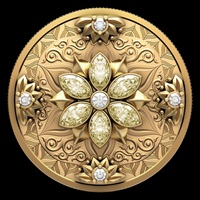
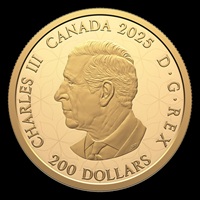
Face Value: $200 … Composition: 99.99% pure gold, with six marquise cut fancy yellow diamonds (min. 1.14 total carat weight); Mintage: 30; Weight: 31.16 g; Diameter: 30 mm; Edge: Serrated; Finish: Proof; Artist: Simon Ng (reverse), Steven Rosati (obverse). Packaging: Matte black wood case with a removable coin tray that slides into the wood stand for an upright display. Also included: gloves, dusting cloth, two certificates of authenticity and a welcome letter.
DID YOU KNOW? … The yellow diamonds on this coin come from the Ekati Diamond Mine, Canada’s first surface and underground diamond mine, which is owned and operated by Burgundy Diamond Mines. Located in the Northwest Territories, the mine is primarily known for its production of high-quality white diamonds, with yellow and the rare fancy yellow diamonds accounting for a small percentage of its total yield. Globally, fancy yellow diamonds make up less than 1% of all diamonds mined worldwide.
Designed by Canadian artist Simon Ng, the engraved art on the coin’s reverse surrounds a jewellery adornment shaped like a Canada lily (Lilium canadense), its tepals formed by six marquise-cut fancy yellow diamonds (minimum total carat weight of 1.14) that surround a round-cut white diamond at the centre, all set in an 18-karat gold mount. The be jewelled centrepiece sits atop an engraved sunburst; inspired by the compass star, the sunburst radiates light across the arrangement of stylized plant elements and towards the four sun-like flowers representing the cardinal directions along the edge, where each one is adorned with a round cut white diamond. An engraved lily shape forms a repeating pattern on the obverse, which features the effigy of His Majesty King Charles III by Canadian artist Steven Rosati.
Simon Ng, Artist … “The compass star was placed at the centre as a play on the title, Radiance. It provides a visually striking and flexible foundation for the placements of diamonds at various locations, thereby permitting them to exhibit their brilliance at their collective best. The four flowers representing the four cardinal points along the border further convey the Radiance imagery with their outstretched, sunflower-like petals. Figuratively, there is sunlight in every direction.”
Louis-Remi Labelle, 3D Artist-Engraver … “With beautiful and intricate designs like this one, it’s always a pleasure to give them form and bring them alive through engraving. This series is very much a coordinated team effort; making sure the wonderful jewellery pieces fit well on the coin, and that the engraving and jewellery complement one another, is quite the challenge!”
Brilliance – 10 oz. Pure Platinum Coin
www.mint.ca
Where light meets luxury: A platinum and yellow diamond Opulence exclusive. In nature, the Canada lily brightens its surroundings with its vibrant yellow petals; on Brilliance, the be jewelled bloom serves as the most exquisite emblem of nature’s luminous beauty and resilience. Adorned with 23 Canadian-sourced fancy yellow diamonds that are among Earth’s rarest gems, the 2025 platinum addition to our prestigious Opulence collection is an extraordinary work of art that shimmers with the glow of scarcity and elegance. Each precision-cut to maximize sparkle, the yellow diamonds’ golden fire is set against a refined fusion of precious metals, with the cool sophistication of platinum warmed by selective touches of gold plating. Together, these rare elements form a striking harmony of light and luxury, transforming the design’s dazzling floral energy into an incomparable visual experience that commands admiration from every angle.
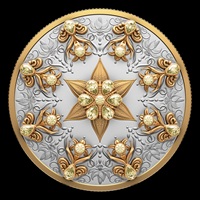
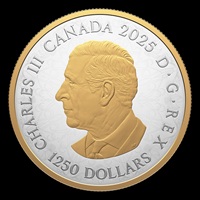
Face Value: $1250 … Composition: 99.95% pure platinum with selective gold plating, plus 14 pear cut and nine round cut fancy yellow diamonds set in 18-karat gold mounts; Mintage: 10; Weight: 311.53 g; Diameter: 76 mm; Edge: Serrated; Finish: Proof; Artist: Chris and Rosina Reid (reverse), Steven Rosati (obverse). Packaging: Matte black wood case with a removable coin tray that slides into the wood stand for an upright display. Also included: gloves, dusting cloth, two certificates of authenticity and a welcome letter.
DID YOU KNOW? … The yellow diamonds on this coin come from the Ekati Diamond Mine, Canada’s first surface and underground diamond mine, which is owned and operated by Burgundy Diamond Mines. Located in the Northwest Territories, the mine is primarily known for its production of high-quality white diamonds, with yellow and the rare fancy yellow diamonds accounting for a small percentage of its total yield. Globally, fancy yellow diamonds make up less than 1% of all diamonds mined worldwide.
Designed by Canadian artists Chris and Rosina Reid, the coin’s engraved reverse celebrates the Canada lily (Lilium canadense) and is adorned with 14 pear cut and nine round cut fancy yellow diamonds (minimum total carat weight of 6.13) set in 18-karat gold mounts. Seven of those diamonds form the be jewelled centre of the largest lily, which is surrounded by eight additional jewelled appliqués and engraved elements that, together, show the lily in various stages of growth. A line-art representation of this arrangement appears on the obverse, which features the effigy of His Majesty King Charles III by Canadian artist Steven Rosati.
Chris and Rosina Reid, Artists … “This limited-edition design is inspired by the Purely Brilliant collection and the elegance of fine jewellery, reinterpreting the lily as a symbol of natural beauty. It blends Art Nouveau influences with modern forms, using detailed motifs and flowing lines to reflect the flower’s growth from bud to full bloom. Designed to incorporate diamonds, the piece emphasizes fluidity and movement in its composition.”
Cecily Mok, 3D Artist-Engraver … “Take a closer look at the engraving surrounding the jewellery pieces—you’ll find lots of incredible details, delicate and deliberately understated, to complement the sparkling flowers. There’s a discernible flow to the scrollwork, and many shapes are raised and faceted to resemble a precision-cut gemstone. On the obverse, I created the line-art pattern based on the reverse’s engraved elements, moving some of the original scrollwork and adding stylized shapes that capture the essence of the flower-and-gemstone theme without overwhelming the space. Finally, with the frostings, we try to keep things shiny with this collection by amplifying light in a way that exudes sophistication.”
Christa Bruce, Product Manager … “Creating a numismatic coin for the prestigious Opulence collection, one that is adorned with yellow diamonds and Canada lilies, fills me with immense pride as it symbolizes the pinnacle of craftsmanship and artistic excellence. Each coin is a testament to our dedication to beauty and meticulous detail, while celebrating the rich heritage and natural splendour of Canada.”
2026 … Lunar Year of the Horse –
1 kg Pure Gold Coin
www.mint.ca
This Year of the Horse coin invites you to ignite the trailblazer in you. According to the Chinese zodiac, the Horse brings with it energy and dynamism, and in 2026, those traits are coupled with the Fire element that sparks transformation and fuels the passion that propels us toward our dreams. People born in the year of the Fire Horse are self-reliant trailblazers and savvy trendsetters blessed with an abundance of confidence and enthusiasm—they don’t give up and they’re always on the go. The Horse’s spirit of advancing bravely toward its goals is beautifully reflected on this 99.99% pure gold kilo coin, which features an abundance of auspicious symbols representing both vitality and good fortune.
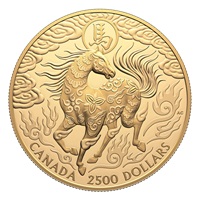
Face Value: $2,500 … Composition: 99.99% pure gold; Mintage: 66; Weight:1005 g; Diameter: 102 mm; Edge: Serrated; Finish: Proof; Artist: Aries Cheung (reverse), Steven Rosati (obverse); Packaging: Red lacquered wood box with red graphic beauty box.
DID YOU KNOW? … ***Each year in the Chinese zodiac’s 12-year cycle is ruled by a different sign and one of the five elements, with Fire being the element for 2026. Horses are free-spirited, confident and energetic (they don’t like to be bored), but Fire Horses are known to be bolder and more decisive. The last year of the Fire Horse was 1966.
The reverse design by artist Aries Cheung celebrates the spirit of advancing bravely towards goals without hesitation in 2026, the year of the Fire Horse. A shining example of vitality, the free-spirited Horse is seen blazing its own trail and proudly looks back at the fire it has generated along the way, while auspicious clouds fill the sky above. The Horse is adorned with auspicious qi (or chi) motifs that symbolize energy; ru yi (or yu yi) patterns that represent granted wishes for protection; wings that reflect the Horse’s celestial status and speed; stylized wild horses and calla lilies, the Horse’s lucky flower; and a chest emblem that traditionally symbolizes hope, wellness and pending good fortune. The reverse also includes the word “CANADA” and a face value of “2500 DOLLARS”. The obverse features the effigy of His Majesty King Charles III by Canadian artist Steven Rosati.
Aries Cheung, Artist … Like most Chinese paintings of horses, which often express our love and affection for them, my design highlights their robust form and vigorous spirit, portraying their natural vitality and reflecting our yearning for freedom and life. The auspicious “qi” (or “chi”) motif on the body symbolizes the very essence of life and the dynamic flow of energy. This resonates beautifully with the sparks-and-fire motif emanating from the racing horse, embodying the vibrant and unstoppable force of a life journey. Together, they capture the horse’s trailblazing vitality that propels one forward on this path.
2026 … Heraldic Lion –
Pure Silver EHR/UHR Coin
www.mint.ca
Another Canadian heraldic animal—this time, the lion—is reimagined in Extraordinarily High Relief. You won’t find a lion in the wilds of Canada, but the noble king of beasts holds a lofty place in Canadian heraldry. Displayed on both the crest and shield of the Coat of Arms of Canada, and as one of its supporters, the heraldic lion symbolizes both Canada’s sovereignty and our historic ties to the United Kingdom, while also embodying the virtues of bravery, courage and strength. The follow-up to 2025’s Heraldic Bear, this 99.99% pure silver coin presents a different take on the lion found in many official Canadian emblems. Reimagined in a heraldically stylized manner, the stately creature is depicted in a forward-facing pose and sculpted in Extraordinarily High Relief (EHR), while the wreath of floral emblems is engraved in Ultra High Relief (UHR), resulting in differing, eye-catching relief heights. Enjoy a fresh take on a heraldic creature found in many Canadian emblems.
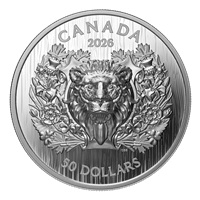
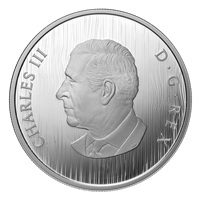
Face Value: $50 … Composition: 99.99% pure silver; Mintage: 2,000; Weight: 68 g; Diameter: 50 mm; Edge: Serrated; Finish: Proof; Artist: Cathy Bursey-Sabourin (reverse), Steven Rosati (obverse); Packaging: Black clamshell with black beauty box.
DID YOU KNOW? … Strong and noble, the lion is a common emblem in Canadian heraldry—in fact, it is featured in eight of the 10 provincial arms. You’ll find several lions in the Arms of Canada: in the shield, as a supporter of the shield, and as part of the crest that also appears on the flag of the Governor General.
Backed by a woodgrain pattern, the reverse design by Cathy Bursey-Sabourin features a lion depicted in a heraldically stylized manner within a cartouche frame. The lion is presented in a forward-facing pose and engraved in Extraordinarily High Relief (EHR). The surrounding wreath is engraved in Ultra High Relief (UHR) and consists of floral emblems from the Arms of Canada—the Tudor rose of England, the thistle of Scotland, the shamrock of Ireland, the lily of France, and Canada’s maple leaf—along with seed pods, flower buds and maple keys signifying renewal and hope for the future. The woodgrain pattern also appears on the obverse, which features the effigy of His Majesty King Charles III by Canadian artist Steven Rosati.
Cathy Bursey-Sabourin, Heraldry Expert and Coin Artist … “The design was based on reimagining elements from the Canadian Coat of Arms, featuring a lion’s head and the floral emblems of England, Scotland, Ireland and France, as well as maple leaves for Canada. The lion is placed on a cartouche frame similar to the one used on the previous coin in the series, and evoking the curls of wood created when woodworking. This element represents a walk in the woods, connecting the flora and fauna elements of the design, albeit in a figurative way. Obviously, one would not encounter a lion or some of the floral elements on this coin in a Canadian setting, but the symbolism of heraldry is not bound by the logic of nature!”
Dr. Samy Khalid, Chief Herald of Canada and Director of the Canadian Heraldic Authority … “From its very beginnings, heraldry has featured the lion as a powerful and inspiring symbol. We see it in the arms of Canada and in those of eight of the 10 provinces, and it is used as an emblem in many cultural traditions around the world. The design of this new coin admirably depicts this king of the animal world, along with the floral emblems found in the arms of Canada.”
Steven Stewart, Engraver-3D Artist … “The real challenge of this project is to live up to the beautiful work that Louis-Rémi did on the previous Heraldic Bear coin. My intent was to sculpt in the same visual style as the Bear, so that those lucky enough to own it could proudly present these two coins side-by-side, and that they could be in dialogue with each other in terms of sculpting approach and stylistic execution. It is worth mentioning that, personally, this project was a joy because of the rare opportunity to sculpt a lion that, although representative of Canadian iconography, does not appear very frequently in our coin designs.”
2025 … $20 Fine Silver Coin – Dinosaur Eye
www.mint.ca
See the prehistoric world through the eye of a top predator. Travel back to an age when dinosaurs ruled the Earth and see the world as they saw it! With each new fossil discovery, paleontologists are able to piece together new information about what the world looked like millions of years before us, and this oval-shaped coin presents a view of that long-gone reality. Its oval outline is perfectly shaped for an extreme closeup of the eye (and scaly eyelid) of Thanatotheristes, the most ancient Canadian tyrannosaur and the top predator of its time. For another view of this species, take a closer look at the colourful reflection in the eye – you’ll notice that this fearsome two-legged carnivore wasn’t travelling alone. The oval shape returns — this time, as a dinosaur eye!

Face Value: $20 … Composition: 99.99% pure silver; Mintage: 8,500; Weight: 31.66 g; Diameter: 48 mm x 30.33 mm; Edge: Serrated; Finish: Proof; Artist: Julius Csotonyi (reverse), Steven Rosati (obverse); Packaging: Black clamshell with black beauty box.
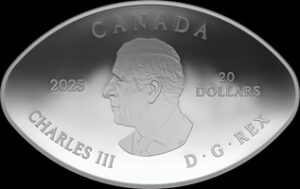
Good to know … ***A realistic dinosaur eye. Shaped like a tyrannosaur eye, this 99.99% pure silver coin transports you back in time to when dinosaurs roamed the earth! ***Our second curved, oval-shaped coin for this size. The oval shape from our 2017 football coin is back, and this time, the curved outline and convex reverse lend themselves beautifully to a realistic rendering of a dinosaur eye. ***An ‘eye’ for details. The reverse features an outstanding amount of finely engraved details that re-create Thanatotheristes’s scaly skin and eye area, while the centre portion is coloured to provide a stunning view of the prehistoric world reflected in the dinosaur’s eye. ***Scientifically accurate. The artist is a well-known Canadian paleoartist. Your coin’s reverse design was also reviewed by the Royal Tyrrell Museum of Palaeontology, which was involved in identifying this tyrannosaur species. ***For dinosaur lovers of all ages. Dinosaurs are always a popular theme with collectors and Canadians of all ages, and they’re an important part of Canada’s natural heritage. ***A limited collectible. Only 8,500 coins are available to collectors worldwide. ***Includes serialized certificate. The Royal Canadian Mint certifies all of its collector coins.
Did you know? … Measuring up to 10 metres in length and weighing up to 2.5 tonnes, Thanatotheristes (“Reaper of Death”) lived roughly 79.5 million years ago, which makes it one of the world’s oldest tyrannosaur species. As an apex predator, this toothy, two-legged carnivore preyed on herbivores such as Colepiocephale and Xenoceratops. Fossil remains discovered in the Foremost Formation, along the Bow River in Alberta, led to its naming in 2020, making it the most recently described tyrannosaur from Canada.
Behind closed doors … “My objective was to strike a balance between, on the one hand, the most vibrant use of color and dynamic form, posture and perspective of the scene of dinosaurs reflected in the convex eye; and on the other hand, a realistic, scientifically informed portrayal of the dinosaurs depicted in the reflection. Skin color patterns, anatomy and behaviour must all fit within plausible constraints reported by paleontologists. This attention to accuracy also extended to the shape and structure of the bird-like eye itself, not fully open in order to fit within the oval margin of the coin.” – Julius Csotonyi, Artist.
About the design … Your coin is encapsulated and presented in a black Royal Canadian Mint-branded clamshell with a black beauty box. Designed by Canadian paleoartist Julius Csotonyi, this oval-shaped coin’s reverse is a close-up of a tyrannosaur eye, specifically that of Thanatotheristes degrootum – the most ancient tyrannosaur species discovered in Canada, and also the most recently named (2020). While the skin and eyelid are covered in fine (engraved) scales, the dinosaur’s surroundings are colourfully reflected in the eye itself, revealing the presence of other individuals of this species, as they move through the swampy forests of Cretaceous western Canada. The obverse features the effigy of His Majesty King Charles III by Canadian artist Steven Rosati.
The Hunter – 10 oz. Fine Silver Coin
www.mint.ca
The Kwakiutl carved panel design from 2024’s The Hunter is superbly re-created on this 2025 piece, where the larger (76.25 mm) diameter provides more space for the master of the skies to spread his wings and fly. The Eagle is resplendent in yellow gold plating, as is the Orca’s fin seen moving through the waves below. Both sides of the coin feature an engraved woodgrain pattern that mimics the straight-grained look of western red cedar, while the twisted cedar rope frame has been brought in slightly to form a tighter fit around this 10 oz.-sized work of contemporary Kwakiutl art. A bigger canvas than in 2024, now in proof finish!

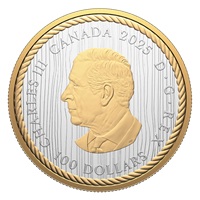
Face Value: $100 … Composition: 99.99% pure silver with yellow gold plating; Mintage: 750; Weight: 311.54 g; Diameter: 76,25 mm; Edge: Serrated; Finish: Proof; Artist: Jason Hunt (reverse), Steven Rosati (obverse); Packaging: Black clamshell with black beauty box.
DID YOU KNOW? … Wood panels are a newer art medium and a contemporary form of the centuries-old carving traditions of the Kwakiutl (Tsaxis) peoples of the Kwakwaka’wakw nation. Framed by braided cedar bark, the designs may be painted, sandblasted or carved as a relief, and may even include inlaid shells or metals. The artist behind this coin design, Jason Hunt, is known to limit his use of power tools when creating carved panels, opting instead for more traditional methods of roughing out and finishing his work.
Designed by Kwakiutl artist Jason Hunt and rendered in the traditional Northwest Coast formline style, the coin’s reverse depicts the Eagle—the master of the skies—hunting from above as it soars through the air, while the Orca’s fin appears in the waves below. To mimic the look of a hand-carved Kwakiutl cedar wood panel, the reverse and obverse both feature an engraved wood grain texture and a rope-like frame. The obverse features the effigy of His Majesty King Charles III by Canadian artist Steven Rosati.
Matt Bowen, Engraver … “For coins larger than 50 mm like tis one, we embark on a meticulous and time-intensive process, cutting the tooling directly into the press. This means every detail is crafted with utmost precision, ensuring that each coin is a masterpiece. While this method is more challenging, the result is a stunningly sized coin that truly stands out in any collection, a testament to our dedication and craftmanship.”
The Ancestor – $30 Fine Silver Coin
www.mint.ca
From the sky to the sea—the follow up to 2024’s The Hunter, this 2 oz. 99.99% pure silver coin dives into the cool Pacific waters for an unforgettable view of the Orca, guardian of the sea. The selectively gold-plated design by Kwakiutl artist Jason Hunt is styled to resemble a hand-carved cedar panel, with the engraved woodgrain pattern and rope-shaped rim on both sides completing the look. On the reverse, the expressive forms and flowing lines convey chaos amid the waves, as the Orca hunts the Salmon on a moonlit night. It is an exquisite tribute to the guardian spirit that traditionally represents family and strength, and a gorgeous snapshot of Kwakwaka’wakw culture. A continuation of 2024’s The Hunter.
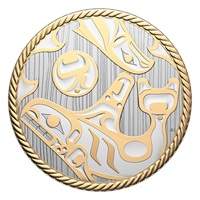
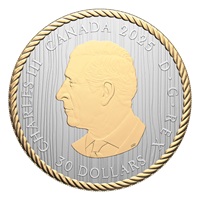
Face Value: $30 … Composition: 99.99% pure silver with yellow gold plating; Mintage: 3,500; Weight: 62.69 g; Diameter: 50 mm; Edge: Serrated; Finish: Modified Reverse Proof; Artist: Jason Henry Hunt (reverse), Steven Rosati (obverse); Packaging: Black clamshell with black beauty box.
DID YOU KNOW? … Artist Jason Hunt is of Kwaguilth descent and comes from a long line of internationally renowned Kwakiutl carvers and artists: “A few years ago, I was part of an exhibition that included works by my grandfather, Henry Hunt, and my father, Stanley Clifford Hunt. When my father and I travelled home, we had to quarantine at my place, and as we sat and looked out on the water, we started talking about the exhibition. Almost instantly, an orca appeared and visited us for the next few days. I like to think it was my grandfather coming by to be a part of the conversation. I’ll cherish that experience forever, and it symbolizes what the Orca represents to me.” – Jason Hunt, Artist.
Designed by Kwakiutl artist Jason Hunt and rendered in the Northwest Coast form line style, the reverse depicts the Orca, guardian of the sea, hunting the Salmon by the light of the moon. To mimic the look of a carved Kwakiutl wood panel framed by cedar bark rope, the reverse and obverse both feature an engraved woodgrain texture and a rope along the rim. The obverse features the effigy of His Majesty King Charles III by Canadian artist Steven Rosati.
Jason Hunt, Artist … “While creating this design, I had in mind some of my own personal experiences and interactions with orcas. I have had the pleasure of watching them hunt, play and feed. I have also wondered about what it must be like for them to hunt by moonlight in the evenings, and how surreal that would be to see. So, this design is showing the Orca hunting a Salmon under the Moon, with the design of the moon reflecting the chaotic nature of such events.”
Alicia Cook Sapene, Product Manager … “It was truly exciting to bring this project to life, especially the emphasis on the Orca, a revered guardian spirit to the Kwakiutl peoples. The richness of its symbolism and deep connection to nature makes this piece incredibly meaningful. I hope our collectors will treasure this piece of art as much as we do, knowing it embodies the strength, wisdom and protection that the Orca represents.”
Matt Bowen, Engraver … “It’s super interesting to sculpt a project that has a high technical threshold! A rope-shaped coin rim is uncommon, so this was a challenging and compelling piece to work on. I just love Jason’s Kwakiutl aesthetic, and his designs translate wonderfully to a coin, so I was psyched to be tapped two years in a row to re-create his art in silver—first for The Hunter, and now The Ancestor.”
Canadian Symbol: The Beaver –
Fine Silver Coin
www.mint.ca
Dive into the beaver’s world with this Double EHR coin. An official emblem of Canada since 1975, the beloved beaver is a natural ecosystem engineer, known for altering the environment to suit its needs. Though many of Castor canadensis’ busy building activities are obscured from our land-based view, its labours are front and centre on this coin, where the two-sided design welcomes you into the beaver’s secret world by presenting different views of the same scene.
Think of the coin as the water’s surface, with one side (reverse) our view from above the water, and the other (obverse) a view from below. And on both sides, the perspective of the beaver family hard at work on their new home is engraved in Extraordinarily High Relief (EHR) and selectively plated with yellow gold.
It’s a specially engineered tribute to the beaver’s instinctive ingenuity, one that fuses the art of engineering and the spirit of the Canadian wilderness! Pure Canadiana: See one of Canada’s national symbols in Double EHR.
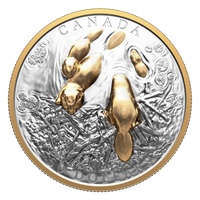
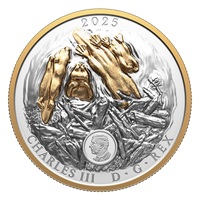
Face Value: $50 … Composition: 99.99% pure silver with yellow gold plating; Mintage: 2,750; Weight: 100.74 g; Diameter: 50 mm; Edge: Serrated; Finish: Proof; Artist: Maurade Baynton (reverse), Steven Rosati (obverse); Packaging: Black clamshell with black beauty box.
DID YOU KNOW? … A beaver lodge is typically located in the middle of a pond or near the edges of a waterway—far enough from land predators, but still in shallow waters so that the top portion of the lodge sits above the surface. Once the pile of sticks and tree limbs is high enough, the beavers excavate an underwater passageway to the centre, where they gnaw through the debris to create interior living chambers, where they’ll remain warm and dry during the winter. The lodge continues to be enlarged throughout the fall, with a mud coating providing concrete-like insulation against the elements.
Designed by artist Maurade Baynton, the coin’s reverse features an above-water view of a family of beavers (Castor canadensis)—an adult male and female, and their two kits—building a lodge, while the obverse presents an underwater perspective of the same scene; on both sides, the beavers are engraved in Extraordinarily High Relief (EHR) and plated with yellow gold. On the reverse, one of the kits (top left) swims alongside its mother, setting off gentle ripples across the surface of the water dotted with lily pads, as the female inserts another branch into the pile. The male is just entering the water from atop the lodge, his head and front legs visible on the obverse, which offers a better view of the submerged kit. The obverse also features the effigy of His Majesty King Charles III by Canadian artist Steven Rosati.
Maurade Baynton, Artist … “I chose to render my designs in clay as it gave me the opportunity to line up and view the elements three -dimensionally, both above the waterline and below. Thinking in reverse was very challenging, and the underwater design is the complete opposite of what you’d think it would be: on the obverse, the female and kit had to be positioned on the right so they’d line up with their left positioning on the reverse, and it was the same with the other elements.”
Aida Alves, 3D Artist-Engraver … “Unlike a standard design, where one side typically takes precedence in complexity, for this coin, we made both the obverse and reverse equally intricate, essentially sculpting two coins in one. We set out to ensure both sides of this Extremely High Relief coin flowed together seamlessly, which was a challenge. Collaboration with Product Engineer Christian Brochu was crucial: we had to experiment with volume distribution to ensure the coin struck properly while maintaining clarity and depth on both sides; and we had to push the limits of the draft angle to maintain the highest level of detail along the contours of the beavers. Maurade Baynton’s clay sculpture served as my main reference and I enjoyed translating her detailed art into engraved relief. I feel like my addition of the lily pads and ripples in the water not only made the design more production-friendly, it also made the beavers’ environment more authentic and realistic. This was a true blend of artistic vision, engineering precision and teamwork, which made this project both challenging and fun!”
The Goldfinch and the Bloom –
$50 Pure Silver Coin
www.mint.ca
Recognized by its black and canary-yellow breeding plumage, a goldfinch delivers a dose of sunshine in feathery form wherever it appears, whether at backyard feeders or in the sunflower patch featured here. This 2025 fine silver movement coin perfectly captures and preserves the spirit of summer through an interactive reverse design, which encourages you to tilt your coin for a glimpse of nature in motion. Cast in silver, the 3D goldfinch and sunflower bloom are both plated with yellow gold that conveys the warm glow of the summer sun, as the small-but-majestic bird circles the outer edges of the sunflower’s petals. Tilt your coin to make this little goldfinch fly.
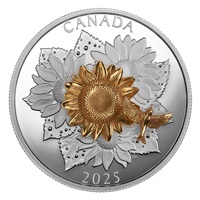
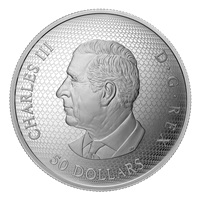
Face Value: $50 … Composition: 99.99% pure silver with selective yellow gold plating; Mintage: 1,250; Weight: 157.6 g; Diameter: 65.25 mm; Edge: Serrated; Finish: Proof; Artist: Ryan Poser (reverse), Steven Rosati (obverse); Packaging: Wood circular base with black beauty box.
DID YOU KNOW? … ***Almost all (90%) of Canada’s sunflower crop is grown in Manitoba, while the balance is grown in southern Alberta, Saskatchewan and southern Ontario. ***If you live in southern Canada and would like to attract a goldfinch to your backyard feeder, add some black oil sunflower seeds and nyjer seeds—these are a goldfinch’s favourite foods.
Designed by RCM Engraver Ryan Poser, the coin’s reverse captures the light and colours of a summer day in an open field, where sunflower (g. Helianthus) blooms tower above leaves dotted with raindrops. The 3D flower at the centre has attracted the attention of a seed-eating American goldfinch (Spinus tristis); both are cast in sterling silver and plated with yellow gold, and when the coin is tipped, the motion causes the goldfinch to circle the bloom. The obverse features the effigy of His Majesty King Charles III by Canadian artist Steven Rosati.
2025 … Legend of the Dreamcatcher –
$20 Fine Silver Coin
www.mint.ca
The dreamcatcher: Celebrate a timeless symbol of love and protection. More than a collectible, this 99.99% pure silver coin is a powerful tribute to Ojibwe heritage, brought to life through the artist’s representation of the dream catcher tradition. Crafted with deep intentionality, the design focuses on a matriarch—the creator of the dreamcatcher featured here—who is also seen nurturing her child within the form of the soaring Eagle that is a sacred connection to the Creator. From healing florals to wigwams representing community, every engraved element beautifully reflects the Anishinaabe understanding of balance, protection and the interconnectedness of all living things. Modern artistry rooted in tradition.
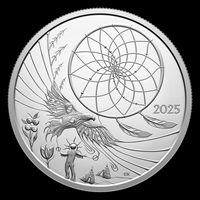
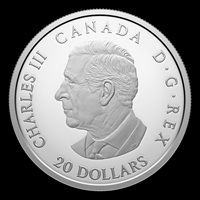
Face Value: $20 … Composition: 99.99% pure silver; Mintage: 5,000; Weight: 31.39 g; Diameter: 38 mm; Edge: Serrated; Finish: Proof; Artist: Emily Kewageshig (reverse), Steven Rosati (obverse); Packaging: Black clamshell with black beauty box.
DID YOU KNOW? … Known as asabikeshiinh (“spider”) or bawaajige nagwaagan (“dream snare”) in the Ojibwe language, the dream catcher is believed to have the spiritual power to capture negative thoughts and nightmares, much like a spider’s web. It originated as a way of protecting the young, using willow hoops and sinew or cord to weave the protective charm that is then suspended from the cradle board, where the web’s holes allow positive thoughts to pass through and slide down the feathers to reach the sleeper below.
The reverse design by Anishinaabe artist Emily Kewageshig features a representation of the dream catcher as a symbol of love and protection, with elements reflecting the Anishinaabe worldview that emphasizes interconnectedness. Surrounded by flowers representing healing and wigwams representing community, a matriarch protects her child through the creation of a dream catcher, positioned at the top. She is seen nurturing her child within the form of the Eagle, who carries prayers and messages up to the Creator (Gchi Manidoo) and returns with the gifts of peace and harmony. The obverse features the effigy of His Majesty King Charles III by Canadian artist Steven Rosati.
In the artist’s words: “Within the design, the matriarch looks over the young child, she heals the child through her gift of creation—the creation of the dream catcher. The woman grows beautiful flowers that represent healing and good medicine. The Eagle teaches us about love, and what it means to be strong and honourable. The Eagle is one of the highest-flying birds, it carries our prayers and requests up to the sky to Gchi-Manidoo (the Creator), and in return, brings us peace and harmony. The elements within the design are interconnected: the people, the animals, the trees and plants. The sunrise of the new day brings hope and reminds us that with each new day, we are granted an opportunity to live our best lives and use our teachings in a good way. The symbol and stories of the dream catcher will forever live on in the Ojibwe culture.” – Emily Kewageshig, Artist.
Emily Kewageshig, Artist … “Dream catchers are a timeless symbol of unconditional love and protection. They remind me of my childhood and they bring back memories of my early days of creating, weaving the sinew and stringing the beads and feathers below. We carry stories such as the one of the dream catcher into the future to keep our children protected, they are so special and important to our culture and traditions.”
Matthew Porter, Sculptor-Engraver-3D Graphics … “This is the kind of intricate design that requires a little more care while preparing the tooling—for example, the webbing in the dream catcher and the Eagle’s wings all have thinner lines that are integral to the art. I had to keep a close eye on those lines throughout the process, especially when striking and hobbing, to avoid line breaks and ensure a crisp impression.”