
HAPPY NEW YEAR 2026
BONNE ANNÉE 2026

SZCZĘŚLIWEGO NOWEGO ROKU 2026
FELIZ AÑO NUEVO 2026
TROYAK EXECUTIVE TEAM is informing all members, colleagues, collectors, and Polonia at large, that Club meetings taking place at John Paul II Polish Cultural Centre, 4300 Cawthra Rd. (just south of Hwy. 403), Mississauga, Ontario. The new members are always welcome. www.polishculturalcentre.ca
ADRES SPOTKAÑ KLUBOWYCH ! Zarząd Główny Klubu “Troyak” informuje wszystkich członków kolekcjonerów, sympatyków oraz całą Polonię, że spotkania klubowe odbywają się w Polskim Centrum Kultury im. Jana Pawła II, przy 4300 Cawthra Rd. (na południe od autostrady 403), Mississauga, Ontario. Zapraszamy nowych członków do prężnego. Klubu “Troyak”. www.polishculturalcentre.ca

“TROYAK” CLUB NEXT MEETINGS …
NASTĘPNE SPOTKANIA KLUBU “TROYAK” …
Sunday 11th January 2026 @ 4:30 p.m. …
… Annual General Meeting

Sunday 25th January 2026 @ 4:30 p.m.
22nd February 2026
Sunday – 1st March 2026 @ 9:00 a.m. to 4:00 p.m.
Mississauga Coin & Stamp Show
29th March 2026 @ 4:30 p.m.
26th April 2026
31st May 2026
21st June 2026
July & August 2026 – Summer break … Letnie wakacje …
27th September 2026
25th October 2026
22nd November 2026
Sunday – 29th November 2026 @ 9:00 a.m. to 4:00 p.m.
Mississauga Coin & Stamp Show
December 2026 … Happy Holidays!
Dywizja Pancerna – Odyseja Wolności (XI 2025)
1st Polish Armoured Division –
Odyssey of Liberty – Wilhelmshaven
www.poczta-polska.pl
2025-17-11 … Nominał znaczka: 4.90 zł … Autor projektu: Agata Tobolczyk; Ilość znaczków w emisji: 1; Format znaczka: 31,25 x 39,5 mm; Technika druku / Papier: Offset / fluorescencyjny; Nakład:114 000 szt.; Ilość znaczków w arkuszu: 12; Format koperty FDC: 162×113 mm.
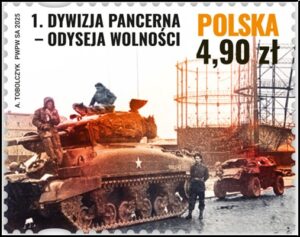
Data emisji: 17-11-2025 … Nowa odsłona serii filatelistycznej poświęconej 1. Dywizji Pancernej – wyjątkowy arkusik upamiętniający zdobycie Wilhelmshaven w 1945 roku. Na każdym znaczku znajduje się fotografia czołgu Sherman z 1. Dywizji Pancernej, stojącego obok zniszczonych zbiorników gazu w porcie Wilhelmshaven w 1945 roku.
Na kopercie FDC wykorzystano zdjęcie przedstawiające gen. Klemensa Rudnickiego (drugi od lewej) i gen. Stanisława Maczka (trzeci od lewej) na terenie portu w Wilhelmshaven w 1945 roku. Datownik jest stylizowany na odznakę 1. Dywizji Pancernej gen. Maczka, co podkreśla symbolikę jednostki. Kolorystyka projektu utrzymana jest w tonach sepii i pomarańczy, co nadaje całości historyczny, dokumentalny charakter. W tle widoczne są stalowe konstrukcje zbiorników, podkreślające przemysłowy charakter portu Wilhelmshaven.
Pod koniec kwietnia 1945 roku 1. Dywizja Pancerna gen. Stanisława Maczka wkroczyła do niemieckiego portu wojennego Wilhelmshaven, jednego z najważniejszych ośrodków Kriegsmarine. Polscy żołnierze przyjęli kapitulację garnizonu liczącego ponad 30 tysięcy żołnierzy, w tym marynarzy i personelu portowego. Zdobycie Wilhelmshaven było jednym z ostatnich akordów wojennych działań dywizji, symbolizując triumf polskich pancerniaków na drodze od Normandii po północne Niemcy.

2025-17-11 … Denomination: 4.90 PLN … Author of the stamp design: Agata Tobolczyk; Number of stamps in issue: 1; Stamp size: 31,25 x 39,5 mm; Paper: Fluorescent; Printing techniques: Offset; Sales sheet: 12t; Print run: 114 000 pcs; FDC size: 162 mm x 113 mm.
Issue date: 17-11-2025 … A new installment in the philatelic series dedicated to the 1st Armored Division – a unique sheet commemorating the capture of Wilhelmshaven in 1945. Each stamp features a photograph of a Sherman tank from the 1st Armored Division, positioned next to destroyed gas tanks in the port of Wilhelmshaven in 1945. FDC envelope features a photo showing Gen. Klemens Rudnicki (second from the left) and Gen. Stanisław Maczek (third from the left) at the Wilhelmshaven port in 1945.Postmarkis stylized as the badge of the 1st Armored Division commanded by Gen. Maczek, highlighting the unit’s symbolism. The design uses sepia and orange tones, giving the composition a historical and documentary character. In the background, steel structures of the tanks emphasize the industrial nature of the Wilhelmshaven port.
In late April 1945, Gen. Stanisław Maczek’s 1st Armored Division entered the German naval port of Wilhelmshaven, one of the most important Kriegsmarine bases. Polish soldiers accepted the surrender of a garrison of over 30,000 troops, including sailors and port personnel. The capture of Wilhelmshaven was one of the final acts of the division’s wartime campaign, symbolizing the triumph of Polish armored forces from Normandy to northern Germany.
Szlachetna Paczka (2025)
Noble Package (2025)
www.poczta-polska.pl
2025-25-11 … Nominał znaczka: 6.40 zł … Autor projektu: Poczta Polska SA; Ilość znaczków w emisji: 1; Format znaczka: 25.5 x 31.25 mm; Technika druku: Rotograwiura; Papier: fluorescencyjny; Nakład:1000 000 szt.; Ilość znaczków w arkuszu: 100; Format koperty FDC: 162×113 mm.
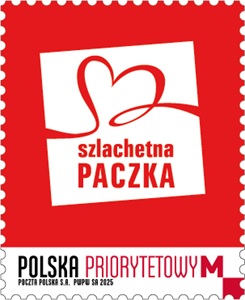
Data emisji: 25-11-2025 … Emisja Poczty Polskiej prezentuje logo akcji „Szlachetna Paczka” – czerwone tło z białym motywem serca i napisem „szlachetna PACZKA”. To wyjątkowy znaczek, który łączy filatelistykę z ideą pomocy potrzebującym. Emisję uzupełnia koperta FDC, której grafika nawiązuje do zimowej atmosfery akcji. Widać osoby niosące prezenty oraz hasło: „Zmieniamy świat na dobre”, które pojawia się również w projekcie datownika. Znaczek powstał w ścisłej współpracy z Stowarzyszeniem WIOSNA, organizatorem akcji „Szlachetna Paczka”, która od lat zmienia życie tysięcy rodzin w Polsce.
Szlachetna Paczka to ogólnopolski program mądrej pomocy, organizowany przez Stowarzyszenie WIOSNA z siedzibą w Krakowie. Od 25 lat łączy ludzi, którzy chcą realnie zmieniać świat na dobre, docierając do rodzin i osób w najtrudniejszych sytuacjach życiowych. Program działa dzięki kilkunastu tysiącom wolontariuszy w całej Polsce. Jesienią pukają oni do drzwi potrzebujących, poznają ich historie, spotykają się z rodzinami i podejmują decyzję o włączeniu danej rodziny do projektu. Razem określają konkretne potrzeby, których zaspokojenie może stać się początkiem trwałej zmiany. Zebrane historie i listy potrzeb trafiają do internetowej Bazy Rodzin, która co roku zostaje otwarta w połowie listopada. W 2025 roku Otwarcie Bazy Rodzin zaplanowano na 15 listopada.
Darczyńcy z całej Polski, po zapoznaniu się z historiami rodzin, wybierają te, które chcą wesprzeć, przygotowując paczki odpowiadające realnym potrzebom. Kulminacją działań jest Weekend Cudów, który w tym roku odbędzie się 13 i 14 grudnia. Darczyńcy dostarczają paczki do specjalnie przygotowanych magazynów, skąd wolontariusze przewożą je do rodzin. To wyjątkowy, pełen emocji moment spotkania dobra i finał wspólnej pracy tysięcy osób zaangażowanych w projekt. W 2025 roku Szlachetna Paczka obchodzi swoje 25-lecie. Od ćwierćwiecza uwrażliwia na potrzeby najsłabszych i zaprasza do współtworzenia świata, w którym dzieje się więcej dobra. Hasło programu – „Zmieniamy świat na dobre” – pozostaje jej najważniejszą obietnicą i znakiem rozpoznawczym. Oznaczenie PRIORYTETOWY M odpowiada wartości nominalnej znaczka pocztowego właściwego do uiszczania opłaty za przesyłkę listową nierejestrowaną priorytetową w obrocie krajowym w formacie M (waga od 500 g do 1000 g).

2025-25-11 … Denomination: 6.40 PLN … Author of the stamp design: Poczta Polska SA; Number of stamps in issue: 1; Stamp size: 25.5 x 31.25 mm; Paper: Fluorescent; Printing techniques: Rotogravure; Sales sheet: 100; Print run: 1000 000 pcs; FDC size: 162 mm x 113 mm.
Issue date: 25-11-2025 … The issue by Polish Post features the logo of the “Szlachetna Paczka” charity campaign – a red background with a white heart and the inscription “szlachetna PACZKA”. This unique stamp combines philately with the idea of helping those in need. The issue is complemented by an FDC envelope with a winter-themed design, showing people carrying gifts and the slogan: “We change the world for good”, also included in the postmark graphic. The stamp was created in close cooperation with the WIOSNA Association, organizer of the “Szlachetna Paczka” campaign, which has been changing lives of thousands of families in Poland.
Szlachetna Paczka is a nationwide program of smart help, organized by the WIOSNA Association based in Kraków. For 25 years, it has been connecting people who want to truly change the world for good, reaching families and individuals in the most difficult life situations. The program operates thanks to tens of thousands of volunteers across Poland. In autumn, they knock on the doors of those in need, learn their stories, meet families, and decide whether to include them in the project. Together, they define specific needs, the fulfillment of which can become the beginning of lasting change. The collected stories and lists of needs are entered into the online Family Database, which opens every year in mid-November.
In 2025, the opening of the Family Database is scheduled for November 15. Donors from all over Poland, after reading the families’ stories, choose those they want to support by preparing packages that meet real needs. The culmination of these efforts is the Weekend of Miracles, which this year will take place on December 13 and 14. Donors deliver packages to specially prepared warehouses, from where volunteers transport them to families. It is an extraordinary, emotional moment – the meeting of goodness and the grand finale of the joint work of thousands of people involved in the project. In 2025, Szlachetna Paczka celebrates its 25th anniversary. For a quarter of a century, it has been raising awareness of the needs of the most vulnerable and inviting everyone to co-create a world where more good happens. The program’s slogan – “We change the world for good” – remains its most important promise and hallmark.
Tysiąclecie koronacji Bolesława Chrobrego
www.nbp.pl
5 listopada 2025 roku Narodowy Bank Polski wprowadził do obiegu banknot kolekcjonerski o nominale 20 zł „Tysiąclecie koronacji Bolesława Chrobrego”. Koronacja Bolesława Chrobrego w 1025 r. była jednym z najdonioślejszych wydarzeń pośród podobnych, w które obfitowało panowanie tego władcy. Dzięki jego aktywności doszło bowiem w 1000 r. do utworzenia Arcybiskupstwa Gnieźnieńskiego, co wówczas oznaczało emancypację i wzmocnienie siły państwa, nie tylko zaś miało religijną doniosłość.
Wydarzenie to było możliwe dzięki objęciu opieką przez władcę polskiego misji biskupa praskiego Wojciecha Sławnikowica – późniejszego patrona Polski, św. Wojciecha – do pogańskich Prusów, a następnie wykupieniu ciała męczennika za złoto – według legendy – równe jego wadze. Duże znaczenie w całej sprawie miały bliski sojusz, a nawet przyjaźń władcy polskiego z cesarzem Ottonem III, które utorowały drogę do późniejszej koronacji Bolesława Chrobrego. Około 1000 r. Bolesław rozkazał wybić monetę znaną jako denar Princes Polonie, na której po raz pierwszy pojawiła się łacińska nazwa kraju, czym manifestował istnienie organizmu politycznego równego znaczeniem innym państwom ugruntowanego chrześcijaństwa. Postępy chrystianizacji, wiążące się z ustanowieniem arcybiskupstwa, stanowiły ochronę dla mieszkańców przed sprzedawaniem ich jako niewolników.
Wygrane przez Bolesława Chrobrego ciężkie i długie wojny z władcą Niemiec Henrykiem II dały kształtującej się społeczności świadomość sukcesu i etos zwycięzców, co miało później znaczenie w trudnych czasach. Uwieńczenie świetnego panowania Bolesława Chrobrego koronacją wniosło do pamięci historycznej powstającej polskiej wspólnoty przeświadczenie, że jest ona równa przodującym narodom chrześcijańskiej Europy. Przez stulecia pamięć o tym wydarzeniu umacniała morale polskiej społeczności, a w okresie rozbiorów podtrzymywała idee niepodległości i podmiotowości kolejnych pokoleń Polaków. Informacja: prof. Andrzej Pleszczyński .
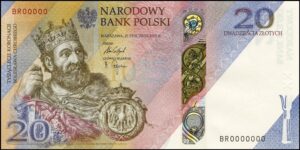
Strona przednia banknotu przedstawia wizerunek Bolesława Chrobrego według grafiki Rudolfa Fryderyka Friedleina z ok. 1857 r., inspirowanej portretem autorstwa Marcella Bacciarellego. Obok usytuowano ozdobny pasek zabezpieczający w kolorach złotym i srebrnym z grafiką przedstawiającą fragment bordiury Drzwi Gnieźnieńskich oraz nominałem. W centralnym punkcie banknotu, jako jedno z zabezpieczeń widocznych w świetle UV, umieszczono rok 1025. W prawym dolnym rogu widnieje element zabezpieczający recto-verso, przedstawiający stylizowany fragment Włóczni z Nętna.
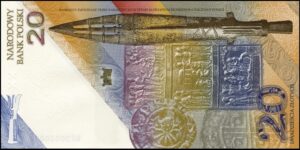
Na stronie odwrotnej banknotu, skomponowanej w układzie pionowym, zostały zaprezentowane m.in. wizerunki trzech kwater Drzwi Gnieźnieńskich oraz awersu i rewersu monety z czasów Bolesława Chrobrego – Princes Polonie, a także grot Włóczni św. Maurycego. Sceny z Drzwi Gnieźnieńskich oraz awers monety są widoczne w świetle UV. Na tej stronie banknotu znajduje się również wycięte w papierze okienko w kształcie korony, wewnątrz którego widać złoty fragment paska zabezpieczającego z przedniej strony. W przechodzącym świetle okienko jest widoczne w kolorze niebieskim. W papierze zastosowano znak wodny, przedstawiający wizerunek fragmentu bordiury Drzwi Gnieźnieńskich oraz oznaczenie roku koronacji Bolesława Chrobrego. W mikrotekstach na stronie przedniej oraz odwrotnej banknotu widnieje epitafium z sarkofagu króla: Inclyte dux tibi laus strenue Boleslae / Przesławny wodzu, chwała tobie, dzielny Bolesławie. Projektant: Agnieszka Próchniak; Wymiary: 170 × 85 mm; Nakład: 70 000; Data emisji: 05-11-2025.

1000th Anniversary of the Coronation
of Boleslaus the Brave
www.nbp.pl
On 5 November 2025, Narodowy Bank Polski issued into circulation a collector banknote “1000th Anniversary of the Coronation of Boleslaus the Brave” with a face value of 20 złoty. The coronation of Boleslaus the Brave in 1025 was one of the most momentous events in a string of other similar ones that the ruler’s reign abounded in. It was the duke’s activity that led to the foundation of the Archbishopric of Gniezno in 1000, which was then equivalent to the emancipation and strengthening of the power of the state, besides the mere religious significance of the event.
This was possible thanks to the Polish ruler’s support for the mission to pagan Prussians led by the bishop of Prague Wojciech Sławnikowic, later to become the patron saint of Poland, Saint Adalbert, and then buying the martyr’s body back in exchange for an amount of gold – as legend has it – equal to its weight. Of great importance to the whole affair was the close alliance or even friendship between the Polish ruler and Holy Roman Emperor Otto III, which opened the way to the subsequent coronation of Boleslaus the Brave. Around 1000 Boleslaus ordered the mintage of a coin known as the Princes Polonie denarius, on which the Latin name of the country appeared for the first time, thus manifesting the existence of a political organism of importance equal to other countries of established Christianity. The advance of Christianisation, along with the foundation of the archbishopric, provided the inhabitants protection against being traded as slaves.
The hard and prolonged wars with King of Germany Henry II, won by Boleslaus the Brave, had given the newly forming community a sense of success and the winner ethos, which later on proved to be of significance in difficult times. The coronation of Boleslaus the Brave coping his excellent reign infused the historical memory of the emerging Polish community with the belief that they were on a par with the leading nations of Christian Europe. Over the centuries, the memory of this event strengthened the morale of the Polish community, and during the partitions period it kept alive the ideas of independence and empowerment in the subsequent generations of Poles. Info: Prof. Andrzej Pleszczyński.
The front side of the banknote depicts an image of Boleslaus the Brave according to the print by Rudolf Fryderyk Friedlein from ca. 1857, which was inspired by the portrait of the King by Marcello Bacciarelli. Next to the image, there is a decorative security stripe in gold and silver, with a print featuring a fragment of the bordure of the Gniezno Doors and the banknote’s denomination. The year 1025 is placed in the centre of the banknote as one of its security features visible in ultraviolet light. In the bottom right corner, there is a recto-verso security feature depicting a stylised fragment of the Lance of Nętno.
The back side of the banknote, composed in a vertical arrangement, features, among others, the images of three panels of the Gniezno Doors and the obverse and reverse of Princes Polonie, a coin from the reign of Boleslaus the Brave, as well as the tip of the Lance of Saint Maurice. Scenes from the Gniezno Doors and the coin’s obverse can be seen in ultraviolet light. This side of the banknote also features a crown-shaped window cut into the paper, inside which one can see a gold fragment of the security stripe of the banknote’s front side. In the transmitted light, the window is seen in blue. The banknote paper bears a watermark depicting the image of a fragment of the bordure of the Gniezno Doors and the notation of the coronation year of Boleslaus the Brave. The microtexts on the front and back side of the banknote feature an epitaph from the king’s sarcophagus reading Inclyte dux tibi laus strenue Boleslae / Respected leader, glory be to you, brave Boleslaus. Designer: Agnieszka Próchniak; Dimensions: 170 × 85 mm; Mintage: 70 000; Date of issue: 05-11-2025.
Odkryj Polskę – Ratusz w Brzegu
www.nbp.pl
Narodowy Bank Polski jest centralnym bankiem państwa odpowiadającym za politykę pieniężną i stabilność cen. Jego funkcje określa Konstytucja Rzeczypospolitej Polskiej i ustawa o NBP. NBP ma wyłączne prawo emisji pieniądza. Jako bank centralny nie prowadzi rachunków bankowych obywateli, nie przyjmuje od nich lokat, nie udziela kredytów. Prowadzi natomiast obsługę budżetu państwa, a także podmiotów sektora finansów publicznych. Gromadzi rezerwy walutowe państwa i zarządza nimi. Pełni funkcję banku banków, tworząc warunki do działania systemu bankowego. Jest również jednym z najważniejszych ośrodków naukowo-analitycznych w dziedzinie ekonomii i rynków finansowych.
Emisja wartości kolekcjonerskich stanowi okazję do upamiętniania ważnych historycznych rocznic i postaci oraz do rozwijania zainteresowań polską kulturą, nauką i tradycją. 20 listopada 2025 roku Narodowy Bank Polski wprowadził do obiegu monetę okolicznościową o nominale 5 zł „Odkryj Polskę” – „Ratusz w Brzegu”.
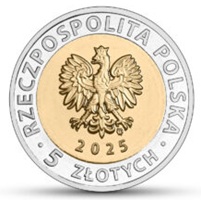
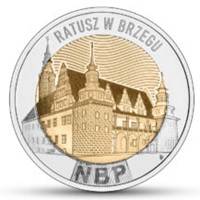
Nominał: 5 zł … stop: pierścień MN25, rdzeń CuAl6Ni2; stempel: zwykły; średnica: 24,00 mm; masa: 6,54 g; brzeg (bok): moletowany nieregularnie; na boku ośmiokrotnie powtórzony napis: NBP, co drugi odwrócony o 180 stopni, rozdzielony gwiazdkami; nakład: do 1 000 000 szt.; Projektantka awersu: Dobrochna Surajewska; Projektant rewersu: Paweł Pietras; Emitent: NBP; Na zlecenie NBP monety wyprodukowała Mennica Polska SA. Na rewersie monety znajduje się ujęcie północno-zachodniej części ratusza w Brzegu.
Dzieje brzeskiego ratusza sięgają czasów średniowiecznych. Na przełomie XV i XVI wieku ratusz składał się z dwóch budynków ustawionych równolegle do siebie. Ceglane elewacje, dodatkowo malowane na czerwono, ozdobiono dekoracyjnymi blendami okiennymi. Taki kształt siedziby rady miejskiej nie odpowiadał już aspiracjom władz Brzegu w połowie XVI wieku. Zdecydowano o przebudowie ratusza. Plany te przyśpieszył wielki pożar Brzegu w 1569 r. Rok później miasto podpisało umowę z włoskim architektem i przedsiębiorcą Jakubem Parrem, który przed 1577 r. przebudował ratusz – według planów swojego zięcia Bernarda Niurona – w duchu renesansu.
Od początku prace te wspierał książę brzeski Jerzy II. Dzięki tak ambitnemu mecenasowi powstała reprezentacyjna siedziba władz miejskich, mająca formę pałacu miejskiego. Wykorzystując stare gotyckie mury, architekci wznieśli trójskrzydłowy budynek. Od zachodu stworzyli reprezentacyjną fasadę z arkadową loggią, flankowaną dwoma wieżami z klatkami schodowymi oraz trzema trójbocznymi szczytami w połaci stromego dachu. Wieżę zegarową zwieńczono ozdobnym, dwuprześwitowym hełmem, a jej ściany pokryto dekoracją sgraffitową, imitującą ciosy diamentowe.
Ukształtowana w ten sposób renesansowa bryła siedziby brzeskiej rady miejskiej przetrwała do dziś niemal bez zmian, stając się wybitnym przykładem recepcji włoskiego renesansu w Europie Środkowej. W kolejnych wiekach zmieniały się jedynie funkcje i wystrój niektórych wnętrz ratusza. W 1646 r. wielka sala znajdująca się na pierwszym piętrze południowego skrzydła została nakryta efektownym modrzewiowym stropem. W latach 1743–1746 w jednym z pomieszczeń na pierwszym piętrze północnego skrzydła powstała reprezentacyjna sala rady miejskiej, zwana Salą Rajców. Dzięki niedawnym pracom konserwatorskim brzeski ratusz odzyskał dawny blask i znów zachwyca swoją architekturą. Informacja: dr. Romuald Nowak.
Discover Poland – the Town Hall in Brzeg
www.nbp.pl
Narodowy Bank Polski is the central bank of the State, responsible for its monetary policy and price stability. The Bank’s functions are described in the Constitution of the Republic of Poland and the Act on NBP. NBP holds the exclusive right to issue the currency of the Republic of Poland. As the central bank, it does not provide accounts for the general public, accept deposits from or extend loans to individuals. It acts as a banker to the State budget and public sector entities. NBP also holds and manages the foreign exchange reserves of the State. Finally, it functions as a banker to banks, creating conditions for the operation of the Polish banking system. Narodowy Bank Polski is one of the most important research and analytical centres in the fields of economics and financial markets.
Issuing collector items is an occasion to commemorate important historic figures and anniversaries, as well as to develop the interest of the public in Polish culture, science and tradition. On 20 November 2025, Narodowy Bank Polski issued into circulation a commemorative coin of the series “Discover Poland” – “The Town Hall in Brzeg”, with a face value of 5 złoty.
Face value: 5 zł … Alloy: ring MN25, core CuAl6Ni2; Finish: standard; Diameter: 24.00 mm; Weight: 6.54 g; Edge (side): irregularly milled, with the inscription “NBP”, repeated eight times, every second one inverted by 180 degrees, separated by stars; Mintage: up to 1,000,000 pcs; Obverse designer: Dobrochna Surajewska; Reverse designer: Paweł Pietras; Issuer: Narodowy Bank Polski; The coins, commissioned by Narodowy Bank Polski, were struck by Mennica Polska SA The reverse of the coin features an image of the north-west part of the town hall in Brzeg.
The origin of the town hall in Brzeg dates back to the Middle Ages. At the turn of the 15th and 16th centuries, the town hall consisted of two parallel buildings. Their red-painted brick façades were decorated with ornamental blind windows. By the mid-16th century, the town council’s seat in this form no longer satisfied the aspirations of the authorities of Brzeg. They decided to remodel the town hall. In the wake of the great fire of Brzeg in 1569, their plans gathered momentum. A year later, the town signed a contract with an Italian architect and entrepreneur, Giacomo Parr, who rebuilt the town hall by 1577 to a design by his son-in-law, Bernardo Niuron, in Renaissance style. Duke George II of Brzeg had supported this undertaking from the start. Thanks to this ambitious patron, the municipal authorities gained a splendid residence in the form of a municipal palace. Incorporating the old Gothic walls, the architects constructed a three-wing building. On its west side, they made an elegant façade with an arcaded loggia, flanked by two towers with staircases, and three gables in the steep roof.
The clock tower was topped with an ornamental steeple with two openings, and its walls were adorned with sgraffito decorations imitating diamond cuts. The seat of the Brzeg town council in its Renaissance shape has survived to this day almost unaltered, becoming a remarkable example of the adoption of the Italian Renaissance style in Central Europe. The following centuries saw modifications solely in the functions and décor of certain interiors of the town hall. In 1646, the large hall on the first floor of the southern wing gained an impressive larch ceiling. In 1743-1746, one of the rooms on the first floor of the northern wing was converted into a splendid chamber of the town council, called the Councillors’ Chamber. Thanks to the recent restoration works, the Brzeg town hall has regained its original splendour and ravishing architecture. Info: Romuald Nowak, PhD.
2025 … Truth and Reconciliation
booklet of 6 Permanent™ stamps
www.canadapost.ca
In partnership with the Survivors Circle of the National Centre for Truth and Reconciliation, this series of stamps seeks to raise awareness about residential schools and the legacy of trauma and abuse that continues to have an impact on Indigenous Peoples today. The Survivors Circle selected the Bentwood Box (Medicine Box) to be featured on this year’s stamps in this ongoing series. A lasting tribute to all residential school Survivors, the Bentwood Box is a symbol of healing, reconciliation and hope.
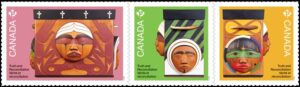
About the Truth and Reconciliation stamp issue … Canada Post is committed to listening to Indigenous voices and to using these stamps as a vehicle for Survivors to share the truth of their experiences so that we can support the process of reconciliation and, ultimately, healing, as we move forward. Canada Post thanks the Survivors Circle of the National Centre for Truth and Reconciliation for their guidance throughout this process.
About the Bentwood Box (Medicine Box) … Commissioned by the Truth and Reconciliation Commission (TRC) in 2009, the Bentwood Box (Medicine Box) travelled with the TRC to its eight national events. People placed sacred items into the box to symbolize their spiritual journey toward healing and as gestures of truth and reconciliation. These included thousands of items from across the country, such as photographs, reports, books, drums, knitted baby blankets and beaded regalia.
The box was crafted by Coast Salish artist Luke Marston in the traditional style from a single piece of sacred old-growth red cedar. Its carved panels feature artistic styles and imagery that represent the distinct cultures of First Nations, Métis and Inuit who attended residential schools. During the TRC’s work, the box gathered the voices and experiences of those impacted by Canada’s residential school system, ensuring their stories were honoured and remembered. After being housed temporarily at the Canadian Museum for Human Rights in Winnipeg, Manitoba, it now resides at the National Centre for Truth and Reconciliation in the same city. The Bentwood Box is a powerful symbol that reminds Canadians of the need to confront the past, work toward healing and hold hope for future generations.
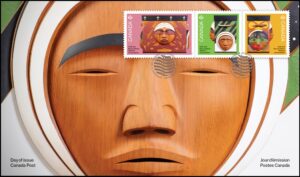
About the design … Each of the three stamps features a different side of the Bentwood Box that represents the distinct cultures of First Nations, Inuit and Métis children who attended residential schools. Through carefully considered proportions, the two different stamp sizes work together to create a balanced and inclusive expression – one that elevates the distinct voices of First Nations, Inuit and Métis children who endured the residential school system.
On the rectangular stamp depicting the front panel of the box, crosses represent the churches that ran residential schools (with the federal government), while raised hands symbolize the helplessness felt by parents when their children were taken away from them and sent to residential schools. The square stamp with a green background depicts the side panel of the box that relates Inuit experiences at residential schools. The northern lights and the stars beyond represent Inuit ancestors and teachings. Students were separated from this knowledge while at residential schools.
The square stamp with a yellow background shows the side panel of the box that depicts student experiences from the Prairies and Eastern Canada. The infinity symbol, found on the Métis flag, acknowledges the Métis children who were taken to residential schools. The back panel of the box, featuring Thunderbird, does not appear on the stamps. It is found on the inside of the booklet and on the back of the OFDC. The carving of Thunderbird on the back panel of the box proclaims the strong voices of Indigenous Peoples. Cancellation Site: Winnipeg, MB; Stamp Designer: Blair Thomson, Believe in; Quantity Produced: 200,000 booklets of 6 Permanent™ domestic rate stamps (1.2 million stamps); Issue Date: September 29, 2025.
About the design … The front of Official First Day cover depicts the panel of the Bentwood Box that relates Inuit experiences at residential schools. The northern lights and the stars beyond represent Inuit ancestors and teachings. Students were separated from this knowledge while at residential schools. Seen on the back of the OFDC, the carving of Thunderbird on the back panel of the Bentwood Box proclaims the strong voices of Indigenous Peoples. Learning the truth about historic abuse and injustice in Canada is essential to true reconciliation.
The Official First Day Cover is cancelled on September 29 in Winnipeg, Manitoba, the location of the NCTR, which houses the Bentwood Box. The cancel references both the woodgrain and curves seen in the carvings on the box. Quantity Produced: 7,000;. Issue Date September 29, 2025.
2025 … Holiday – Tinsel Tales:
Booklet of 12 Permanent™ stamps
www.canadapost.ca
Show your holiday spirit with every piece of mail you send with the Holiday (2025) – Tinsel … These stamps, in three popular denominations, are part of our annual tradition of providing secular holiday-themed stamps for mailing cards and other holiday mail.
Tinsel Tales … This playful fox isn’t even a little bit shy about his love for the holidays. He uses his characteristic agility and ambition to transform his home into a colourful wonderland. Let this cheerful creature and his festive forest help you celebrate the season and show your holiday spirit with every piece of mail you send.
About the design … These stamps feature a fox (Permanent™ domestic rate), squirrels (U.S. rate) and a rabbit (international rate) cheerily decorating their home for the holidays. The issue’s storybook approach feels nostalgic and captures the magical feeling of the holidays. Stamp Designer: Kristine Do; Stamp Illustrator: Alexandra Finkelddey; Quantity Produced: 800,000 booklets of 12 Permanent™ stamps; Issue Date: November 6, 2025.
2025 … Holiday – Tinsel Tales: Sheetlet of 6 U.S. rate stamps … Show your holiday spirit with every piece of mail you send to the U.S. with the Holiday (2025) – Tinsel Tales: Sheetlet of 6 U.S. rate stamps. These stamps, in three popular denominations, are part of our annual tradition of providing secular holiday-themed stamps for mailing cards and other holiday mail.
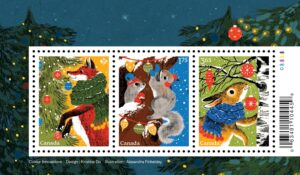
About the design … These stamps feature a fox (Permanent™ domestic rate), squirrels (U.S. rate) and a rabbit (international rate) cheerily decorating their home for the holidays. The issue’s storybook approach feels nostalgic and captures the magical feeling of the holidays. Stamp Designer: Kristine Do; Stamp Illustrator: Alexandra Finkeldey; Quantity Produced: 250,000 sheetlets of 6 international rate stamps; Issue Date: November 6, 2025.
2025 … Holiday – Tinsel Tales: Sheetlet of 6 international rate stamps … Show your holiday spirit with every piece of international mail you send abroad with the Holiday (2025) – Tinsel Tales: Sheetlet of 6 international rate stamps. These stamps, in three popular denominations, are part of our annual tradition of providing secular holiday-themed stamps for mailing cards and other holiday mail.
About the design … These stamps feature a fox (Permanent™ domestic rate), squirrels (U.S. rate) and a rabbit (international rate) cheerily decorating their home for the holidays. The issue’s storybook approach feels nostalgic and captures the magical feeling of the holidays. Stamp Designer: Kristine Do; Stamp Illustrator: Alexandra Finkeldey; Quantity Produced: 250,000 sheetlets of 6 international rate stamps; Issue Date: November 6, 2025.
2025 … Holiday – Tinsel Tales: Souvenir sheet … Make the holidays even more heartwarming with these three stamps, available in Permanent™, U.S., and international rates, featured together in the charmingly illustrated Holiday (2025) – Tinsel Tales: Souvenir sheet. These stamps, in three popular denominations, are part of our annual tradition of providing secular holiday-themed stamps for mailing cards and other holiday mail.
Tinsel Tales … “We can leave the tops of the trees to the Squirrel twins – that’s where they do their best work,” said Fox. Rabbit smiled at Fox’s comments. He was happy to jump in where needed and was a fast and efficient worker. After all, Fox had managed to sneak the balls and lights and shiny bits past the forest’s kits and pups, all of them excited about the holidays. Rabbit could see why that talent for slyness made Fox believe he was in charge of the holiday decorating.
“Starting to look quite festive!” called down the Squirrels in unison. They leaped from treetop to treetop, passing strings of lights back and forth, wrapping the upper branches of the stand of trees chosen for the festivities. The forest friends worked tirelessly to hang the glittering balls and arrange the lights. Soon the deepest part of their woodland home, where no human ever goes, shimmered and shone with light and warmth and colour. Assessing their efforts, they took great satisfaction. Once again, they had proven that the holidays are a time when each of us shares the best of ourselves to create something beautiful with others.
About the design … These stamps feature a fox (Permanent™ domestic rate), squirrels (U.S. rate) and a rabbit (international rate) cheerily decorating their home for the holidays. The issue’s storybook approach feels nostalgic and captures the magical feeling of the holidays. Cancellation Site: Fox Creek, Alberta; Stamp Designer: Kristine Do; Stamp Illustrator: Alexandra Finkledey; Quantity Produced: 40,000; Issue Date: November 6, 2025.
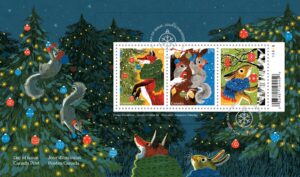
2025 … Holiday – Tinsel Tales: Souvenir Sheet Official First Day Cover … Make the holidays even more heartwarming with these three stamps, available in Permanent™, U.S., and international rates, featured together in the charmingly illustrated Holiday (2025) – Tinsel Tales: Souvenir sheet Official First Day Cover. These stamps, in three popular denominations, are part of our annual tradition of providing secular holiday-themed stamps for mailing cards and other holiday mail.
Tinsel Tales … “We can leave the tops of the trees to the Squirrel twins – that’s where they do their best work,” said Fox. Rabbit smiled at Fox’s comments. He was happy to jump in where needed and was a fast and efficient worker. After all, Fox had managed to sneak the balls and lights and shiny bits past the forest’s kits and pups, all of them excited about the holidays. Rabbit could see why that talent for slyness made Fox believe he was in charge of the holiday decorating.
“Starting to look quite festive!” called down the Squirrels in unison. They leaped from treetop to treetop, passing strings of lights back and forth, wrapping the upper branches of the stand of trees chosen for the festivities. The forest friends worked tirelessly to hang the glittering balls and arrange the lights. Soon the deepest part of their woodland home, where no human ever goes, shimmered and shone with light and warmth and colour. Assessing their efforts, they took great satisfaction. Once again, they had proven that the holidays are a time when each of us shares the best of ourselves to create something beautiful with others.
About the design … These stamps feature a fox (Permanent™ domestic rate), squirrels (U.S. rate) and a rabbit (international rate) cheerily decorating their home for the holidays. The issue’s storybook approach feels nostalgic and captures the magical feeling of the holidays. The cancel depicts the decorative balls with which the forest friends adorned their festive trees. Cancellation Site: Fox Creek, Alberta; Stamp Designer: Kristine Do; Stamp Illustrator: Alexandra Finkeldey; Quantity Produced: 6,000; Issue Date: November 6, 2025.
2026 … Enthusiastic and energetic:
Embrace the spirit of the Horse
www.mint.ca
Make way for the Fire Horse! Those born in the year of the Horse are known for their boundless energy, adventurous spirit and unrivalled zest for life. As seen on this fine silver coin, Horse people are always on the move; they’re eager to discover and try new things, and their cheerful personalities allow them to attract friends with ease. With the Fire element fuelling both passion and determination in 2026, there’s no telling what a Horse spirit can accomplish while blazing its own path to success.
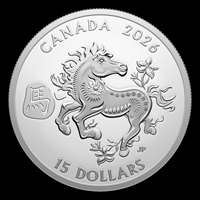
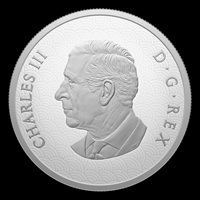
Face Value: $15 … Composition: 99.99% pure silver; Mintage: 18,888; Weight: 31.39 g; Diameter: 38 mm; Edge: Serrated; Finish: Proof; Artist: Jai Paek (reverse), Steven Rosati (obverse); Packaging: Black clamshell with red graphic beauty box.
DID YOU KNOW? … Each year in the Chinese zodiac’s 12-year cycle is ruled by a different sign and one of the five elements, with Fire being the element for 2026. Horses are free-spirited, confident and energetic (they don’t like to be bored), but Fire Horses are known to be bolder and more decisive, and are more likely to be trendsetters and trailblazers.
The reverse design by Canadian artist Jai Paek celebrates the Year of the Horse through its folk-art styled depiction of the Chinese zodiac animal, with details on the body, mane and tail corresponding to the ruling element in 2026, Fire. The Horse is paired with its lucky flower, jasmine, which is also the traditional emblem of grace and good fortune; together with the sunflower that symbolizes vitality and loyalty, the flowers help cultivate the energy flow and movement of Fire, which is itself a symbol of transformation and renewal. The obverse features the effigy of His Majesty King Charles III by Canadian artist Steven Rosati.
Jai Paek, Artist … “The Fire Horse is adorned with flames emphasizing its power and energy, while also symbolizing transformation and purification. In addition, the Horse is decorated with the blossoms and petals of the jasmine flower and the sunflower, arranged in a folk-art pattern to reflect the Horse’s importance and relevance to humankind. In contrast to the Horse’s stout traits of strength, vigour, and independence, the jasmine flower symbolizes love, beauty and sensuality, while the sunflower highlights the Horse’s intelligence, vitality, joy, and loyal heart to the one who tamed it.”
2026 … Lunar Year of the Horse –
Pure Gold Coin
www.mint.ca
Harness your power and strength in the Year of the Fire Horse. According to the Chinese zodiac, the adventurous and fun-loving Horse is a fire sign, and as the element for the year 2026, Fire further intensifies the Horse’s dynamic spirit and high energy, resulting in personalities that are typically bold and decisive, smart and style-savvy. Adorned with lucky jasmine flowers, the Fire Horse’s dashing confidence is evident on this 15.43 g pure gold coin, where, undaunted by the blazing sun or what lies ahead, the hard-working equine steps assuredly towards success without breaking its stride.
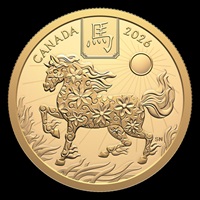
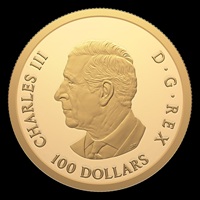
Face Value: $100 … Composition: 99.99% pure gold; Mintage: 1,888; Weight: 15.43 g; Diameter: 29 mm; Edge: Serrated; Finish: Proof; Artist: Simon Ng (reverse), Steven Rosati (obverse); Packaging: Red lacquered case with red outer box.
DID YOU KNOW? … Each year in the Chinese zodiac’s 12-year cycle is ruled by a different sign and one of the five elements, with Fire being the element for 2026. Horses are free-spirited, confident and energetic (they don’t like to be bored), but Fire Horses are known to be bolder and more decisive, and are more likely to be trendsetters and trailblazers. The best zodiac matches for the Horse are the Tiger, the Dog and the Goat.
Inspired by traditional Chinese artforms, the reverse design by artist Simon Ng marks the Year of the Horse (2026) by depicting the Chinese zodiac animal adorned with various iterations of its lucky flower, jasmine, which symbolizes grace, purity and elegance. Undaunted by the tall windblown grass, the energetic Horse trots assertively into a headwind, its flame-like mane and tail flowing in the breeze, while the sun’s rays fill the sky above to represent the Fire element. The reverse includes the word “CANADA”, the traditional Chinese character for “Horse” and the year “2026”. The obverse features the effigy of His Majesty King Charles III by Canadian artist Steven Rosati.
Simon Ng, Artist … “The element of Fire plays a significant role in the overall design of this auspicious Lunar Horse, whose pose strikes a balance between strength and gentle charm. While the thick legs convey the power of a working horse casually trotting into a headwind under a blazing sun, its mane and tail, as well as the tall grass, all mirror flames dancing in the wind, and further emphasize the imagery of Fire. Meanwhile, the decorative flora consists of various iterations of the jasmine flower that symbolizes grace, purity and elegance, while the combination of branches and blooms produces a consistent pattern and texture that’s pleasing to the eye.”
2026 … $1 Pure Gold Coin –
30th Anniversary of Canada’s Arboreal Emblem
www.mint.ca
Marking a maple milestone in affordable gold. Canadians see the maple leaf as a popular emblem that proudly expresses our identity and culture, and our national tree, the maple (g. Acer), is an extension of that national pride. As we mark the 30th anniversary of Canada’s arboreal emblem in 2026, this small-sized (11 mm) 99.99% pure gold coin honours the significance of the maple tree and its cultural importance across Canada, where the maple is more than a landscape feature—it’s part of who we are, a symbol of Canada’s sovereignty intertwined with our distinct spirit, history, heritage and values. Beauty meets value with this 0.5 g pure gold coin.

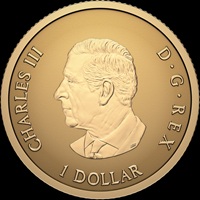
Face Value: $1 … Composition: 99.99% pure gold; Mintage: 20,000; Weight: 0.5 g; Diameter: 11 mm; Edge: Serrated; Finish: Reverse Proof; Artist:Nathalie Lagacé (reverse), Steven Rosati (obverse); Packaging: Black clamshell with black beauty box.
Good to know … ***Beauty and value combined. Celebrate the 30th anniversary of Canada’s arboreal emblem with a miniature (11 mm) maple showcase crafted in 99.99% pure gold. ***Our smallest gold collector coin. With a diameter of just 11 millimetres (smaller than a dime), this half-gram (0.5 g) gold coin features a surprising amount of finely engraved details for such a small canvas. ***Affordable gold option. Some of the purest gold is within your reach! This coin’s small size and weight make it an affordable gold option for collectors, and an excellent starting point for a gold coin collection. ***Reverse proof finish. The matte field ensures all the shine is on the engraved elements, ensuring all of the focus is on the beautiful maple leaves. ***Canada’s beloved maples. Nothing says “Canada” like a maple leaf, and it continues to be one of our most popular coin themes. ***Limited mintage. Mintage is limited to 20,000 coins worldwide. ***Includes serialized certificate. The Royal Canadian Mint certifies all of its collector coins.
Did you know? … The Proclamation Designating the Maple Tree as National Arboreal Emblem of Canada (SI/96-36) species that “the maple tree (genus Acer) has ten species native to Canada.” Those species are: sugar, silver, black, bigleaf, red, mountain, striped, Douglas, vine and Manitoba maples.
Behind closed doors … “Its lobes, adorned with numerous serrations, and its graceful appearance make it a captivating leaf to work with. A light breeze in this illustration allowed me to suggest the two shades of this leaf: pale green above and silvery grey below.” – Nathalie Lagacé, Artist
“The 1996 Proclamation designating the maple tree (genus Acer) as national arboreal emblem of Canada acknowledges the national and international distinction of the maple as a Canadian symbol. Thirty years on the proclamation, having included all 10 species of maples native to Canada, continues to reflect the maple’s historical, economic, and environmental significance to Canadians everywhere.” – Ken Farr, RPF, Dendrologist.
About the design …Your coin is encapsulated and presented in a black Royal Canadian Mint-branded clamshell with a black beauty box. The reverse design by Canadian artist Nathalie Lagacé is double-dated (“1996 2026”) to commemorate the 30th anniversary of Canada’s arboreal emblem, the maple tree (g. Acer); it features two silver maple (Acer saccharinum) leaves presented in a natural, realistic style. The foremost leaf appears larger than the rear one, whose curled basal lobe evokes the feeling of movement and a gentle breeze. The obverse features the effigy of His Majesty King Charles III by Canadian artist Steven Rosati.
$20 Fine Silver Coin –
Haunted Canada: Lady in White
www.mint.ca
Love eternal: Experience a ghostly encounter at Québec’s Montmorency Falls. Whether you’re peering over the suspension bridge to view the rushing water from above, or watching it from below, you’ll be mesmerized by the all-season beauty of the Montmorency Falls, located in the Québec City area. If you look carefully, you might even catch a glimpse of something—or someone—unexpected in its mist: Mathilde Robin, the grief-stricken bride-to-be who, dressed in her white wedding gown, plunged into those tumbling waters after her beloved was killed nearby in the Battle of Beauport (1759). They say her body was never found… but many still claim to hear her cries or see her ghost leap from the top of the falls, as she did in life—she is the Lady in White, who haunts this coin’s reverse when the black light paint technology is activated. Back by popular demand: A new Haunted Canada tale.
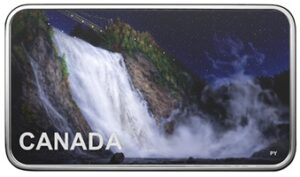
Face Value: $20 … Composition: 99.99% pure silver with colour and black light paint technology; Mintage: 6,500; Weight: 31.56 g; Dimensions: 49.80 mm x 28.60 mm; Edge: Plain; Finish: Proof; Artist: Pandora Young (reverse), Steven Rosati (obverse); Packaging: Black clamshell with black beauty box.
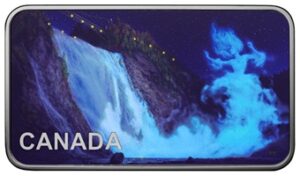
DID YOU KNOW? … ***Montmorency Falls consists of three separate waterfalls, with the Grand Sault (seen here) being the largest of the three. It was Samuel de Champlain who gave the falls their name in 1613, in honour of the Duke of Montmorency, Viceroy of New France and Brittany, who never actually saw the falls that still bear his name. ***It is said that Mathilde’s fiancé was one of the more than 60 French soldiers who perished while fighting British forces in the Battle of Beauport (also known as the Battle of Montmorency), which was waged near the falls on July 31, 1759.
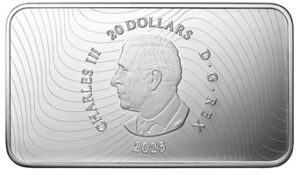
The reverse design by Canadian artist Pandora Young presents a view of the Montmorency Falls in the Québec City area, where a suspension bridge spans the top of the falls that plunge into the St. Lawrence River below. When the black light paint technology is activated, a ghostly figure appears in the mist, clad in a white wedding dress—it is the Lady in White, Mathilde Robin, who, distraught over the death of her fiancé in battle in 1759, threw herself into the falls that she still haunts today. The obverse features a wave pattern behind the effigy of His Majesty King Charles III by Canadian artist Steven Rosati.
Pandora Young, Artist … “Growing up, I attended many Renaissance Fairs and developed a deep reverence for historically accurate costuming. I tried to put myself in Mathilde’s place, to imagine how a young woman of her time would dream of being adorned for the occasion—and of the young man she was so excited to marry. Mathilde’s phantom is a preservation of one bride’s hopes and dreams, of the labour she poured into her dress and wedding plans, and the happiness she desired for herself and her beloved. The Robe à la française was the height of fashion for over half a century, and I tried to make hers as lovely as possible. I spent a long time watching footage of the falls, looking for the best angles and hoping for inspiration. I took note of the rising mists and the patterns they made, and was reminded of an inkblot test. Here, the imagination could glimpse the unexpected—a rabbit, a swan, or perhaps a ghostly mademoiselle. If Mathilde’s spirit resides in these falls, she could certainly be in those mists!”
$20 Fine Silver Coin –
Gilded Elegant Maple
www.mint.ca
Basking in the last light of autumn. A single gold maple leaf glows with quiet elegance against a black backdrop, capturing the fleeting beauty of autumn in perfect stillness. Enhanced with selective gold plating, this 1-oz. 99.99% pure silver coin features a black rhodium plated field that puts all the focus on the elegant maple leaf, creating a striking contrast that transforms the beloved Canadian emblem into a shining symbol of resilience and natural grace. Own this selectively gold-plated and black rhodium plated version of our Elegant Maple.

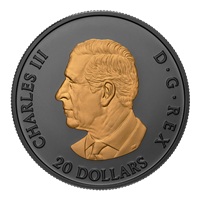
Face Value: $20 … Composition: 99.99% pure silver with selective black rhodium plating and selective gold plating; Mintage: 5,500; Weight: 31.39 g; Diameter: 38 mm; Edge: Serrated; Finish: Matte Proof; Artist: Donna Kriekle (reverse), Steven Rosati (obverse); Packaging: Black clamshell and black beauty box.
DID YOU KNOW? … The sugar maple is one of 10 maple species that naturally occur in Canada, but it is arguably the most well-known Canadian maple due to its ecological and economic importance—it’s also the preferred species for maple syrup production.
Designed by Canadian artist Donna Kriekle, your coin’s reverse features a gold-plated sugar maple (Acer saccharum) leaf set against the black rhodium plated field and rim. Black rhodium plating also fills the field and rim on the obverse, which features the gold-plated effigy of His Majesty King Charles III by Canadian artist Steven Rosati.
$50 Fine Silver Coin –
A Whimsical Tale: Steam Locomotive
www.mint.ca
Imagining a past vision of tomorrow. Embark on a journey to a retro-future with this steampunk scene, which captures the grit and grandeur of an industrial age imagined through the eyes of a bygone era. A stylized steam-powered locomotive leaves behind a fantastical vintage cityscape and comes alive with a depth of field captured by spectacular engraving and extraordinary detail that blur the lines between historical periods. To top it off, a superb, antique finish lends the piece a storied feel, like a long-treasured artifact from an alternate timeline. With so many engraved details to be discovered, this design is an enchanting tribute to 19th century optimism, and to the kind of speculative artistry that evokes a world fuelled by steam and imagination. Ride the rails to a steampunk future.
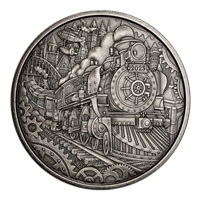
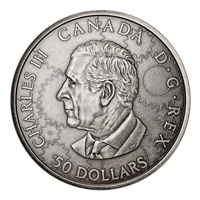
Face Value: $50 … Composition: 99.99% pure silver; Mintage: 2,500; Weight: 94.25 g; Diameter: 55 mm; Edge: Serrated; Finish: Antique finish; Artist: David Oram (reverse), Steven Rosati (obverse); Packaging: Black clamshell with black beauty box.
DID YOU KNOW? … Steampunk is a future imagined from the perspective of the past. Blending vintage aesthetics and steam-era tech with modern/sci-fi elements, the genre paints an image of what people in the 19th century might have imagined the future to look like—a future filled with modern and gear-driven marvels.
Designed by Canadian artist David Oram, the steampunk-styled reverse invites you to step into a whimsical retro-futuristic world. A stylized steam locomotive charges out of a vintage train station, filling the scene with steam as it pulls cars along the track. Turrets, ornate facades, and towering buildings contribute to the cityscape that rises up in the background, where a steamboat-inspired airship has taken to the skies. In keeping with the industrial-era aesthetic, gears positioned near the edge partially frame the scene, while gear shapes form a pattern on the obverse, which features the effigy of His Majesty King Charles III by Canadian artist Steven Rosati.
David Oram, Artist … “I started my design with a generic 19th-century steam locomotive and added sweeping curves that highlight its elegant form from the pilot/cowcatcher, to the smoke lifters on each side and exhaust pipes added to the side leaving a plume of steam along the tracks. For the fantastical cityscape, I drew inspiration from early Victorian architecture styles, adding decorative triangular rooftops adorned with spires. It was a real challenge to forgo the historical accuracy of my previous work in favour of the imaginative creativity of the steampunk style, but also a joy to let loose my creative artistic side.”
Dr. Mike Perschon, MacEwan University … “Steampunk, as with all speculative fiction, is about possibility. If we can dream of a world where the fantastic can occur, then we realize that our own world can be something other than what it currently is. The steampunk Canada depicted on this coin is not the Canada of history, but a fanciful speculation of a Canada that never was and likely never will be. But it is our ability to dream of alternate histories that can motivate us as Canadians to always seek out alternate futures of a better, brighter Canada.”
2025 Fine Silver Coin …
Baffin Island Mountains by Lawren S. Harris
www.mint.ca
A Lawren S. Harris original is transformed into fine silver art. A key member of the Group of Seven whose paintings shaped Canada’s artistic identity, Lawren S. Harris presented a singular vision of Northern Canada in his series of Arctic works, which include the canvas Baffin Island Mountains (c. 1931). The stylized mountain landscape appears stark at first glance, but it is filled with contrasts that imbue the painting with light and spiritual energy. The scene is far from flat, and neither is our take on it: this dimensionally sculpted, 99.99% pure silver version places the focus on Harris’ bold lines and symmetrical composition, using various frostings and relief heights to mimic the original contrasts and forms that inspire reverence for nature in its purest form. See Baffin Island through an artist’s eyes. Instead of colour, varying relief heights and contrasting frostings mimic the original interplay of light and shadow.

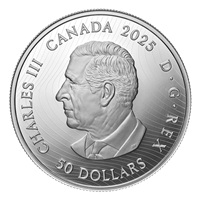
Face Value: $50 … Composition: 99.99% pure silver; Mintage: 1,250; Weight: 157.6 g; Diameter: 65.25 mm; Edge: Serrated; Finish: Proof; Artist: Lawren S. Harris (reverse), Steven Rosati (obverse); Packaging: Black clamshell and beauty box with custom art card.
DID YOU KNOW? … Baffin Island Mountains is one of six large canvases produced by Harris after his 1930 voyage to the Eastern Arctic. Harris spent two months aboard the supply vessel S.S. Beothic, visiting various sites and completing over 50 oil sketches.
Completed circa 1931, the original painting remained in private hands until May 29, 2001, when it went up for auction and sold for $2.2 million. At the time, it was the highest price ever paid for a Canadian painting; it was later donated to the Art Gallery of Ontario (AGO) as part of the Thomson Collection of Canadian Art, where it is currently on view.
Your coin’s reverse features a carefully sculpted adaptation of Baffin Island Mountains(c. 1931), one of several Arctic canvases by Lawren Stewart Harris, the renowned landscape painter and a founding member of Canada’s famous Group of Seven painters. While Harris’ original oil painting features cool blues, bold browns and varying shades of white, this engraved interpretation uses different frostings and relief heights to re-create the dramatic contrast between the icy peaks and the radiant sky, as well as the rugged rocks and the icy water. The obverse features a wavy pattern and the effigy of His Majesty King Charles III by Canadian artist Steven Rosati.
2025 … $2 Honouring Canada’s Unknown Soldier
Colourized Special Wrap Roll
www.mint.ca
Saluting the one who represents the many. Few symbols are more sacred than the Tomb of the Unknown Soldier, and none more eloquently express the enduring consequences of war. The Unknown Soldier’s tomb is hallowed ground, and, every November 11, it becomes one of the focal points for our collective remembrance, grief and gratitude for Canada’s service members past, present, and future. Designed by Mary-Ann Liu, sculptor of the tomb’s bronze relief, the 2025 $2 Honouring Canada’s Unknown Soldier Commemorative Circulation Coin calls all Canadians to remembrance. The 25 coins in each colourized Special Wrap Roll all feature the same view of the Tomb of the Unknown Soldier, backed by silhouettes of four sentries representing all Canadians who serve or have served, and with a red poppy of remembrance. Marked by the poppy of remembrance.
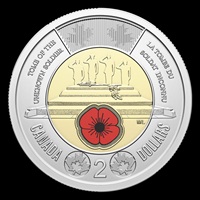
Face Value: $2 … Composition Outer ring: Three-ply nickel-plated steel; Inner core: Three-ply brass-plated aluminum bronze with selective colour; Mintage: 15,000; Weight: 6.99 g; Diameter: 28 mm; Edge: Interrupted serrations; Finish: Circulation; Artist: Mary-Ann Liu (reverse), Steven Rosati (obverse).
DID YOU KNOW? … ***Selected from among the 1,603 unknown Canadians buried in the vicinity of Vimy Ridge, the remains of Canada’s Unknown Soldier were exhumed from plot 8, Row E, Grave 7 in the Cabaret-Rouge British Cemetery in France, then taken by hearse to the Canadian National Vimy Memorial, where the official handover ceremony took place on May 25, 2000. ***The original “Known unto God” grave marker was relocated to the Memorial Hall at the Canadian War Museum, where, weather permitting, sunlight shines directly on the headstone once a year, illuminating it at precisely 11 a.m. on Remembrance Day. ***The gravesite in France is now marked by a stone marker bearing this inscription: “THE FORMER GRAVE OF AN UNKNOWN CANADIAN SOLDIER OF THE FIRST WORLD WAR. HIS REMAINS WERE REMOVED ON 25 MAY 2000 AND NOW LIE INTERRED AT THE NATIONAL WAR MEMORIAL IN OTTAWA CANADA“
Designed by Canadian artist Mary-Ann Liu, sculptor of the bronze relief on Canada’s Tomb of the Unknown Soldier, the coin’s reverse commemorates the 25ᵗʰ anniversary of the repatriation of Canada’s Unknown Soldier. The inner core features a street-level view of the Tomb of the Unknown Soldier in front of the National War Memorial in Ottawa. The base of the granite tomb extends onto the outer ring, which bears the words “CANADA”, a face value of “2 DOLLARS”, the bilingual inscription “TOMB OF THE UNKNOWN SOLDIER LA TOMBE DU SOLDAT INCONNU”, and two maple leaf security features. The silhouettes of four sentries representing all Canadians who serve or have served appear behind the tomb. The inclusion of a poppy, bright red on the colourized coin, completes this poignant expression, honouring sacrifice and national service. The obverse features the effigy of His Majesty King Charles III by Canadian artist Steven Rosati.
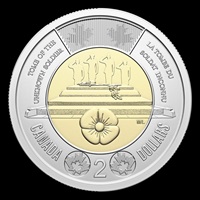
Face Value: $2 … Composition Outer ring: Three-ply nickel-plated steel; Inner core: Three-ply brass-plated aluminum bronze; Mintage: 10,000; Weight: 6.99 g; Diameter: 28 mm; Edge: Interrupted serrations; Finish: Circulation; Artist: Mary-Ann Liu (reverse), Steven Rosati (obverse).
2025 … $2 Honouring Canada’s Unknown Soldier … Non-Colourized Special Wrap Roll … Saluting the one who represents the many. Few symbols are more sacred than the Tomb of the Unknown Soldier, and none more eloquently express the enduring consequences of war. The Unknown Soldier’s tomb is hallowed ground, and, every November 11, it becomes one of the focal points for our collective remembrance, grief and gratitude for Canada’s service members past, present, and future.
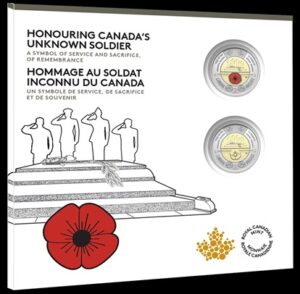
2025 … Commemorative Collector Keepsake Card – Honouring Canada’s Unknown Soldier … Service and sacrifice: A Collector Keepsake Card makes it easy to collect and remember. Few symbols are more sacred than the Tomb of the Unknown Soldier, and none more eloquently express the enduring consequences of war. The Unknown Soldier’s tomb is hallowed ground, and, every November 11, it becomes one of the focal points for our collective remembrance, grief and gratitude for Canada’s service members, past, present, and future.
Designed by Mary-Ann Liu, sculptor of the tomb’s bronze relief, the 2025 $2 Honouring Canada’s Unknown Soldier commemorative circulation coin calls all Canadians to remembrance. Two versions of the coin, struck and colourized, are presented in every Commemorative Collector Keepsake Card, as we pay tribute to all who serve, and to the anonymous hero who represents Canada’s fallen. Reflect, honour and remember. Mintage: 50,000; Composition Outer ring: Three-ply nickel-plated steel, Inner core: Three-ply brass-plated aluminum bronze; Finish: Circulation; Artist: Mary-Ann Liu (reverse), Steven Rosati (obverse).