
TROYAK EXECUTIVE TEAM is informing all members, colleagues, collectors, and Polonia at large, that Club meetings taking place at John Paul II Polish Cultural Centre, 4300 Cawthra Rd. (just south of Hwy. 403), Mississauga, Ontario. The new members are always welcome. www.polishculturalcentre.ca
ADRES SPOTKAÑ KLUBOWYCH ! Zarząd Główny Klubu “Troyak” informuje wszystkich członków kolekcjonerów, sympatyków oraz całą Polonię, że spotkania klubowe odbywają się w Polskim Centrum Kultury im. Jana Pawła II, przy 4300 Cawthra Rd. (na południe od autostrady 403), Mississauga, Ontario. Zapraszamy nowych członków do prężnego. Klubu “Troyak”. www.polishculturalcentre.ca

“TROYAK” CLUB NEXT MEETINGS …
NASTĘPNE SPOTKANIA KLUBU “TROYAK” …
Sunday 26th October 2025 @ 4:30 p.m.

23rd November 2025
Sunday – 30th November 2025 @ 9:00 a.m. to 4:00 p.m.
Mississauga Coin & Stamp Show
December 2025 … Happy Holidays!
Sunday 11th January 2026 AGM
Sunday 25th January 2026
Sunday 22nd February 2026
Sunday 29th March 2026
Sunday 26th April 2026
Sunday 31st May 2026
Sunday 21st June 2026
July & August 2026 –
Summer break … Letnie wakacje …
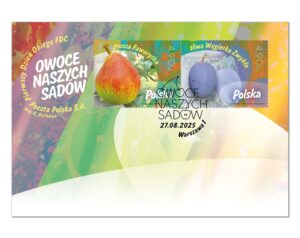
Owoce naszych sadów
The fruits of our orchards
www.poczta-polska.pl
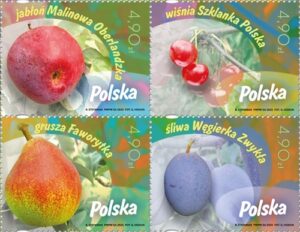
2025-08-27 … Nominał znaczka: 4.90 zł … Autor projektu: Roch Stefaniak; autor fotografii: Grzegorz Hodun; Ilość znaczków w emisji: 1; Format znaczka: 51×39,5 mm; Technika druku / Papier: Offset / fluorescencyjny; Nakład:88 000 szt.; Arkusz sprzedażny: 8 (2×4) znaczków.
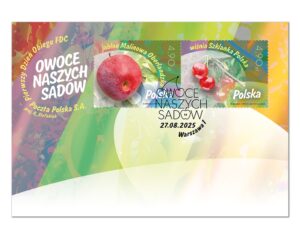
2025-08-27 … Denomination: 4.90 PLN … Author of the stamp design: Roch Stefaniak; autor fotografii: Grzegorz Hodun; Number of stamps in issue: 1; Sheet size: 51×39,5 mm; Paper: Fluorescent; Printing techniques: Offset; Sales sheet: 8 (2×4) stamps; Print run: 88 000 pcs.
AirSHOW RADOM 2025 – 100 lat Szkoły Orląt
AirSHOW RADOM 2025 –
100 years of the Eaglets School
www.poczta-polska.pl
2025-08-30 … Nominał znaczka: 4.90 zł … Autor projektu: Agata Tobolczyk; Ilość znaczków w emisji: 1; Format znaczka: 51×39,5 mm; Technika druku / Papier: Offset / fluorescencyjny; Nakład:90 000 szt.; Arkusz sprzedażny: 8 znaczków (po 4 znaczki każdego rodzaju).
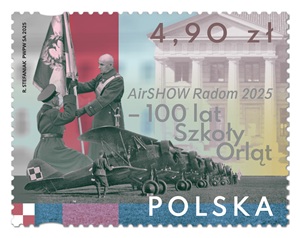
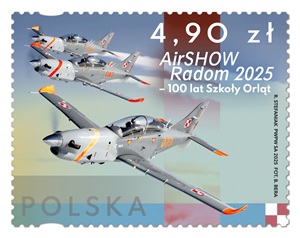
AirSHOW Radom 2025 został odwołany w związku z tragiczną śmiercią majora Macieja Krakowiana podczas prób do pokazów, co doprowadziło do czasowego zawieszenia wprowadzenia do obiegu znaczków pocztowych i kopert FDC upamiętniających to wydarzenie. Międzynarodowe Pokazy Lotnicze, których celem było uczczenie 100-lecia Szkoły Orląt, miały odbyć się w dniach 30-31 sierpnia 2025 roku, jednak z powodu katastrofy organizatorzy wystosowali komunikat o odwołaniu imprezy i zwrocie środków za bilety.
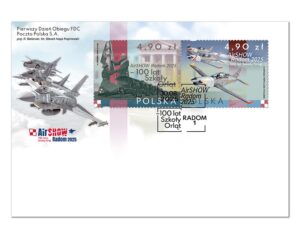
2025-08-30 … Denomination: 4.90 PLN … Author of the stamp design: Agata Tobolczyk; Number of stamps in issue: 1; Sheet size: 51×39,5 mm; Paper: Fluorescent; Printing techniques: Offset; Sales sheet: 8 stamps (4 of each type); Print run: 90 000 pcs.
AirSHOW Radom 2025 was planned for August 30-31 but was cancelled after a Polish Air Force F-16 fighter jet crashed on August 28 during a rehearsal, resulting in the death of the pilot. The event was to be held at Radom Airport and was significant because the Polish Air Force Academy, also known as the “Eaglets School,” was celebrating its 100th anniversary on June 14, 2025. The crash prompted the cancellation, and an investigation was launched.
Karpaty Wschodnie
www.poczta-polska.pl
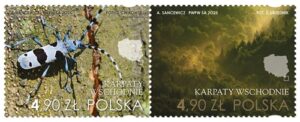
2025-09-15 … Nominał znaczka: 4.90 zł … Autor projektu: Agnieszka Sancewicz; Ilość znaczków w emisji: 1; Format znaczka: 51×39,5 mm; Technika druku / Papier: Offset / fluorescencyjny; Nakład:88 000 szt.; Arkusz sprzedażny: 8 znaczków (2×4).
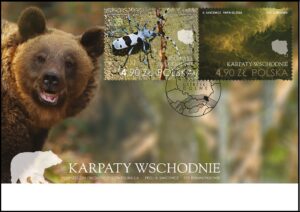
2025-09-15 … Denomination: 4.90 PLN … Author of the stamp design: Agnieszka Sancewicz; Number of stamps in issue: 1; Sheet size: 51×39,5 mm; Paper: Fluorescent; Printing techniques: Offset; Sales sheet: 8 stamps (2×4); Print run: 88 000 pcs.
80. rocznica powrotu Polski
na Ziemie Zachodnie i Północne
www.nbp.pl
Narodowy Bank Polski jest centralnym bankiem państwa odpowiadającym za politykę pieniężną i stabilność cen. Jego funkcje określa Konstytucja Rzeczypospolitej Polskiej i ustawa o NBP. NBP ma wyłączne prawo emisji pieniądza. Jako bank centralny nie prowadzi rachunków bankowych obywateli, nie przyjmuje od nich lokat, nie udziela kredytów. Prowadzi natomiast obsługę budżetu państwa, a także podmiotów sektora finansów publicznych. Gromadzi rezerwy walutowe państwa i zarządza nimi. Pełni funkcję banku banków, tworząc warunki do działania systemu bankowego. Jest również jednym z najważniejszych ośrodków naukowo-analitycznych w dziedzinie ekonomii i rynków finansowych.
Emisja wartości kolekcjonerskich stanowi okazję do upamiętniania ważnych historycznych rocznic i postaci oraz do rozwijania zainteresowań polską kulturą, nauką i tradycją. 26 czerwca 2025 roku Narodowy Bank Polski wprowadził do obiegu srebrną monetę kolekcjonerską o nominale 10 zł „80. rocznica powrotu Polski na Ziemie Zachodnie i Północne”.
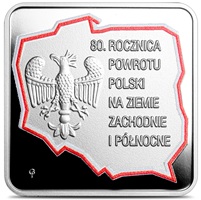
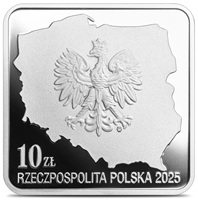
Nominał: 10 zł … metal: Ag 999/1000; stempel: lustrzany, druk UV; wymiary: 28,00 × 28,00 mm; masa: 14,14 g; brzeg (bok): gładki; nakład: do 8000 szt.; Projektant: Grzegorz Pfeifer; Emitent: NBP; Na zlecenie NBP monety wyprodukowała Mennica Polska SA.
Na rewersie monety został umieszczony orzeł Przemysła II – władcy, który jako pierwszy od XI w., przezwyciężając rozbicie dzielnicowe, w 1295 r. koronował się na króla Polski. Przyjęty przez niego znak to również pierwszy oficjalny herb całego państwa. Orzeł wraz z tytułem monety jest przedstawiony na tle stylizowanej, współczesnej mapy Polski, obwiedzionej wstęgą o barwach flagi Rzeczypospolitej Polskiej.
Na awersie widnieje wizerunek orła ustalony dla godła Rzeczypospolitej Polskiej na tle stylizowanej, współczesnej mapy Polski oraz nominał, napis: Rzeczpospolita Polska i rok emisji.
Na konferencjach w Teheranie, Jałcie i Poczdamie trzy wielkie mocarstwa zdecydowały o zmianie granic kilku państw środkowej Europy. Największe z tych zmian wynikały ze zgody Stanów Zjednoczonych i Wielkiej Brytanii na zachowanie przez Związek Sowiecki większości terytoriów, które wydarł on Polsce napaścią na nasze państwo we wrześniu 1939 r. – dokonanej kilkanaście dni po rozpoczęciu inwazji przez hitlerowskie Niemcy. Jako rekompensatę za niemal połowę zagarniętego przez ZSRS obszaru przedwojennej Polski, naszemu państwu przyznano ziemie należące przed II wojną do Trzeciej Rzeszy, które były jednak mniejsze o około jedną piątą. Zwycięskie mocarstwa uznały też za niedopuszczalne pozostawienie w granicach Polski zwartych skupisk ludności niemieckiej, której liczni przedstawiciele byli odpowiedzialni za jedne z największych w dziejach grabieże, zniszczenia i dokonywane z premedytacją zbrodnie – w szczególności za śmierć około 6 milionów obywateli Rzeczypospolitej Polskiej, w tym blisko 3 milionów obywateli narodowości żydowskiej. Z tych przyczyn z całego terytorium Polski została wysiedlona ludność niemiecka, a na jej miejsce przybywali przede wszystkim Polacy ekspatriowani z ziem anektowanych przez Związek Sowiecki.
Od 1945 r. granice Polski na zachodzie przebiegają wzdłuż Odry i Nysy Łużyckiej, a na północy – wzdłuż wybrzeża Bałtyku, podobnie jak za czasów pierwszych Piastów. Tym samym do Polski powróciły: Warmia, Gdańsk, ziemie babimojska i pilska oraz inne tereny zagarnięte przez Prusy w wyniku rozbiorów, których II Rzeczpospolita nie zdołała odzyskać. W granicach naszego państwa znalazła się również część Śląska, na której zostały stoczone najkrwawsze walki III powstania śląskiego, oraz dawne ziemie Prus Książęcych, które przez wieki stanowiły polskie lenno. Dolny Śląsk, Ziemia Lubuska i Pomorze Zachodnie ze Szczecinem powróciły po stuleciach, w których wielokrotnie zmieniały swą przynależność państwową. Ziemie Zachodnie i Północne należały do najbardziej zniszczonych i rozgrabionych obszarów Europy. Mimo niewyobrażalnych strat ludzkich – proporcjonalnie największych wśród wszystkich narodów uczestniczących w II wojnie światowej – naród polski zdołał odbudować tę niemal jedną trzecią terytorium państwa, przywracając życie i rozwój wyniszczonym regionom. Informacja: Artur Adamski.

80th Anniversary of Poland’s return to
the Western and Northern Lands
www.nbp.pl
Narodowy Bank Polski is the central bank of the State, responsible for its monetary policy and price stability. The Bank’s functions are described in the Constitution of the Republic of Poland and the Act on NBP. NBP holds the exclusive right to issue the currency of the Republic of Poland. As the central bank, it does not provide accounts for the general public, accept deposits from or extend loans to individuals. It acts as a banker to the State budget and public sector entities. NBP also holds and manages the foreign exchange reserves of the State. Finally, it functions as a banker to banks, creating conditions for the operation of the Polish banking system. Narodowy Bank Polski is one of the most important research and analytical centres in the fields of economics and financial markets.
Issuing collector items is an occasion to commemorate important historic figures and anniversaries, as well as to develop the interest of the public in Polish culture, science and tradition. On 26 June 2025, Narodowy Bank Polski issued into circulation a silver collector coin “80th Anniversary of Poland’s Return to the Western and Northern Territories”, with a face value of 10 złoty.
Face value: 10 zł … Metal: Ag 999/1000; Finish: proof, UV printing; Dimensions: 28.00 × 28.00 mm; Weight: 14.14 g; Edge (side): plain; Mintage: up to 8,000 pcs; Designer: Grzegorz Pfeifer; Issuer: Narodowy Bank Polski; The coins, commissioned by Narodowy Bank Polski, were struck by Mennica Polska SA.
The reverse of the coin features the image of the eagle of King Przemysł II – the ruler who was the first since the 11th century to crown himself king of Poland in 1295, overcoming the fragmentation of the realm and its division into provinces. The coat of arms adopted by him is also the first official coat of arms of the whole state. The eagle and the title of the coin are presented against the background of a stylised contemporary map of Poland edged with a ribbon in the colours of the Republic of Poland. The obverse features the image of the Eagle established as the state emblem of the Republic of Poland against the background of a stylised contemporary map of Poland as well as the face value, the inscription: Rzeczpospolita Polska (Republic of Poland) and the year of issue.
At the conferences in Tehran, Yalta and Potsdam, the three great powers decided to change the borders of several Central European countries. The biggest of these changes resulted from the consent of the United States and the United Kingdom for the Soviet Union to retain most of its territories it had wrested from Poland by attacking our country in September 1939, sixteen days after the Nazi Germany invasion. As compensation for almost half of the area of pre-war Poland seized by the USSR, our country was granted lands that had belonged to the Third Reich before World War II, which were, however, smaller by about one-fifth. The victorious powers also considered it unacceptable to leave within Poland’s borders dense concentrations of German population, many of whose representatives were responsible for some of the greatest looting, destruction and deliberate crimes in history – in particular, for the deaths of about 6 million citizens of the Republic of Poland, including almost 3 million citizens of Jewish nationality.
For these reasons, the German population was expelled from the entire territory of Poland, and its place was taken primarily by Poles expatriated from lands annexed by the Soviet Union. Since 1945, Poland’s borders in the west have run along the Oder and the Lusatian Neisse, and in the north along the Baltic coast, just as in the times of the first Piast rulers. Thus, Warmia, Gdańsk, the Babimost and Piła lands, as well as other territories seized by Prussia as a result of the partitions, and which the Second Republic was unable to regain, returned to Poland. A part of Silesia – especially the part most affected by the fighting of the Third Silesian Uprising – and the former lands of Ducal Prussia, which had been a Polish fiefdom for centuries, were also included within the borders of our state. Lower Silesia, the Lubusz Land and Western Pomerania with Szczecin returned after centuries of repeated changes of statehood.
The Western and Northern Territories were among the most devastated and plundered areas of Europe. Despite unimaginable human losses – proportionally the greatest of all nations participating in World War II – the Polish nation managed to rebuild this almost one third of the country’s territory, restoring life and development to the devastated regions. Info: Artur Adamski.
Pamięci ks. Franciszka Blachnickiego
www.nbp.pl
Narodowy Bank Polski jest centralnym bankiem państwa odpowiadającym za politykę pieniężną i stabilność cen. Jego funkcje określa Konstytucja Rzeczypospolitej Polskiej i ustawa o NBP. NBP ma wyłączne prawo emisji pieniądza. Jako bank centralny nie prowadzi rachunków bankowych obywateli, nie przyjmuje od nich lokat, nie udziela kredytów. Prowadzi natomiast obsługę budżetu państwa, a także podmiotów sektora finansów publicznych. Gromadzi rezerwy walutowe państwa i zarządza nimi. Pełni funkcję banku banków, tworząc warunki do działania systemu bankowego. Jest również jednym z najważniejszych ośrodków naukowo-analitycznych w dziedzinie ekonomii i rynków finansowych.
Emisja wartości kolekcjonerskich stanowi okazję do upamiętniania ważnych historycznych rocznic i postaci oraz do rozwijania zainteresowań polską kulturą, nauką i tradycją. 17 lipca 2025 roku Narodowy Bank Polski wprowadził do obiegu srebrną monetę kolekcjonerską o nominale 10 zł „Pamięci ks. Franciszka Blachnickiego”.
Nominał: 10 zł … metal: Ag 999/1000; stempel: lustrzany; średnica: 32,00 mm; masa: 14,14 g; brzeg (bok): gładki; nakład: do 8000 szt.; Projektantka: Paulina Kotowicz; Emitent: NBP Na zlecenie NBP monety wyprodukowała Mennica Polska SA.
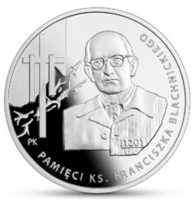
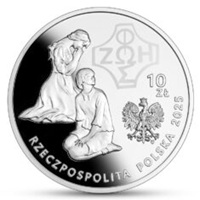
Na rewersie monety widnieje postać ks. Franciszka Blachnickiego. Lewa część płaszcza kapłana została przedstawiona jako obozowy pasiak z numerem 1201, nawiązujący do pobytu księdza w KL Auschwitz. W tle umieszczono krzyż ze stułą i ciernie. Na awersie znajdują się znak Ruchu Światło-Życie oraz wizerunek kobiety i mężczyzny podążających za Ewangelią.
Ks. Franciszek Blachnicki urodził się 24 marca 1921 r. w Rybniku. W latach młodzieńczych był harcerzem i żołnierzem – uczestniczył w wojnie obronnej we wrześniu 1939 r. Działał w konspiracji antyniemieckiej. Był też więźniem KL Auschwitz, skazanym w 1942 r. na karę śmierci zamienioną na 10 lat ciężkiego więzienia. W 1945 r. wstąpił do Wyższego Śląskiego Seminarium Duchownego w Krakowie. Święcenia kapłańskie przyjął 25 czerwca 1950 r. Jako wikariusz pracował w parafiach w Tychach, Borowej Wsi, Łaziskach Górnych, Rydułtowach, Cieszynie i Bieruniu Starym. W 1957 r. zainicjował ogólnopolską akcję trzeźwościową pod nazwą Krucjata Wstrzemięźliwości. Już w 1960 r. obejmowała ona 100 tys. członków deklarujących abstynencję od alkoholu. W sierpniu 1960 r. władze państwowe zakazały jej działalności. Ks. Blachnicki zarzucił im łamanie prawa i prześladowanie Kościoła. Z tego powodu w 1961 r. oskarżono go o „rozpowszechnianie pism zawierających fałszywe wiadomości”, aresztowano, a następnie skazano na karę 10 miesięcy więzienia z zawieszeniem na 3 lata. W roku akademickim 1961/1962 ks. Blachnicki podjął studia i pracę dydaktyczno-naukową na Katolickim Uniwersytecie Lubelskim.
W 1965 r. obronił pracę doktorską. Po niezatwierdzeniu przez władze państwowe jego habilitacji zrezygnował z pracy na uczelni. Napisał ponad 600 publikacji naukowych i popularnych. W 1963 r. podjął na nowo organizowanie rekolekcji oazowych dla młodzieży, z których z czasem rozwinął się Ruch Światło-Życie. W 1970 r. liczba uczestników letnich oaz wyniosła 1,5 tys. W 1976 r. brało w nich udział ok. 20 tys. osób, a dziesięć lat później – 76 tys. Od grudnia 1981 r. przebywał na emigracji. W 1982 r. osiadł w Carlsbergu (RFN), gdzie utworzył Międzynarodowe Centrum Ewangelizacji Światło-Życie oraz wydawnictwo Maximilianum. W czerwcu 1982 r. założył Chrześcijańską Służbę Wyzwolenia Narodów – stowarzyszenie skupiające Polaków i przedstawicieli innych narodów Europy Środkowo-Wschodniej wokół idei suwerenności wewnętrznej i jedności narodów w walce o wyzwolenie. Od połowy lat 50. XX w. do końca życia był prześladowany przez komunistyczny aparat państwowy. W toku śledztwa prowadzonego w Instytucie Pamięci Narodowej ustalono, że śmierć ks. Blachnickiego w dniu 27 lutego 1987 r. w Carlsbergu nastąpiła na skutek zabójstwa przez podanie mu śmiertelnych substancji toksycznych. Informacja: Andrzej Sznajder.
In Memory of Rev. Franciszek Blachnicki
www.nbp.pl
Narodowy Bank Polski is the central bank of the State, responsible for its monetary policy and price stability. The Bank’s functions are described in the Constitution of the Republic of Poland and the Act on NBP. NBP holds the exclusive right to issue the currency of the Republic of Poland. As the central bank, it does not provide accounts for the general public, accept deposits from or extend loans to individuals. It acts as a banker to the State budget and public sector entities. NBP also holds and manages the foreign exchange reserves of the State. Finally, it functions as a banker to banks, creating conditions for the operation of the Polish banking system. Narodowy Bank Polski is one of the most important research and analytical centres in the fields of economics and financial markets.
Issuing collector items is an occasion to commemorate important historic figures and anniversaries, as well as to develop the interest of the public in Polish culture, science and tradition. On 17 July 2025, Narodowy Bank Polski issued into circulation a silver collector coin “In Memory of Rev. Franciszek Blachnicki”, with a face value of 10 złoty.
Face value: 10 zł … Metal: Ag 999/1000; Finish: proof; Diameter: 32.00 mm; Weight: 14.14 g; Edge (side): plain; Mintage: up to 8,000 pcs; Designer: Paulina Kotowicz; Issuer: Narodowy Bank Polski; The coins, commissioned by Narodowy Bank Polski, were struck by Mennica Polska SA.
The reverse of the coin features the silhouette of Rev. Franciszek Blachnicki. The right side of the priest’s coat is depicted as a striped camp uniform with the number 1201, referring to the priest’s stay in KL Auschwitz. A cross with a stole and thorns is placed in the background. The obverse carries the symbol of the Light-Life Movement and the image of a man and a woman following the Gospel.
Father Franciszek Blachnicki was born on 24 March 1921 in Rybnik. In his youth he used to be a boy scout and a soldier and took part in the Polish defensive war of September 1939. He was part of the anti-Nazi resistance movement. He was also a prisoner of the Auschwitz concentration camp, in 1942 sentenced to death, which was commuted to 10 years of harsh imprisonment. In 1945, he entered the Higher Silesian Seminary in Kraków and was ordained a priest on 25 June 1950. As a vicar, he worked in parishes in Tychy, Borowa Wieś, Łaziska Górne, Rydułtowy, Cieszyn and Bieruń Stary. In 1957, he initiated a nationwide sobriety campaign called the Temperance Crusade. Already in 1960 it had 100,000 members declaring abstinence from alcohol. In August 1960, the state authorities banned its activities. Rev. Blachnicki accused them of breaking the law and persecuting the Church. For this reason, in 1961 he was accused of ‘distributing writings containing false information’, arrested and then sentenced to 10 months’ imprisonment, suspended for three years. In the academic year 1961-62, Rev. Blachnicki began his studies as well as teaching and research work at the Catholic University of Lublin.
In 1965, he defended his doctoral thesis. After his habilitation was not approved by the state authorities, he resigned from his work at the university. He wrote more than 600 scientific and popular publications. In 1963, he resumed organising oasis retreats for young people, from which the Light-Life Movement developed over time. In 1970, the number of participants in summer oasis retreats was 1,500. In 1976, about 20,000 people took part, and ten years later, as many as 76,000. Rev. Blachnicki lived in exile since December 1981. In 1982, he settled in Carlsberg (FRG), where he founded the International Light-Life Evangelisation Centre and the Maximilianum publishing house. In June 1982, he founded the Christian Service for the Liberation of Nations – an association that brings together Poles and representatives of other nations of Central and Eastern Europe around the idea of internal sovereignty and the unity of nations in the fight for liberation. He was persecuted by the communist state apparatus from the mid-1950s until the end of his life. An investigation by the Institute of National Remembrance established that Rev. Blachnicki’s death on 27 February 1987 in Carlsberg was the result of a homicide by administering lethal toxic substances. Info: Andrzej Sznajder.
2025 Indigenous Leaders –
Julia Haogak Ogina booklet of 6 Permanent™ stamps
www.canadapost.ca
Each booklet includes six Permanent™ stamps featuring drum dance teacher and leader, Julia Haogak Ogina. The Inuit leader helped retrieve forgotten drum dance songs and contributed to the creation of a regional language framework and programs promoting oral learning and knowledge transfer. The stamp is one of three in the 2025 Indigenous Leaders issue, the fourth set of stamps in the Indigenous Leaders series.
The Indigenous Leaders series recognizes the outstanding achievements and contributions of First Nations, Inuit and Métis leaders. The 2025 issue pays tribute to three remarkable knowledge/language keepers: Haogak Ogina – Inuit; Bruce Starlight – First Nations; Sophie McDougall – Métis. The Indigenous Leaders series, launched in 2022, highlights the contributions of modern-day First Nations, Inuit and Métis leaders who dedicated their lives to preserving their culture and improving the quality of life of Indigenous Peoples in Canada.

About Julia Haogak Ogina … Witnessing the erosion of her Inuit heritage spurred Julia Haogak Ogina (b. 1962, Ulukhaktok, Northwest Territories) to devote her life to revitalizing the culture and languages of her ancestors. As colonization fragmented families and undermined traditions, she noticed that lessons once learned through singing, dancing and storytelling were gradually being lost.
Ogina worked with anthropologist Richard G. Condon on The Northern Copper Inuit: A History (1996) to document the rapid pace of socio-economic change experienced by her community. In 2017, the accomplished drum dance teacher and leader helped publish Huqqullaarutit Unipkaangit (Stories Told through Drum Dance Songs). The project involved a decade-long consultation with Elders to retrieve forgotten drum dance songs – which she sees as a conduit for ancestral knowledge and “a window into all the strengths of our people.”
In nearly two decades with the Kitikmeot Inuit Association, Ogina has contributed to the creation of a regional language framework and programs promoting oral learning and knowledge transfer. In 2020, she was awarded a Meritorious Service Medal for her efforts to protect and promote Inuit culture and traditions.
About the design … The booklet cover features a photograph of Ogina in her drum-dancing attire (credit: Dustin Patar |The Canadian Press). The inside of the booklet features a photograph of the Huqqullaaqatigiit drum dance group in Cambridge Bay, Nunavut, in 2018. The drummer in the foreground is Ogina’s husband, Jerry Puglik (credit: Kate Kyle | CBC Licensing). It also includes a sentence about the cultural significance of drum dances (in English, French and Inuinnaqtun).The back features a short text on Ogina, a bar code and credits. Stamp Designer: Andrew Perro; Quantity Produced: 600,000; Issue Date: June 20, 2025.

The Official First Day Cover features a stamp honouring drum dance teacher and leader, Julia Haogak Ogina. The Inuit leader helped retrieve forgotten drum dance songs and contributed to the creation of a regional language framework and programs promoting oral learning and knowledge transfer. The stamp is one of three in the 2025 Indigenous Leaders issue, the fourth set of stamps in the Indigenous Leaders series. It is cancelled in Ulukhaktok, Northwest Territories, where Ogina was born.
The front of the OFDC features a photograph of the Huqqullaaqatigiit drum dance group in Cambridge Bay, Nunavut, in 2018. Group host Julia Ogina sits at bottom right (credit: Kate Kyle |CBC Licensing). The front also includes the text “Julia Haogak Ogina” and her stamp, cancelled in Ulukhaktok, Northwest Territories, where she was born. The stamp was cancelled on June 20, in connection with National Indigenous Peoples Day (June 21). The cancel features an illustration of a traditional drum. The back features a short text on Ogina, a bar code and credits. Cancellation Site: Ulukhaktok NT; Stamp Designer: Andrew Perro; Quantity Produced: 18,000 (6,000 of each); Issue Date: June 20, 2025.
2025 Indigenous Leaders –
Bruce Starlight booklet of 6 Permanent™ stamps
www.canadapost.ca
Each booklet includes six Permanent™ stamps featuring Elder and Knowledge Keeper Bruce Starlight (known as Dit’óní Didlishí ), who has dedicated his life to the preservation and revitalization of his mother tongue, Tsúut’ínà. The stamp is one of three in the 2025 Indigenous Leaders issue, the fourth set of stamps in the Indigenous Leaders series.
The Indigenous Leaders series recognizes the outstanding achievements and contributions of First Nations, Inuit and Métis leaders. The 2025 issue pays tribute to three remarkable knowledge/language keepers: Haogak Ogina – Inuit; Bruce Starlight – First Nations; Sophie McDougall – Métis. The Indigenous Leaders series, launched in 2022, highlights the contributions of modern-day First Nations, Inuit and Métis leaders who dedicated their lives to preserving their culture and improving the quality of life of Indigenous Peoples in Canada.
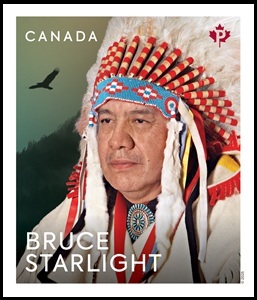
About Bruce Starlight … Known as Dit’óní Didlishí (Spotted Eagle), Bruce Starlight is one of the last fluent speakers of the Tsúut’ínà language. Born in 1947 on the Tsúut’ínà Nation near Calgary, Alberta, the Elder and Knowledge Keeper has worked hard for more than five decades to save his language and culture from extinction.
Although he had to leave high school to help support his family after his father died, Starlight went on to study linguistics at the University of Calgary later in life. Frustrated by a lack of support for the teaching of Tsúut’ínà, he began to document its alphabet, words and phrases. Starlight founded the Tsúut’ínà Gunáhà Násʔághà – an institute dedicated to the preservation and revitalization of his mother tongue – and served as language commissioner for the Tsúut’ínà Nation.
Also an accomplished teacher and speaker, he has developed extensive materials for Tsúut’ínà instruction, including dictionaries and recordings. Starlight recently collaborated on a collection of traditional narratives and historical accounts in Tsúut’ínà and a Tsúut’ínà-to-English glossary. He is still active as a cultural mentor, adviser and ambassador. In 2023, he received an honorary doctorate from Mount Royal University.
About the design … The booklet cover features a photograph of Bruce Starlight. The inside of the booklet features a photograph of treetops and sky and a quote by Bruce Starlight (in Tsúut’ínà, English and French.). The back features a short text on Starlight, a bar code and credits. Stamp Designer: Andrew Perro; Issue Date: June 20, 2025.

The Official First Day Cover features a stamp honouring Elder and Knowledge Keeper Bruce Starlight (known as Dit’óní Didlishí ), who has dedicated his life to the preservation and revitalization of his mother tongue, Tsúut’ínà. The stamp is one of three in the 2025 Indigenous Leaders issue, the fourth set of stamps in the Indigenous Leaders series. It is cancelled in Calgary, Alberta, near Starlight’s birthplace, the Tsúut’ínà Nation.
2025 Indigenous Leaders –
Sophie McDougall booklet of 6 Permanent™ stamps
www.canadapost.ca
Each booklet includes six Permanent™ stamps featuring Language Keeper Sophie McDougall (1928-2023), who shared extensive knowledge of her Métis culture and language with generations of students and community members over her long life. The stamp is one of three in the 2025 Indigenous Leaders issue, the fourth set of stamps in the Indigenous Leaders series.
The Indigenous Leaders series recognizes the outstanding achievements and contributions of First Nations, Inuit and Métis leaders. The 2025 issue pays tribute to three remarkable knowledge/language keepers: Haogak Ogina – Inuit; Bruce Starlight – First Nations; Sophie McDougall – Métis. The Indigenous Leaders series, launched in 2022, highlights the contributions of modern-day First Nations, Inuit and Métis leaders who dedicated their lives to preserving their culture and improving the quality of life of Indigenous Peoples in Canada.
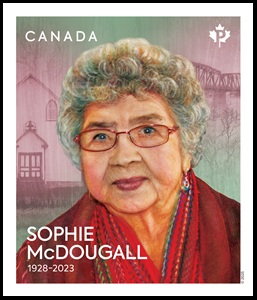
About Sophie McDougall … Sophie McDougall (née Margaret Sophie Boyer, 1928-2023) shared extensive knowledge of her Métis culture and language with generations of students and community members over her long life. She was born in St. Louis, Saskatchewan – a descendant of one of the area’s original settlers. As a Métis woman, McDougall experienced discrimination at teachers’ college but faced it with courage and determination. She graduated at age 17 and spent many years as a devoted schoolteacher.
An Elder with the Prince Albert Métis Women’s Association in Saskatchewan for 20 years, she translated books and other materials into Michif, the traditional language of the Métis. Michif is categorized as critically endangered by UNESCO.
McDougall was a dedicated Language Keeper who also worked with many organizations in Prince Albert to document and teach the regional dialect Michif French. She appeared in the YouTube series Métis Women Stories when she was in her late 80s and later contributed to the creation of the Learn Michif French app. In 2023, McDougall received the Order of Gabriel Dumont Gold Medal in recognition of her lifetime of service to the Métis of Canada.
About the design … The booklet cover features the stamp illustration. The inside and back of the booklet feature the same photographs that appear on the stamp of the Old St. Louis Roman Catholic Church and the original St. Louis Bridge, both located in the Saskatchewan town of the same name, where McDougall was born and raised. The inside also features a phrase in English, French, and Michif French , from the Learn Michif French app. The back includes a short text on McDougall, credits, and a bar code. Stamp Designer: Andrew Perro; Stamp Illustrator Illustration, Jennifer Faria, based on photo (courtesy of McDougall family); Quantity Produced: 600,000; Issue Date: June 20, 2025.
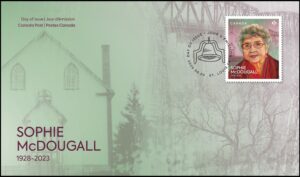
The Official First Day Cover features a stamp honouring Language Keeper Sophie McDougall (1928-2023), who shared extensive knowledge of her Métis culture and language with generations of students and community members over her long life. The stamp is one of three in the 2025 Indigenous Leaders issue, the fourth set of stamps in the Indigenous Leaders series. It is cancelled in St. Louis, Saskatchewan, where McDougall was born and raised.
About the design … The front of the Official First Cay Cover features photographs of the Old St. Louis Roman Catholic Church and the original St. Louis Bridge, both located in the Saskatchewan town of the same name, where McDougall was born and raised. The front also includes the text “Sophie McDougall 1928-2023” and her stamp, cancelled in St. Louis, Saskatchewan. The stamp was cancelled on June 20, in connection with National Indigenous Peoples Day (June 21). The cancel features an illustration of an old schoolhouse bell, symbolizing the pivotal role that education played in McDougall’s life.
Cancellation Site: St Louis, SK; Stamp Designer: Andrew Perro; Stamp Illustrator: Jennifer Faria, based on photo (courtesy of McDougall family); Quantity Produced: 6,000; Issue Date: June 20, 2025.
Great Hunters: Grey Wolf –
$20 Fine Silver Ultra High Relief Coin
www.mint.ca
Teamwork, persistence and adaptability—these are the traits that assure a wolf pack’s survival, and they have helped cement the grey wolf’s reputation as one of the Great Hunters. Unlike ambush predators such as the cougar (Coin #2 in this series), the grey wolf (Coin #3) is a pursuit predator, capable of chasing its prey over long distances and adjusting its tactics as circumstances change. The hunt itself is a coordinated group effort, as illustrated from the prey’s perspective on this Ultra High Relief (UHR) coin, with each pack member contributing to a common goal—an inspiring example of the complexity and wonder of the Canadian wilderness.
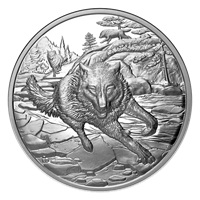
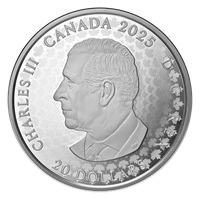
Face Value: $20 … Composition: 99.99% pure silver; Mintage: 6,000; Weight: 31.39 g; Diameter: 36.15 mm; Edge: Plain; Finish: Proof; Artist: Emily Damstra (reverse), Steven Rosati (obverse); Packaging: Black clamshell with black beauty box.
DID YOU KNOW? … ***Wolves are highly intelligent. They track and observe their prey, often targeting individuals that show signs of weakness or illness, while also assessing how the terrain and weather conditions might be used to their advantage.
Engraved in Ultra High Relief (UHR), the reverse design by artist Emily Damstra brings the viewer face-to-face with the grey wolf (Canis lupus) in the Canadian wilderness. The wolf in the foreground leads the chase and is trailed by other members of the pack as it moves swiftly across the rocky forest terrain, even making a hairpin turn while closing in on its fleeing prey. The obverse features the effigy of His Majesty King Charles III by Canadian artist Steven Rosati.
Emily Damstra, Artist … I chose to show the wolf mid-pivot because it was a pose that demonstrates the animal’s agility, and allows the viewer to see the wolf’s body while it gazes directly at the viewer. Whatever it is chasing had better watch out! The rocky backdrop enabled me to show two other members of the pack from different angles, and it, along with the water, provides a good contrast to the textures of the foreground wolf.
Konrad Wachelko, Engraver … It’s easy to let your creativity flow when interpreting a design like this. The challenge, as with any Ultra High Relief coin, is striking the right balance between aesthetic and technical considerations as you work simultaneously in the worlds of art and engineering. It’s a very fine line, and it involves a lot of back and forth between Engraving and Engineering to ensure everything flows perfectly. As an engraver, you also need to think several steps ahead and look at everything as a whole: can the CNC machine actually cut this small, carefully sculpted detail? Will the relief withstand the finishes and frostings? You have to anticipate the different steps and tools that will be required, and if you do, the design will be perfect all the way through.
Colourful Birds: Baltimore Oriole –
$20 Fine Silver Coin
www.mint.ca
If the Baltimore oriole’s happy whistling song doesn’t catch your attention in nature, its fiery orange plumage certainly will. A spring and summer resident of southern Canada, this energetic bird loves to perch high among the treetops in open woodland or along waterways, as illustrated on this selectively coloured coin, where the male’s bold colours contrast beautifully with the more delicate hues of a flowering dogwood.
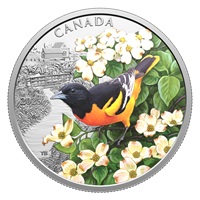
Face Value: $20 … Composition: 99.99% pure silver with selective colour; Mintage: 7,500; Weight: 31.39 g; Diameter: 38 mm; Edge: Serrated; Finish: Proof; Artist:Tony Bianco (reverse), Steven Rosati (obverse); Packaging: Black clamshell with black beauty box.
DID YOU KNOW? … ***Forget bird seed: the Baltimore oriole eats insects and famously has a sweet “tooth,” with fruits, berries and flower nectar providing the kind of high-energy foods needed to fuel migration. Its pendant nest is also unique; constructed from woven natural and man-made fibres, the pouch-like sack dangles from branches and can cradle up to seven eggs.
The reverse design by Canadian artist Tony Bianco is a springtime scene set in a rural area in southern Canada, where a small bridge lies over a meandering brook that winds past weathered barns in the engraved background. The selectively coloured portion of the design re-creates the striking colours of a male Baltimore oriole (Icterus galbula) among the cream-coloured blooms of a flowering dogwood (Cornus florida). The obverse features the effigy of His Majesty King Charles III by Canadian artist Steven Rosati.
Tony Bianco, Artist … The Baltimore oriole speaks summer to many Canadians. Its lyrical call from the tops of trees draws our attention, and we are often rewarded with a view of its striking orange and black plumage. I regularly see them as I travel a local trail that runs along Ontario’s Georgian Bay, which is where I based the setting of this design.
Kyle Cameron, Ontario Projects Biologist, Birds Canada … A vibrantly bright orange breast contrasting with a deep black head and back, combined with a loud clear whistling song, make the Baltimore oriole one of the most stunning birds in Eastern North America. These birds eat insects, fruit, and nectar, and will readily eat oranges or grape jelly at backyard feeders. While Baltimore orioles are not listed as a species at risk, their population is declining. You can help orioles and other birds by minimizing pesticide use and planting flowering fruit trees that are native to your region.
Avro Arrow – $20 Fine Silver Coin
www.mint.ca
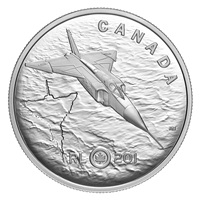
Heralded in the 1950s as “the symbol of a new era for Canada in the air,” the Avro CF-105 Arrow was one of this nation’s greatest engineering achievements, its impressive altitude and Mach-2 speed capabilities making it one of the most advanced supersonic interceptor jets of its time. It captured the imagination of the Canadian public, and, long after the project’s cancellation in 1959, the Arrow lives on as a delta-winged symbol of Canadian ingenuity and technical achievement.
The first Arrow, RL-201, is featured on this 1 oz. fine silver coin, where the spirit of innovation that produced the storied aircraft is reflected in the waters of Lake Ontario—the very waters over which different scaled models were launched during the development phase between 1954 and 1957. Remembering a made-in-Canada aeronautic marvel.
Face Value: $20 … Composition: 99.99% pure silver; Mintage: 10,000; Weight: 31.39 g; Diameter: 38 mm; Edge: Serrated; Finish: Proof; Artist: Ardell Bourgeois (reverse), Steven Rosati (obverse); Packaging: Black clamshell with black beauty box.
DID YOU KNOW? … ***This year (2025) marks the 80ᵗʰ anniversary of the founding of A.V. Roe Canada Limited. More commonly known as Avro, the aircraft manufacturer began operations in the former Victory Aircraft plant in Malton, Ont., and went on to become the third-largest corporation in Canada. It folded in 1962 after the Arrow’s cancellation. ***During the development stage, the assessment of the Arrow design’s flight ability involved wind-tunnel testing and experiments using scale models. Nine small-scale models—each 1/8 the size of a fully functional jet—were launched on rockets for aerodynamic tests over Lake Ontario, eventually slipping beneath the surface.
The reverse design by Canadian artist Ardell Bourgeois highlights the incredible story of the Avro CF-105 Arrow through its aerial view of the 1950s supersonic interceptor jet in flight. The view is of the first Arrow, indicated by the serial number “RL-201” (paired with the Royal Canadian Air Force classic roundel) on both the aircraft’s fuselage and in the inscription near the bottom of the design, just above the face value (“20 DOLLARS”) and year (“2025”). The image pays homage to the development of Canada’s most legendary aircraft, depicting the Arrow flying over the waters of Lake Ontario, where the small scale models were tested. This is represented by the Arrow’s outline, which is engraved incuse on the surface of the water, where it invokes the achievements that made it’s creation possible and contributed to aeronautics. The obverse features the effigy of His Majesty King Charles III by Canadian artist Steven Rosati.
Flying high: The story of the Avro Arrow … In 1953, A.V. Roe Canada Ltd. was commissioned to develop a supersonic interceptor that would bolster North America’s air defenses during the Cold War. Production began at the company’s facilities in the town of Malton, Ontario, and on October 4, 1957, the first Arrow, RL-201, was unveiled to great fanfare. After a successful first flight on March 25,1958, four more prototypes were completed, plus one Arrow Mk. 2 that was 97 percent complete. The twin-engine, delta-winged Arrow was hailed as a technological triumph; it was the first production aircraft to adopt a fly-by-wire flight control system, while the newly developed Iroquois PS-13 turbojet engine would have allowed it to fly at a speed exceeding Mach 2—twice the speed of sound. But on February 20, 1959, the government cancelled the project due to mounting costs and the belief that missiles were the future threat, not manned bomber against which the Arrow was developed. All CF-105 Arrow prototypes, models, plans and equipment were to be destroyed, though some surviving artifacts can be found in Canadian museums.
ARDELL BOURGEOIS, ARTIST … To me, the Arrow represents the pinnacle of aviation development in Canada. For a short time, Canada was at the cutting edge of aerodynamics, creating a design in Malton, a neighbourhood in the city of Mississauga, Ontario, that had the potential to match the best in the world – it was a high-water mark for our aviation industry. While the actual aircraft did not fly this close to the water, test models were fired via rocket engines from the shore into Lake Ontario, and these smaller replicas did get close to the surface and ultimately, below it.
Maple Leaves in Motion – $50 Fine Silver Coin
www.mint.ca
A popular issue year after year, our Maple Leaves in Motion coin turns up the contrast in 2025 with reverse yellow gold plating and multiple engraving styles. Like sunshine spilling across the coin’s surface, the yellow gold plating adds a visual warmth that evokes joy and vitality. It also creates a striking contrast between the two traditionally engraved maple leaves and the non-plated one, which has a more modern look thanks to multifaceted engraving. Tilt the coin to catch the light, and all those reflective facets make the silver leaf sparkle like a jewel, while the laser-engraved pattern in the background adds depth within the design. See how this multifaceted maple leaf shines bright.

Face Value: $50 … Composition: 99.99% pure silver with reverse (yellow) gold plating; Mintage: 2,000; Weight: 157.6 g; Diameter: 65.25 mm; Edge: Serrated; Finish: Proof; Artist: Lisa Thomson-Khan (reverse), Steven Rosati (obverse); Packaging: Red lacquer wood case and black beauty box.
DID YOU KNOW? … The leaves on your coin are based on those of a sugar maple tree, Acer saccharum, the preferred species for making maple syrup (Canada is the world’s top producer of maple syrup).
Designed by Canadian artist Lisa Thomson-Khan, your coin’s reverse features two traditionally engraved sugar maple (Acer saccharum) leaves and a third leaf brought to life by multifaceted engraving. The contrast between the engraving styles is further heightened by the application of yellow gold plating to all but the foremost leaf, while a laser-engraved maple leaf pattern fills the field. The pattern repeats on the obverse, which is also almost entirely plated with yellow gold, save for the effigy of His Majesty King Charles III by Canadian artist Steven Rosati.
Nature’s Delight:
Honey Bee – 1 oz. Fine Silver Coin
www.mint.ca
Flying from flower to flower, the honey bee collects pollen, floral oils, and the nectar that is turned into honey at the hive; as it moves about, it provides an essential pollination service that helps plants grow and reproduce, ultimately contributing to one-third of the foods we eat. Known to be efficient both in instinct and design, the honeybee and its comb are beautifully adorned with yellow gold plating on this 99.99% pure silver coin, which, fittingly, features the popular hexagon coin shape that mimics the natural design of a honeycomb cell, widely considered to be nature’s perfect structure.
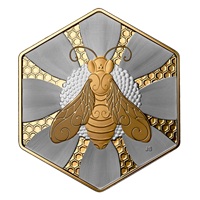
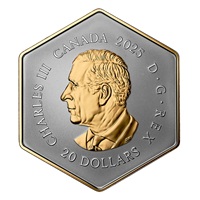
Face Value: $20 … Composition: 99.99% pure silver with yellow gold plating; Mintage: 7,500; Weight: 32 g; Diameter: 42 mm; Edge: Plain; Finish: Reverse Proof; Artist: June Steube (reverse), Steven Rosati (obverse); Packaging: Black paperboard case.
DID YOU KNOW? … ***Honey bees have five eyes and six legs, and can fly at a speed of 24 km/h. That buzzing sound you hear when a honeybee comes near? That’s the sound of its wings beating up to 240 times per second! ***Depending on the time of year, one hive can contain up to 80,000 individuals – mostly female workers/foragers, a few hundred male workers, and one queen. Making honey requires team work: it takes nectar sourced from about 2 million flowers to make just one pound of honey (a beehive can yield between 10 and 100 pounds of honey in a year), and each forager only produces about 1/12th of a teaspoon of honey in her short lifetime. ***Each hexagonal honeycomb cell serves as both a storehouse and a nest for larvae, and it isn’t just the honey bee that builds nests with hexagonal cells—wasps do it, too. The shape, which has inspired architects and engineers, provides several advantages, such as excellent strength-to-weight ratio, thermal insulation, space efficiency and structural stability, while minimizing the amount of building material (beeswax) required.
Inspired by daisies and black-eyed Susans, the centre of a stylized flower serves as a landing pad for a busy honey bee (Apis mellifera) in this reverse design by Canadian artist June Steube. The bee’s central position reflects its importance as a pollinator, while the overhead view allows for a more stylized representation of its wing pattern. The honeycomb in the background is visible between the flower petals, its hexagonal cells mirroring the coin’s six-sided shape. Both the bee and the honeycomb, as well as the rim on both sides, are plated with yellow gold. The obverse features the gold-plated effigy of His Majesty King Charles III by Canadian artist Steven Rosati.
June Steube, Artist … Inspired by nature’s creative genius, my vision for this coin design was a stylized interpretation of the exquisite relationship between the shapes of the bee, the flower and the honeycomb. The bee is central to this vision, with the reflective symmetry of its wings emphasizing a classical order and harmony. The Fibonacci spiral of the flower pistil along with the honeycomb hexagons highlight the complexity and beauty existing in the natural world.
Ryan Poser, Engraver-3D Artist … Due to the specialized nature of hexagon shaped coins, we had rigid manufacturing restrictions and the relief height was at a premium. With so many prominent elements stacked on top of one another – the bee, the flower, the hexagon pattern – we had to really optimize things to make them stand out without losing any of their details or form in the process. We decided to cut this design with the laser, which allowed us to achieve much finer and more delicate details. Many parts of the design go down almost as far as the zero plain (the field), creating space for other connected elements that may otherwise have been lost in the modeling process. For example, with the centre of the flower, the relief was lowered down to nearly zero percent where it meets the bee, so that we could give extra roundness and form to the pollinator, making full use of the range within the allotted relief height.
Moon Sky: Raven – 1 oz. Fine Silver Coin
www.mint.ca
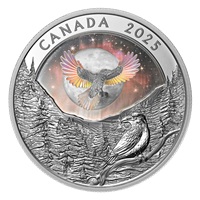
Benevolent creator and mischief maker, bringer of light and keeper of secrets: the Raven plays a central role in many Inuit legends. These stories are passed down to each new generation of artists and storytellers, inspiring them to create beautiful interpretations of these timeless tales, as seen on this 99.99% pure silver coin. Developed in collaboration with Nunatsiavut artist Bronson Jacque, this coin’s reverse design simultaneously honours the Raven of legends while presenting a new, original take: here, the engraved raven is a representation of our grounded selves, while the hologram-enhanced raven speaks to the power of storytelling and its ability to lift our creative spirits to new heights. In the artist’s own words, “the coin is a reminder that we are more than what we show of ourselves, that we have a colourful world within, one that is capable of creating a light in the darkest of nights.”
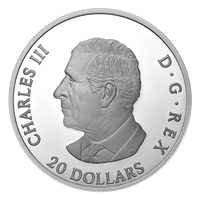
Face Value: $20 … Composition: 99.99% pure silver; Mintage: 7,500; Weight: 31.39 g; Diameter: 38 mm; Edge: Serrated; Finish: Proof; Artist: Bronson Jacque (reverse), Steven Rosati (obverse); Packaging: Black clamshell with black beauty box.
DID YOU KNOW? … ***The raven is one of the most common birds in Canada’s Arctic region, and one of the few bird species that resides there year-round.
The story on your coin’s reverse was developed in collaboration with Nunatsiavut artist Bronson Jacque, who presents a new interpretation of the traditional Raven figure of Inuit legends. Realistically depicted on the lower engraved portion of the design, a raven perched on a branch and surrounded by trees represents each of us, grounded in our sense of self. The other, rendered in bas-relief, gleefully soars high into the sky upon realizing they are Raven, Creator of Life. An achromatic hologram—a three-dimensional image created with nanotechnology-based imagining—softens the full moon’s features and captures its magnificent luminosity, while the aurora borealis dances in the night sky. The spectrum of colours seemingly shifts depending on the viewing angle, creating the illusion of motion as it illuminates the raven’s feathers. The obverse features the effigy of His Majesty King Charles III by Canadian artist Steven Rosati.
Bronson Jacque, Artist … “In the crafting of the Raven in the Night Sky coin, I aimed to embody the dual nature of our being—the tangible and internal. The engraved raven, grounded with vivid detail and reminiscent of the landscapes of my home, speaks to our solid and discernible selves. Above, the holographic raven takes flight, its wings vibrant and entrancing like our legends passed down through generations; it is our creativity that we nurture, which births our boundless inner worlds. I drew from the period of my childhood when I was developing my sense of self in Nunatsiavut, where even the smallest details mean everything. Nature, in all its power and grace, both deserves and demands full attention; this instilled an inclination to capturing details as a way to share and connect with my community. I always strive to be genuine in my art, feeling that authenticity is the only way to truly be understood, and through it, I hope to share my experience.”
Moon Sky: Raven – 1 oz. Fine Silver Coin
www.mint.ca
Gaze into this holographic night sky as Raven soars to new heights. Benevolent creator and mischief maker, bringer of light and keeper of secrets: the Raven plays a central role in many Inuit legends. These stories are passed down to each new generation of artists and storytellers, inspiring them to create beautiful interpretations of these timeless tales, as seen on this 99.99% pure silver coin. Developed in collaboration with Nunatsiavut artist Bronson Jacque, this coin’s reverse design simultaneously honours the Raven of legends while presenting a new, original take: here, the engraved raven is a representation of our grounded selves, while the hologram-enhanced raven speaks to the power of storytelling and its ability to lift our creative spirits to new heights.
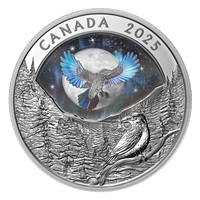
Hologram Technology: The hologram on this coin is struck directly with 3D embossing micro-textures into the coin’s surface during the minting process. The colors seen in the hologram are not as pigmented compared to a painted coin. They may appear iridescent, shifting between hues such as blue, green, yellow, or red. These effects are intentional and are a hallmark of genuine holographic minting. The appeal of this technology is with the variations in hologram clarity and colour intensity. As a result, the hologram may display a range of iridescent colors that shift depending on, lighting and viewing angle.
In the artist’s own words, “the coin is a reminder that we are more than what we show of ourselves, that we have a colourful world within, one that is capable of creating a light in the darkest of nights.” Features an inspiring, never-before-seen interpretation of the Raven.
2025 … Moon phases – Puzzle Coin Set
www.mint.ca
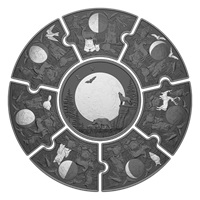
The Moon is a powerful force in the natural world, where moonlight and Moon phases can influence everything from wildlife navigation to birdsong. Using selective black rhodium plating to create a high-contrast night view, this wildlife-themed Puzzle Coin Set traces the Lunar cycle across its eight coins: one round centrepiece and seven puzzle-shaped outer pieces. The outer pieces share the same engraved design, but one by one, different Moon phases and animals emerge from under the cover of darkness, as the rhodium plating yields to a portion of the engraving, allowing these silver elements to tell the story. Meanwhile, the Full Moon at the centre casts its silver light on the landscape, offering you a glimpse of what goes on in the wild after dark. Our first black-rhodium-plated puzzle coin set. Dimensions: 111.3 mm (Central coin: 50 mm; Individual puzzle pieces: 47.4 mm x 30.65 mm x 21.54 mm)
Face Value: $ValueVarious … Composition: 99.99% pure silver with selective black rhodium plating; Mintage: 1,100; Weight: 297 g; Diameter: 38 mm; Edge Centre: Plain; Puzzle Shaped: Interrupted Serrations; Finish: Modified Reverse Proof; Artist: Caitlin Lindstrom-Milne (reverse), Steven Rosati (obverse); Packaging: Wood case.
DID YOU KNOW?… ***The Moon is the biggest and brightest object in our night sky, and the luminance of a full Moon is about 250 times greater than that of a new Moon night. The extra light makes it easier to see your surroundings at night, but it also helps visual predators, meaning prey species may be at higher risk of predation during that Moon phase. The Lunar cycle repeats every 29.5 days.
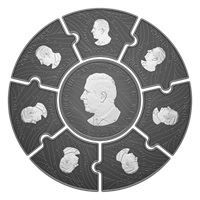
Inspired by the Lunar cycle and the Moon’s influence on nature, the assembled eight-piece puzzle set features a reverse design by artist Caitlin Lindstrom-Milne, with black rhodium plating setting the tone for a nighttime view.
The round centre piece features a nocturnal landscape inhabited by bats, wolves and bears, and illuminated by a full Moon that appears larger near the horizon, allowing a clear view of its surface features. Around this central piece, seven interconnecting, puzzle-shaped pieces share the same engraved, forest-themed design. On each piece, selective black rhodium plating conceals most of the engraving in order to reveal a different Moon phase and a known nocturnal or crepuscular Canadian animal (clockwise from the right/3 o’clock position): white-tailed deer for the new Moon; a Great Horned Owl for the waxing crescent; wolves for the first quarter; a North American beaver for the waxing gibbous; a Common Nighthawk for the waning gibbous; grizzly bears for the third quarter; and little brown bats for the waning crescent Moon. Each coin’s obverse features the effigy of His Majesty King Charles III by Canadian artist Steven Rosati.
Caitlin Lindstrom-Milne, Artist … I had a lot of fun designing this particular coin, and through researching the theme, I got to learn how different animals react to the Lunar cycle. I thought it would be nice to feature a mix of animals that reside in water, land and sky, but the size constraints proved challenging: trying to fit seven animals into one cohesive illustration required some trial and error, and I ended up taking some artistic liberties in terms of their sizes in relation to each other. Still, precise placement and consistency are important when designing a puzzle coin set – for example, we had to make sure the Moon was not only the same design on each piece, but also in the exact same place. It took a lot of teamwork to get it all just right!
Alicia Cook Sapene, Product Manager … The 2025 Puzzle Coin set has been one of the most challenging and rewarding projects I’ve worked on so far. There were a lot of challenges to overcome when applying black rhodium plating to an irregular coin shape for the first time, but we wanted to get it right because it elevates the beauty of the design and is essential to the storytelling. Thinking creatively and working in close collaboration with the artist, our team of engravers and engineers played a pivotal role in bringing this concept to life. My hope is that the many hours of work that went into this project translate into a collectible piece that will be cherished for generations.
Matt Bowen, Engraver (centre piece)… This was a cool project to work on thanks to the variety of animals and my close collaboration with a fellow engraver. Between the Moon, landscape and animal fur, there is tons of texture on the centre coin. The animals were first treated as if they were bald, because we had to get the musculature correct; only then did we place the fur on top. But I think the grass field took me the longest, and lots of patience was required – the first level alone contains over 90 individual blades, with many crossing over each other, and these all had to be done separately.
Samantha Strath, 3D Artist-Engraver (outer piece)… The rhodium plating didn’t affect my engraving, though it did complicate our frosting decisions: we created test coins and divided them into quadrants, each with a different frosting; we then plated half of each quadrant to see what those frostings looked like under the black rhodium before deciding on what to use. The real challenge was the amount of detail and overlapping layers in the outer piece, given the piece’s unique shape. Sculpting that much detail, with so many overlapping elements and the animals looking at us head-on, was a challenge – not to mention working with extreme caution on the master tooling to ensure none of that detail got lost. But it’s what I enjoy about the process, and seeing the final coin after so much delicate work is quite the reward.