
TROYAK EXECUTIVE TEAM is informing all members, colleagues, collectors, and Polonia at large, that Club meetings taking place at John Paul II Polish Cultural Centre, 4300 Cawthra Rd. (just south of Hwy. 403), Mississauga, Ontario. The new members are always welcome. www.polishculturalcentre.ca
ADRES SPOTKAÑ KLUBOWYCH ! Zarząd Główny Klubu “Troyak” informuje wszystkich członków kolekcjonerów, sympatyków oraz całą Polonię, że spotkania klubowe odbywają się w Polskim Centrum Kultury im. Jana Pawła II, przy 4300 Cawthra Rd. (na południe od autostrady 403), Mississauga, Ontario. Zapraszamy nowych członków do prężnego. Klubu “Troyak”. www.polishculturalcentre.ca

“TROYAK” CLUB NEXT MEETINGS …
NASTĘPNE SPOTKANIA KLUBU “TROYAK” …

July & August 2025 –
Summer break … Letnie wakacje …

TROYAK CLUB @
Roncesvalles Polish Festival 2025
Saturday – September 13th 2025 &
Sunday – September 14th, 2025
https://polishfestival.ca www.kazimierz.org
St. Casimir’s Church
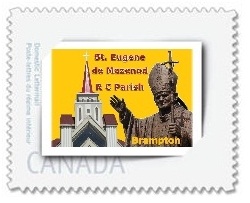
Parish Hall … 156 Roncesvalles Ave. Toronto, Ontario
Stamp Exhibit … Pope John Paul II on World Stamps
and Displays of Coins, Stamps, Collectibles
by Troyak Club Members.
Roncesvalles Polish Festival
www.troyakclub.com

28th September 2025
26th October 2025
23rd November 2025
Sunday – 30th November 2025 @ 9:00 a.m. to 4:00 p.m.
Mississauga Coin & Stamp Show
December 2025 … Happy Holidays!
Sunday 11th January 2026 AGM
Sunday 25th January 2026
Sunday 22nd February 2026
Sunday 29th March 2026
Sunday 26th April 2026
Sunday 31st May 2026
Sunday 21st June 2026
July & August 2026 –
Summer break … Letnie wakacje …
Wzgórze Tumskie w Płocku
Tumskie Hill in Płock
www.poczta-polska.pl
2025-06-07 … Nominał znaczka: 4.90 zł … Autor projektu: Poczta Polska; autor fotografii: Michał Fortuna; Ilość znaczków w emisji: 1; Format znaczka: 31,25×25,5 mm; Technika druku / Papier: Rotograwiura; Nakład:7 000 000 szt.; Arkusz sprzedażny: 100.
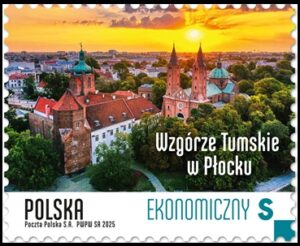
Spośród innych nadwiślańskich miast Płock wyróżnia wyjątkowo malownicze położenie na stromej, 53-metrowej skarpie zwanej Wzgórzem Tumskim. Panorama miasta od strony Wisły urzeka swą urodą. To kwintesencja Płocka i jego ikona. Przez wieki była uwieczniana pędzlem malarzy i opiewana przez poetów.
Ze skarpy rozciąga się zachwycający widok na szeroko rozlane wody Wisły, która zachowała swój niemal pierwotny charakter. Rzeka pomiędzy Płockiem a Włocławkiem tworzy rozległy zbiornik, zwany Jeziorem Włocławskim, który w najszerszym miejscu ma prawie półtora kilometra szerokości. Widać lewobrzeżną część Płocka – Radziwie z portowymi dźwigami stoczni rzecznej i monumentalnym budynkiem elewatora, a w oddali – lasy Gostynińsko-Włocławskiego Parku Krajobrazowego, w których jest kilkadziesiąt jezior i małych zbiorników wodnych, a także wiele ośrodków wypoczynkowych. Jest to naturalne zaplecze weekendowe i urlopowe płocczan oraz turystów, w szczególności z Warszawy i Łodzi.
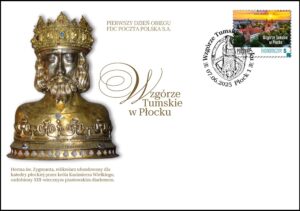
2025-06-07… Denomination: 4.90 PLN … Author of the stamp design: Polish Post author of the photograph: Michał Fortuna; Number of stamps in issue: 1; Stamp size: 31,25×25,5 mm; Paper/ Printing techniques: Rotogravure; Sales sheet: 100); Print run: 7000 000 pcs.
Płock is a medium-sized city located in the central part of Poland. One of the most important parts of the city is the picturesque Tumskie Hill, situated on a steep 53-meter slope. The Tumskie Hill, together with the buildings on the top, is the oldest part of the historic urban and architectural complex of the city, including the area of the former duke’s stronghold. The complex of historic buildings on the hill consists of: the cathedral basilica, the complex of the former Benedictine abbey with the relics of the castle and the building of the Diocesan Museum. The Renaissance cathedral of the Assumption of the Blessed Virgin Mary is the dominant building on the Tumskie Hill.
In the vicinity of the cathedral basilica from the north-west there is a complex of the former Benedictine abbey with the relics of the castle of Masovian dukes. Unfortunately, not much has survived from the former castle. The building experienced its splendor in the times of Casimir the Great, when the old fortifications were rebuilt into a Gothic stronghold. Today, the Gothic Clock Tower covered with a baroque dome draws attention. North of the basilica is the Diocesan Museum. The museum collects broadly understood religious art, but also kontusz sashes and manuscripts. The most beautiful panorama visitors can admired from the view points: behind the cathedral, at the Starzyński Hotel and at Książęce Square, next to the Bolesław Krzywousty monument. Below the Tumskie Hill there is an unusual pier (stretching along the shoreline). A bit further, the Płock amphitheater was built. In summer it is a place of many events and concerts.
Rośliny uprawne
Crop plants
www.poczta-polska.pl
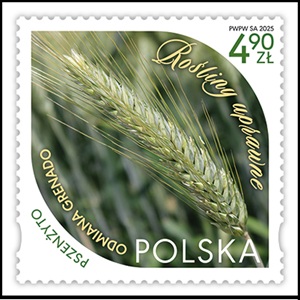
2025-06-17 … Nominał znaczka: 4.90 zł … Autor projektu: Poczta Polska; Ilość znaczków w emisji: 1; Format znaczka: 40.5×40.5mm; Technika druku / Papier: Offset / Fluorescencyjny; Nakład: 120 000 szt.; Arkusz sprzedażny: 5+przywieszka.
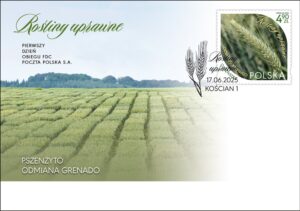
2025-06-17 … Denomination: 4.90 PLN … Author of the stamp design: Polish Post; Number of stamps in issue: 1; Stamp size: 40.5×40.5mm; Paper: Fluorescent; Printing techniques: Offset; Sales sheet: 5+tag; Print run: 120 000 pcs.
Zwierzęta domowe
Pets
www.poczta-polska.pl
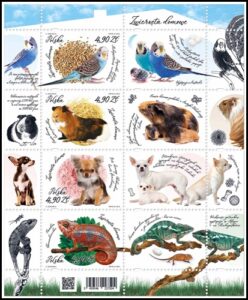
2025-06-21 … Nominał znaczka: 4.90 zł … Autor projektu: Agnieszka Sancewicz; Ilość znaczków w emisji: 1; Format znaczka: 31,25×43 mm; Technika druku / Papier: Offset / Fluorescencyjny; Nakład: 112 000 szt.; Arkusz sprzedażny: 4 znaczki + 4 przywieszki.

2025-06-21 … Denomination: 4.90 PLN … Author of the stamp design: Agnieszka Sancewicz; Number of stamps in issue: 1; Stamp size: 31,25×43 mm; Paper: Fluorescent; Printing techniques: Offset; Sales sheet: 4 badges + 4 tags; Print run: 112 000 pcs.

45. rocznica powstania NSZZ „Solidarność”
www.nbp.pl
Narodowy Bank Polski jest centralnym bankiem państwa odpowiadającym za politykę pieniężną i stabilność cen. Jego funkcje określa Konstytucja Rzeczypospolitej Polskiej i ustawa o NBP. NBP ma wyłączne prawo emisji pieniądza. Jako bank centralny nie prowadzi rachunków bankowych obywateli, nie przyjmuje od nich lokat, nie udziela kredytów. Prowadzi natomiast obsługę budżetu państwa, a także podmiotów sektora finansów publicznych. Gromadzi rezerwy walutowe państwa i zarządza nimi. Pełni funkcję banku banków, tworząc warunki do działania systemu bankowego. Jest również jednym z najważniejszych ośrodków naukowo-analitycznych w dziedzinie ekonomii i rynków finansowych.
Emisja wartości kolekcjonerskich stanowi okazję do upamiętniania ważnych historycznych rocznic i postaci oraz do rozwijania zainteresowań polską kulturą, nauką i tradycją. 25 kwietnia 2025 roku Narodowy Bank Polski wprowadził do obiegu srebrną monetę kolekcjonerską o nominale 10 zł „45. rocznica powstania NSZZ »Solidarność«”.
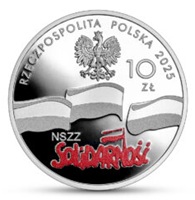
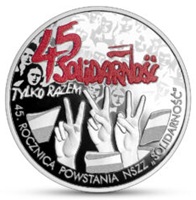
Nominał: 10 zł … metal: Ag 999/1000; stempel: lustrzany, druk UV; średnica: 32,00 mm; masa: 14,14 g; brzeg (bok): gładki; nakład: do 9000 szt.; Projektant: Robert Kotowicz; Emitent: NBP; Na zlecenie NBP monety wyprodukowała Mennica Polska SA.
Na awersie monety umieszczono wizerunek orła ustalony dla godła Rzeczypospolitej Polskiej, logo NSZZ „Solidarność”, a także symboliczne odwzorowanie polskich flag. Na rewersie widnieją: rocznicowe logo 45-lecia powstania NSZZ „Solidarność”, hasło „Tylko Razem” i ręce w symbolicznym znaku zwycięstwa, a w tle – tłum protestujących.
W 2025 r. mija 45. rocznica podpisania Porozumień Sierpniowych i powstania NSZZ „Solidarność”. W sierpniu 1980 r. fala protestów przeciwko niesprawiedliwej władzy objęła cały kraj. Strajkowało ponad 700 zakładów pracy i ponad 700 tys. odważnych ludzi w całej Polsce. To oni 45 lat temu walczyli o lepsze warunki pracy, o godność i prawo do decydowania o swojej Ojczyźnie. Porozumienia sierpniowo-wrześniowe otworzyły drogę do utworzenia wolnych związków zawodowych. Dzięki nieustępliwej walce, negocjacjom i wreszcie podpisaniu porozumień – przełamano monopol władzy i utworzono pierwszą po II wojnie światowej niezależną reprezentację pracowniczą w Polsce. Wielu ludzi miało udział w tych przemianach, tworzyło i wspierało rodzącą się Solidarność. Później miliony pracowników zaangażowały się w działania Związku jako uczestnicy pokojowej rewolucji, która wyzwoliła nasz kraj spod jarzma totalitarnej władzy.
Porozumienie Gdańskie podpisane 31 sierpnia 1980 r. po trwającym dwa tygodnie strajku w Stoczni im. Lenina było jednym z czterech porozumień sierpniowo-wrześniowych. Wcześniej porozumienie z władzami PRL zawarto 30 sierpnia w Szczecinie, a później – 3 września w Jastrzębiu-Zdroju i 11 września w Hucie Katowice w Dąbrowie Górniczej. Wynikiem zawartych porozumień było powstanie ogólnokrajowego Niezależnego Samorządnego Związku Zawodowego „Solidarność”, który oficjalnie zarejestrowano 10 listopada 1980 r. NSZZ „Solidarność” zapisał się w historii Polski i świata, ale wciąż ma wiele do zrobienia. Postulaty sierpniowe pozostają dla wszystkich związkowców testamentem do realizacji i drogowskazem dla przyszłych pokoleń. Informacja: Piotr Machnica Komisja Krajowa NSZZ „Solidarność”.
Fala protestów w 1980 r. doprowadziła do podpisania Porozumień Sierpniowych i powstania NSZZ „Solidarność” – pierwszej niezależnej od władz komunistycznych organizacji związkowej. Z okazji 45. rocznicy tego przełomowego wydarzenia Narodowy Bank Polski wyemitował monetę, która jest wyrazem wdzięczności i pamięci o tamtym czasie – początku wielkich zmian. To dla mnie również osobiście ważna rocznica. Niezależność zawsze była i zawsze będzie dla mnie wartością nadrzędną. Informacja: prof. Adam Glapiński Prezes Narodowego Banku Polskiego.
Stało się już tradycją, że jubileusz NSZZ „Solidarność” wiąże się z wyemitowaniem przez Narodowy Bank Polski monety kolekcjonerskiej. Bardzo się cieszę, że 45. rocznica podpisania Porozumień Sierpniowych i powstania NSZZ „Solidarność” również została upamiętniona w ten sposób. W 2025 r. chcemy podkreślić, jak ważne dla losów Polski i Europy było zaangażowanie milionów Polaków w powstanie i rozwój Solidarności. Dzięki NBP na rynek numizmatyczny trafia niezwykła moneta, symbolizująca podziękowanie dla nich. Informacja: Piotr Duda Przewodniczący Komisji Krajowej NSZZ „Solidarność”.

45th Anniversary of the “Solidarity” Trade Union
www.nbp.pl
Narodowy Bank Polski is the central bank of the State, responsible for its monetary policy and price stability. The Bank’s functions are described in the Constitution of the Republic of Poland and the Act on NBP. NBP holds the exclusive right to issue the currency of the Republic of Poland. As the central bank, it does not provide accounts for the general public, accept deposits from or extend loans to individuals. It acts as a banker to the State budget and public sector entities. NBP also holds and manages the foreign exchange reserves of the State. Finally, it functions as a banker to banks, creating conditions for the operation of the Polish banking system. Narodowy Bank Polski is one of the most important research and analytical centres in the fields of economics and financial markets.
Issuing collector items is an occasion to commemorate important historic figures and anniversaries, as well as to develop the interest of the public in Polish culture, science and tradition. On 25 April 2025, Narodowy Bank Polski issued into circulation a silver collector coin “45th Anniversary of the ‘Solidarity’ Trade Union”, with a face value of 10 złoty.
Face value: 10 zł … Metal: Ag 999/1000; Finish: proof, UV printing; Diameter: 32.00 mm; Weight: 14.14 g; Edge (side): plain; Mintage: up to 9,000 pcs; Designer: Robert Kotowicz; Issuer: Narodowy Bank Polski; The coins, commissioned by Narodowy Bank Polski, were struck by Mennica Polska SA.
The obverse of the coin features the image of the Eagle established as the state emblem of the Republic of Poland, the logo of the Independent and Self-Governing Trade Union “Solidarity”, and also the symbolic representation of Polish flags. The reverse of the coin features the anniversary logo, slogan and hands making the symbolic victory sign, against the background of a symbolic crowd of protesters.
The year 2025 marks the 45th anniversary of the signing of the August Agreements and the establishment of the Independent Self-Governing Trade Union “Solidarity”. In August 1980 a wave of protests against the unjust authorities swept across the whole country. Over 700 workplaces and more than 700,000 courageous people went on strike in the whole of Poland. They were the ones who fought for better working conditions, dignity and the right to decide about their country 45 years ago. The August-September agreements paved the way for the creation of free trade unions. Thanks to a relentless struggle, negotiations and finally the signing of the agreements, the monopoly of power was broken and independent workers’ representation was established for the first time in Poland since World War II. Many people had a part in these changes, created and supported the nascent “Solidarity”. Later, millions of workers got involved in the activities of the trade union as participants of the peaceful revolution which liberated Poland from the yoke of totalitarian rule.
The Gdańsk Agreement signed on 31 August 1980 following a two-week strike at the Lenin Shipyard was one of the four August-September agreements. An agreement with the authorities of the Polish People’s Republic had been signed earlier in Szczecin on 30 August, and later, agreements were signed on 3 September in Jastrzębie-Zdrój and on 11 September in Katowice Steelworks in Dąbrowa Górnicza. The result of the agreements was the creation of the nationwide Independent Self-Governing Trade Union “Solidarity”, which was officially registered on 10 November 1980. “Solidarity” made its mark on the history of Poland and the world, but still has much to do. The August demands remain a testament to all trade unionists to be implemented and a road map for future generations. Info: Piotr Machnica National Commission of the Independent and Self-Governing Trade Union “Solidarity”.
The wave of protests in 1980 led to the signing of the August Agreements and the creation of the Independent Self-Governing Trade Union “Solidarity” – the first trade union organisation independent of the communist authorities. On the 45th anniversary of this landmark event, Narodowy Bank Polski issued a coin which is an expression of gratitude and remembrance of that time – the beginning of great changes. This is also an important anniversary for me personally. Independence has always been and always will be a supreme value for me. Info: Prof. Adam Glapiński Governor of Narodowy Bank Polski.
It has now become a tradition that the anniversary of the Independent and Self-Governing Trade Union “Solidarity” involves the issue of a collector coin by Narodowy Bank Polski. I am very pleased that the 45th anniversary of the signing of the August Agreements and the creation of “Solidarity” has also been commemorated in this way. In 2025 we want to underline how important the involvement of millions of Poles in the creation and development of “Solidarity” was for the fate of Poland and Europe. Thanks to NBP, an extraordinary coin comes on the numismatic market symbolising gratitude to them. Piotr Duda President of the National Commission of the Independent and Self-Governing Trade Union “Solidarity”.
Odkryj Polskę – Tykocin
www.nbp.pl
Narodowy Bank Polski jest centralnym bankiem państwa odpowiadającym za politykę pieniężną i stabilność cen. Jego funkcje określa Konstytucja Rzeczypospolitej Polskiej i ustawa o NBP. NBP ma wyłączne prawo emisji pieniądza. Jako bank centralny nie prowadzi rachunków bankowych obywateli, nie przyjmuje od nich lokat, nie udziela kredytów. Prowadzi natomiast obsługę budżetu państwa, a także podmiotów sektora finansów publicznych. Gromadzi rezerwy walutowe państwa i zarządza nimi. Pełni funkcję banku banków, tworząc warunki do działania systemu bankowego. Jest również jednym z najważniejszych ośrodków naukowo-analitycznych w dziedzinie ekonomii i rynków finansowych.
Emisja wartości kolekcjonerskich stanowi okazję do upamiętniania ważnych historycznych rocznic i postaci oraz do rozwijania zainteresowań polską kulturą, nauką i tradycją. 22 maja 2025 roku Narodowy Bank Polski wprowadził do obiegu monetę okolicznościową o nominale 5 zł z serii „Odkryj Polskę” – „Tykocin”.
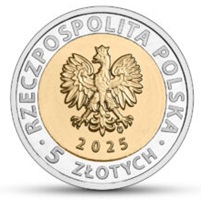
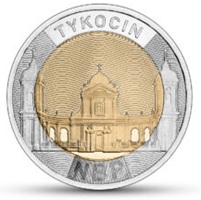
Nominał: 5 zł … stop: pierścień MN25, rdzeń CuAl6Ni2; stempel: zwykły; średnica: 24,00 mm; masa: 6,54 g; brzeg (bok): moletowany nieregularnie; na boku ośmiokrotnie powtórzony napis: NBP, co drugi odwrócony o 180 stopni, rozdzielony gwiazdkami; nakład: do 1 000 000 szt.; Projektantka: Dobrochna Surajewska; Emitent: NBP; Na zlecenie NBP monety wyprodukowała Mennica Polska SA. Na rewersie monety znajduje się wizerunek kościoła pw.Trójcy Przenajświętszej w Tykocinie od strony zachodniej.
Strona odwrotna (rewers): centralnie, na wyodrębnionej płaszczyźnie w kształcie koła wypełnionej falistymi liniami, oraz częściowo w otoku wizerunek kościoła pw. Trójcy Przenajświętszej w Tykocinie od strony zachodniej. W otoku, u góry, półkolem napis: TYKOCIN, u dołu wyodrębnione pole, na którym w zależności od kąta patrzenia jest widoczny napis: NBP albo rok: 2025.
Strona przednia (awers): centralnie, na wyodrębnionej płaszczyźnie w kształcie koła, wizerunek orła ustalony dla godła Rzeczypospolitej Polskiej. Poniżej orła półkolem oznaczenie roku emisji: 2025. W otoku, u góry, półkolem napis: RZECZPOSPOLITA POLSKA oraz u dołu półkolem napis: 5 ZŁOTYCH, poprzedzony oraz zakończony perełką. Pod orłem, po prawej stronie, znak mennicy: m / w.
Barokowy kościół parafialny pw. Trójcy Przenajświętszej jest jednym z najpiękniejszych zabytków doby staropolskiej w Tykocinie. Budowa murowanej świątyni chrześcijańskiej w mieście jest ściśle związana z realizowanym od lat 40. XVIII w. zamysłem właściciela Tykocina Jana Klemensa Branickiego, hetmana wielkiego koronnego, regulacji jego zabudowy według reguł barokowej urbanistyki. Reorganizacja miasta zaowocowała oprócz wzniesienia kościoła parafialnego także przekształceniem rynku chrześcijańskiego w reprezentacyjny plac miejski z ustawieniem w jego centrum pomnika Stefana Czarnieckiego (1763), przebudową wielkiej synagogi w dzielnicy żydowskiej i gmachem nowego klasztoru bernardynów.
Kościół pw. Trójcy Przenajświętszej, zamykający wschodnią pierzeję uregulowanego rynku, został zbudowany w latach 1742–1749. Sam korpus wzniesiono w latach 1742–1745 zapewne według projektu architekta Tomasza Bellotiego II, natomiast dalsze prace zostały przejęte przez nadwornego architekta Branickiego – Jana Henryka Klemma. Dokonał on korekty pierwotnego planu i zaprojektował fasadę kościoła, wieże-dzwonnice, arkadowe łączniki z fasadą oraz bramę z popiersiami ewangelistów (1748–1749). Około 1775 r. nad tympanonem fasady nadbudowano schodkowy szczyt zaprojektowany przez białostockiego architekta Józefa Sękowskiego. Kościół jest trójnawową, orientowaną bazyliką ścienno-filarową z nawami bocznymi w formie rzędu skomunikowanych ślepych kaplic. Jego trójprzęsłowy korpus został wzniesiony na planie prostokąta, z prezbiterium wysokości i szerokości nawy głównej. Po obu stronach fasady znajdują się kwadratowe dwukondygnacyjne wieże-dzwonnice, bardzo mocno wysunięte przed jej lico. Łączą się one z korpusem kościoła przez jednokondygnacyjne, trójprzęsłowe półkoliste galerie, co wzmacnia efekt zdominowania całej przestrzeni rynkowej przez świątynię.
Wyposażenie kościoła jest późnobarokowo-rokokowe. Większość została zamówiona przez hetmana Branickiego w pracowniach najlepszych artystów i rzemieślników w Warszawie, zaś pozostałe elementy wykonali jego pracownicy z dworu białostockiego. W ołtarzu głównym znajduje się obraz „Trójca Św.” malarza Szymona Czechowicza, pracującego na zamówienie wielu ówczesnych familii magnackich. W obecnym wystroju bazyliki uwagę przykuwają dwa pełnopostaciowe portrety: Jana Klemensa Branickiego i jego trzeciej żony Elżbiety (Izabeli) z Poniatowskich Branickiej, namalowane przez Antoniego Tallmanna i przeniesione do kościoła w Tykocinie na początku XIX w. Barokową bazylikę oddziela żelazne ogrodzenie z bramą usytuowaną na osi fasady. Tworzą ją dwa wysokie prostokątne słupy z namiotowymi daszkami, na których umieszczono popiersia czterech ewangelistów, wykonane przez rzeźbiarza Jana Chryzostoma Redlera. Widoczne w Tykocinie podporządkowanie całego miasta nadrzędnej rynkowo-kościelnej kompozycji zgodnie z barokową koncepcją przestrzenną było wyjątkowo rzadkie w przedrozbiorowej Rzeczypospolitej. Informacja: Prof. dr hab. Cezary Kuklo Uniwersytet w Białymstoku.
Discover Poland – Tykocin
www.nbp.pl
Narodowy Bank Polski is the central bank of the State, responsible for its monetary policy and price stability. The Bank’s functions are described in the Constitution of the Republic of Poland and the Act on NBP. NBP holds the exclusive right to issue the currency of the Republic of Poland. As the central bank, it does not provide accounts for the general public, accept deposits from or extend loans to individuals. It acts as a banker to the State budget and public sector entities. NBP also holds and manages the foreign exchange reserves of the State. Finally, it functions as a banker to banks, creating conditions for the operation of the Polish banking system. Narodowy Bank Polski is one of the most important research and analytical centres in the fields of economics and financial markets.
Issuing collector items is an occasion to commemorate important historic figures and anniversaries, as well as to develop the interest of the public in Polish culture, science and tradition. On 22 May 2025, Narodowy Bank Polski issued into circulation a commemorative coin of the series “Discover Poland” – “Tykocin”, with a face value of 5 złoty.
Face value: 5 zł … Metal: ring MN25, core CuAl6Ni2; Finish: standard; Diameter: 24.00 mm; Weight: 6.54 g; Edge (side): irregularly milled, with the inscription “NBP”, repeated eight times, every second one inverted by 180 degrees, separated by stars; Mintage: up to 1,000,000 pcs; Designer: Dobrochna Surajewska; Issuer: Narodowy Bank Polski; The coins, commissioned by Narodowy Bank Polski, were struck by Mennica Polska SA. The reverse of the coin features the image of the Holy Trinity Church in Tykocin as seen from the west.
Back side (reverse): centrally, on a separated plane in the shape of a circle filled with wavy lines, and, partially along the rim, an image of the west side of the Holy Trinity Church in Tykocin. Along the rim, at the top, a semi-circular inscription: TYKOCIN; at the bottom, a separated field, in which the inscription: NBP or the year: 2025 is visible depending on the viewing angle.
Front side (obverse): centrally, on a separated plane in the shape of a circle, the image of the Eagle established as the state emblem of the Republic of Poland. Below the Eagle, a semi-circular notation of the year of issue: 2025. Along the rim, at the top, a semi-circular inscription: RZECZPOSPOLITA POLSKA (Republic of Poland) and, at the bottom, a semi-circular inscription: 5 ZŁOTYCH, preceded and followed by a pellet. Below the Eagle, on the right, the Mint mark: m / w.
The Baroque Holy Trinity Parish Church in Tykocin is one of the most beautiful monuments of the old Polish period. The construction of a brick Christian temple in the town is closely connected with the idea to regulate its development according to the rules of Baroque urban planning, implemented from the 1740s by the owner of Tykocin, Jan Klemens Branicki, the Grand Hetman of the Crown. In addition to the construction of a parish church, the reorganisation of the town resulted in the transformation of the Christian square into a representative town square with the erection of a monument to Stefan Czarniecki in its centre (1763), the rebuilding of the Great Synagogue in the Jewish quarter and the building of a new Bernardine monastery.
The Holy Trinity Church, closing the eastern frontage of the regulated market square, was built in 1742-1749. The body itself was erected in 1742-1745, probably to a design by the architect Thomas Belloti II, while further work was taken over by Branicki’s court architect – Jan Henryk Klemm. He made corrections to the original plan and designed the church’s façade, bell towers, arcaded links to the façade and a gate with busts of the Evangelists (1748-1749). Around 1775, a stepped gable designed by the Białystok based architect Józef Sękowski was added over the tympanum of the façade. The church is a three-nave orientated wall-and pillar basilica with side aisles in the form of a row of connected side chapels. Its three-bay body was built on a rectangular plan, with a chancel of the height and width of the nave. On both sides of the façade there are square two-story bell towers, projecting in front of its face. They are connected to the body of the church by single-story, three-bay semicircular galleries, which enhances the effect of the temple dominating the entire market space.
The church’s furnishings are late Baroque and Rococo. Most of it was commissioned by Hetman Branicki in the workshops of the best artists and craftsmen in Warsaw, while other elements were made by his employees from the Branicki Palace in Białystok. The main altar contains the ‘Holy Trinity’ painting by Szymon Czechowicz, the artist commissioned by many magnate families of the time. In the present décor of the basilica, attention is drawn to two full-figure portraits: of Jan Klemens Branicki and his third wife Elżbieta (Izabela) Branicka, née Poniatowska, painted by Antoni Tallmann and transferred to the church in Tykocin at the beginning of the 19th century. The Baroque Basilica is separated by an iron fence with a gate located on the axis of the façade. It is formed by two tall rectangular columns with tent-shaped canopies bearing the busts of the four Evangelists by the sculptor Johann Chrysostomus Redler. The subordination of the entire city to the overriding market and church composition in accordance with the Baroque urban planning principles, as seen in Tykocin, was exceptionally rare in the pre-partition Polish Republic. Info: Prof. Cezary Kuklo University of Białystok.
Blue Rodeo 2025 booklet of 6 Permanent™ stamps
www.canadapost.ca
This booklet of stamps honours award-winning band Blue Rodeo. Blue Rodeo has sold more than four million albums and won 12 JUNO Awards, including induction into the Canadian Music Hall of Fame. The band has also received a star on Canada’s Walk of Fame and earned a Governor General’s Performing Arts Award for Lifetime Artistic Achievement. Booklet of 6 Permanent™ domestic rate stamps. The Blue Rodeo stamp was issued on April 4, 2025. There were 130,000 booklets of 6 Permanent™ stamps printed for this issue, for a total of 780,000 stamps. Canada Post has a long history of honouring Canadian bands and singer-songwriters for their contributions to the nation’s arts and culture. Blue Rodeo joins such past honourees as Robert Charlebois (2009), The Tragically Hip (2013), Beau Dommage (2013), and Sarah McLachlan (2024).

About Blue Rodeo … One of Canada’s most beloved bands, Blue Rodeo has helped shape and redefine Canadian popular music. When they formed in 1984, the band’s unique blend of country, folk and rock set them apart in a musical landscape dominated by synth-pop and hair metal. Led by the sweet, soaring harmonies and endearing melodies of principal singer-songwriters Jim Cuddy and Greg Keelor, Blue Rodeo is known for its rootsy eclecticism and superb musicianship. Hits such as “Try,” “Lost Together,” “5 Days in May” and “Hasn’t Hit Me Yet” have propelled Blue Rodeo albums to multi-platinum status.
Blue Rodeo has won 12 JUNO Awards, including induction into the Canadian Music Hall of Fame, received a star on Canada’s Walk of Fame and earned a Governor General’s Performing Arts Award for Lifetime Artistic Achievement. They have sold more than four million albums and played more than 2,500 live shows – including more at Toronto’s venerated Massey Hall (their hometown venue) than any other rock band. Forty years on, Blue Rodeo continues to tour and record.
About the design … The booklet cover features the stamp image. The stamp shows a collage of studio portraits of the seven current members of Blue Rodeo. Pictured from left to right are (front row) Mike Boguski, Jimmy Bowskill, Jim Cuddy, Greg Keelor and (top row) Colin Cripps, Bazil Donovan and Glenn Milchem. In the background of the stamp is an illustration of a blue guitar; in the foreground, flowers reminiscent of the floral embroidery on the band’s western-style shirts. The inside of the booklet includes the six stamps and a photo of Blue Rodeo performing in Toronto in August 2024. The back of the booklet features elements of the guitar and floral art featured on the stamp, along with a short text on the band. Cancellation Site: Toronto, ON; Stamp Designer: Jim Ryce; Stamp Illustrator: Katy Lemay; Quantity Produced: 130,000 booklets of six Permanent™ stamps (780,000 Permanent™ stamps); Issue Date: April 4, 2025.

Blue Rodeo 2025 Official First Day Cover … The Official First Day Cover pays tribute to award-winning band Blue Rodeo. It is cancelled in Toronto, Ontario, where the band formed and is based. Blue Rodeo has sold more than four million albums and won 12 JUNO Awards, including induction into the Canadian Music Hall of Fame. The band has also received a star on Canada’s Walk of Fame and earned a Governor General’s Performing Arts Award for Lifetime Artistic Achievement. This Official First Day cover was issued on April 4, 2025. There were 7,000 covers printed for this issue. The foreground on the front of the Official First Day Cover features the band members’ signatures superimposed over their portraits from the stamp image. In the background is a photo of Blue Rodeo performing in Toronto in August 2024.
The front of the cover also includes the text “Blue Rodeo” and the stamp, cancelled on April 4, 2025, in Toronto, Ontario – where the band formed and is based. The cancel mark is a guitar pick with a flower at its centre that is reminiscent of the floral detail that appears on the band’s western-style shirts. The back of the OFDC is a collage created from a different photo taken at the same concert and art that appears on the stamp. The back also features a short text on the stamp subject, along with credits/captions. Stamp Designer: Jim Ryce; Stamp Illustrator: Katy Lemay; Issue Date: April 4, 2025.
Canada Post Community Foundation (2025):
Permanent™ domestic rate stamps –
booklet of 10 + $1 donation
www.canadapost.ca
Take home this booklet of 10 Permanent™ domestic rate stamps from our 2025 Canada Post Community Foundation stamp issue to help organizations that support Canadian children and youth. Booklet of 10 Permanent™ domestic rate stamps. From the Canada Post Community Foundation’s 2025 fundraising issue. A donation of $1 from each booklet goes directly to the Canada Post Community Foundation Permanent™ stamps are always worth the going postage rate. Buy today and use anytime in the future.

About the issue … Take it from me, life is all about perspective. Attitude. And – in my case – altitude! From way up here, we giraffes can see the path forward. And we’ll most certainly stick our necks out when someone needs help. You can give Canadian children and youth these same advantages through the Canada Post Community Foundation semi-postal fundraising stamp. Your donation of $1 from each booklet of 10 stamps goes directly to the Foundation to fund local and national non-profit groups that assist Canadian children and youth and give them a better outlook on the future.
About the Canada Post Community Foundation … When you purchase a booklet of 10 stamps, a donation of $1 goes directly to the Foundation to fund local and national nonprofit groups that assist Canadian children and youth. Since 2012, the Canada Post Community Foundation has supported more than 1,300 community organizations that bring positive change to Canadian children.
About the design … This year, the Canada Post Community Foundation’s fundraising issue was designed by Paprika and illustrated by Anne-Julie Dudemaine. The stamp depicts a charming illustration of giraffes caring for their young. The stamp represents a supportive community and highlights the importance of providing every child the opportunity to thrive in a supportive and enriching environment. Playful and original typography, designed specifically for the stamp issue, signifies what childhood should be for every child—lighthearted and carefree. Cancellation Site: Ottawa, Ontario; Stamp Designer: Paprika; Stamp Illustrator: Anne-Julie Dudemaine; Quantity Produced: 200,000 booklets (2 million stamps); Issue Date: April 28, 2025.

When you purchase this OFDC, a donation of 10 cents from the stamp affixed goes directly to the Foundation to fund local and national nonprofit groups that assist Canadian children and youth. Since 2012, the Canada Post Community Foundation has supported more than 1,300 community organizations that bring positive change to Canadian children. This year’s Official First Day Cover, designed by Paprika and illustrated by Anne-Julie Dudemaine, depicts a supportive community of giraffes and highlights the importance of providing every child the opportunity to thrive in a supportive and enriching environment. Playful and original typography, designed specifically for the stamp issue, signifies what childhood should be for every child—lighthearted and carefree. Quantity Produced: 5,000; Issue Date: April 28, 2025.
The Calling of an Engineer
– Fine Silver Coin
www.mint.ca
A most honourable vocation, the field of engineering draws many of Canada’s best and brightest—individuals dedicated to innovation and problem-solving, and improving our lives. Upon earning their degree, Canada’s engineering graduates are invited to take part in an obligation ceremony, where they are conferred the Iron Ring that is a symbol of their professional values and responsibilities. That faceted ring inspired this coin’s uniquely shaped edge, itself an impressive feat of engineering. On the coin’s reverse, the ring-like rim rises up to encircle our homage to Canada’s engineers and their many varied achievements, on the 100ᵗʰ anniversary of the rite of passage known as The Calling of an Engineer.
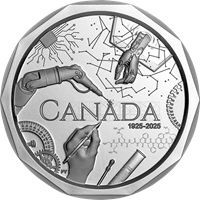
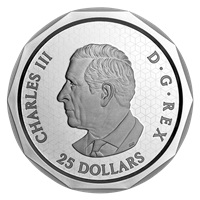
Face Value: $25 … Composition: 99.99% pure silver; Mintage: 5,000; Weight: 32.75 g; Diameter: 34.5 mm; Edge: Faceted edge; Finish: Proof; Artist: Pandora Young (reverse), Steven Rosati (obverse); Packaging: Black clamshell with black beauty box.
DID YOU KNOW? … ***The Iron Ring doesn’t just represent a milestone for Canadian engineers—it serves as an expression of pride for their profession, a reminder of their duty, and a symbol of their commitment to supporting fellow members of the engineering community. ***The first ever Calling of an Engineer was held on April 25, 1925, in Montreal, and another ceremony was held one week later, on May 1, 1925, in Toronto. While the original rings were made of iron, most of today’s rings are stainless steel.
An homage to Canada’s engineers, the reverse design by artist Pandora Young is a representation of a century of engineering innovation and achievements. The diverse field is represented by (clockwise from top): a computer screen with a robotic hand, set against an AI-inspired dot design; a wire gauge; the chemical diagram for insulin partially shown; a test tube and dropper; a hand holding a pencil; a spur gear next to a compass and the tip of a protractor; a soldering iron; and a computer chip. In the centre, the word “CANADA” appears in blueprint lettering, along with the double dates “1925-2025” commemorating the 100th anniversary (“1925-2025”) of the Calling of an Engineer—a rite of passage for Canada’s engineering graduates. The raised rim is uniquely shaped to resemble the Iron Ring worn by Canadian engineers as a symbol of professional obligation. The obverse features the effigy of His Majesty King Charles III by Canadian artist Steven Rosati.
Leonard Shara, P.Eng., MBA, Chief Warden, Corporation of the Seven Wardens … “In 2025, the Canadian Engineering community celebrates the 100th Anniversary of The Calling of an Engineer. At an Obligation Ceremony, an Iron Ring is given to candidates—proudly worn on the little finger of the working hand—as a reminder of their obligation to lifelong ethical practice. This is the first coin ever to have bevelled facets on the edge, reminiscent of the facets of the treasured Iron Ring. For 100 years, obligated engineers have been on the front lines helping to build the wonderful country of Canada. May Canadian engineering innovation continue to grow and flourish for another 100 years!”
Mary A. Wells, Ph.D., FEC, FCAE, FIMMM P. Eng, Dean of the Faculty of Engineering at University of Waterloo … “The iron ring is more than a symbol of professional achievement for Canadian engineers; it is a solemn reminder of the ethical obligations they hold to society. Each ring represents a commitment to uphold the highest standards of integrity, responsibility, and public safety. Engineers are entrusted with the power to shape the world we live in, and it is their duty to ensure their work benefits humanity and protects the well-being of all.”
Gerard McDonald, MBA, P.Eng., ICD.D, former Chief Executive Officer of Engineers Canada … “The Calling of an Engineer is a profound tradition that marks the first step in the transition from student to professional, carrying with it the weight of responsibility and ethical duty. This coin beautifully encapsulates the essence of this rite, serving as a lasting reminder of the commitment to excellence and integrity that defines the engineering profession. Personally, participating in this project has been an honour, reflecting the pride I take in being part of such a storied legacy.”
Christian Brochu, R&D Engineer … “I myself received an Iron Ring in a ceremony held in Montreal, where the first ceremony took place 100 years ago, so I was excited to work on this project from the beginning. For the rim, the idea of having the ring’s facets replace the usual serrations came from our Research and Development team, and we set out to replicate the angles and quantity as best as we could. We pushed the boundaries of the striking process by tripling up the rim height, from 0.18 mm to 0.6 mm, and it is this fabulous high rim that allows the ring facets to stand out and add distinction to this special coin.”
Louis-Remi Labelle, 3D Artist – Engraver … “This coin has been a very interesting challenge on multiple levels, and it required a lot of collaboration with our engineer Christian Brochu, as well as all our CNC and laser technicians. In terms of engraving, the most challenging aspects were the finer elements, such as the chemical diagram; due to their intricate nature, we had to make some choices between traditional engraving, laser engraving and various frostings, and the final coin is a combination of all of those choices. I’m really grateful for the team’s willingness to think outside the box and use the full extent of our manufacturing capabilities, because it allowed us to achieve the very intricate design and the challenging ring-shaped rim in the best way possible!”
Pandora Young, Artist … “The challenge of this coin was to represent a field as diverse and fascinating as engineering on a canvas small enough to lose between couch cushions! The Calling of an Engineer embodies a noble oath—to protect the safety of fellow Canadians through scrupulous work—and the achievements of Canadian engineers are so impressive and important that I felt driven to include as many disciplines as possible in our celebration of their labours. From the cast-iron gears of the steam age to the precision instruments of modern biomedical, aerospace, computers, nuclear, and environmental engineering (to name just a few), I tried to raise a toast to everyone.”
Melanie Luis, Product Manager … “Collaboration made this coin design come to life, from Pandora’s art concept to the invaluable input of experts from various engineering organizations. Our technical team of engineers, engravers and CNC technicians really knocked this one out of the park!”
Tall Ships: Three-masted Schooner
– Fine Silver Coin
www.mint.ca
A marvel of nautical engineering, a tall ship is a thing of wonder, and this three-masted (or tern) schooner on this selectively coloured 99.99% pure silver coin has a majesty all of its own. As seen on your coin’s reverse, this type of schooner doesn’t carry square topsails; instead, the sails are fitted in a fore-and-aft line that enables the ship to have a better windward performance. Between 1880 and 1920, hundreds of tern schooners were launched from shipyards throughout Atlantic Canada. Built with a high carrying capacity and smaller crew requirements, the terns supplanted the square-rigged ships as the backbone of the coastal trade by the end of the 19th century, when these were the wind-powered equivalent to the freight trucks of today.
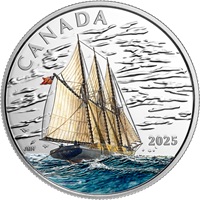
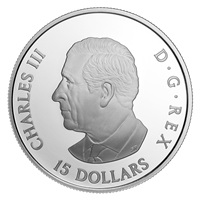
Face Value: $15 … Composition: 99.99% pure silver; Mintage: 15,000; Weight: 23.17 g; Diameter: 36.07 mm; Edge: Serrated; Finish: Proof; Artist: John M. Horton (reverse), Steven Rosati (obverse); Packaging: Black clamshell with black beauty box.
DID YOU KNOW? … ***Notice the red flag on your coin’s reverse? That’s the Canadian Red Ensign, the nautical flag flown by Canadian ships beginning in the 1890s, though it also served as Canada’s de facto flag following Confederation. Combining the Union Jack with variations of the shield of Canada, the Canadian Red Ensign was modified several times but was never formally adopted as the National Flag of Canada; it was ultimately replaced by the Maple Leaf flag in 1965.
Enhanced with selective colour, the reverse design by Canadian marine artist John M. Horton features a starboard quarter view of a three-masted (tern) schooner under full sail on a close reach in a smart breeze, with the starboard side lifting as the ship rolls to port. A full cargo of lumber is stowed on the deck of this coastal freighter, while the patent log is towed astern to measure speed and distance run. The obverse features the effigy of His Majesty King Charles III by Canadian artist Steven Rosati.
John Horton, Artist … I chose the starboard quarter view of the three-masted tern schooner because it shows the power of the vessel driving through a rough sea under a full press of canvas. These vessels were true workhorses, either transporting lumber coastwise, between ports, or across the Atlantic Ocean. On long hauls, they would stream a patent log to measure speed and distance run, so a dead reckoning position could be calculated. I have always enjoyed painting working vessels through the ages, and the hard-working terns are another fine example of how world trade was conducted.
2025 Maple Leaf Forever
– $300 Pure Platinum Coin
www.mint.ca
The 2025 edition of our platinum maple showcase brings you another elegant representation of the sugar maple leaf, the classic Canadian emblem whose beauty is once again made everlasting in 99.95% pure platinum, a precious metal 30 times rarer than gold. Enhanced with a genuine gemstone (a first for a Maple Leaf Forever coin), the maple portrait shifts the focus to the external forces at work in the life of a maple leaf — from the wind that, by blowing the leaf far and wide, paves the way for forest renewal, to the water (represented by a sparkling aquamarine droplet) that nourishes Canada’s treasured maple population, an essential part of our natural heritage.
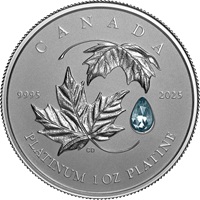
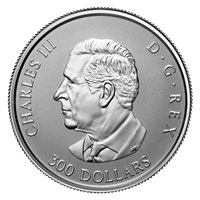
Face Value: $300 … Composition: 99.99% pure platinum with 0.23 ct. genuine AAA pear-shaped rose-cut aquamarine; Mintage: 450; Weight: 31.16 g; Diameter: 30 mm; Edge: Serrated; Finish: Reverse Proof; Artist: Claudio D’Angelo (reverse), Steven Rosati (obverse); Packaging: Wood case with black beauty box.
DID YOU KNOW? … ***The birthstone for March and the gemstone for 19ᵗʰ wedding anniversaries, aquamarine derives its name from the Latin words aqua and marina, meaning “water of the sea.” Aquamarine is found in a range of blue shades, from a light green-blue hue to a deep blue in larger stones.
Set against a matte field, the reverse design features two sugar maple (Acer saccharum) leaves floating in the wind and positioned in a way that suggests a circular motion. The engraved design is embellished with a 0.23-carat, AAA-grade, pear-shaped, rose-cut aquamarine gemstone, which stands in for a sparkling water droplet. The obverse features the effigy of His Majesty King Charles III by Canadian artist Steven Rosati.
Magic of the Northern Lights
– $30 Fine Silver Coin
www.mint.ca
The beauty of the Canadian wilderness is unmatched, but on a cloudless fall or winter night, don’t forget to look up—you might catch a glimpse of the aurora borealis dancing overhead. This 99.99% pure silver coin presents a breathtaking view of the northern lights, a luminous phenomenon that never fails to inspire awe. On the coin’s reverse, the 360-degree perspective pulls you into the night scene, where the surrounding forest—home to a secretive nocturnal hunter—frames your view of nature’s most dazzling celestial light display, which grows even brighter when viewed under a blacklight (included).
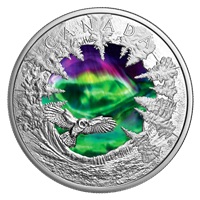
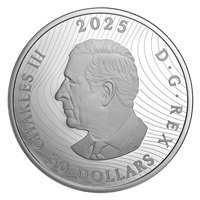
Face Value: $30 … Composition: 99.99% pure silver with colour and blacklight technology; Mintage: 4,500; Weight: 62.69 g; Diameter: 50 mm; Edge: Serrated; Finish: Proof; Artist: Alexandra Lefort (reverse), Steven Rosati (obverse); Packaging: Black clamshell with black beauty box.
DID YOU KNOW? … ***The aurora borealis appears in many different shapes and colours—it depends on the composition of gasses in the atmosphere, the altitude where the aurora occurs, and the level of solar activity. ***Green is the predominant aurora colour (it’s also more readily detected by our eye), and it appears when charged particles collide with oxygen molecules about 100 to 300 kilometres above Earth’s surface. A pink or red lower fringe is produced by nitrogen molecules at an altitude of 100 kilometres, while collisions with oxygen atoms at higher altitudes (250+ km) produce a rare red aurora that is associated with high solar activity.
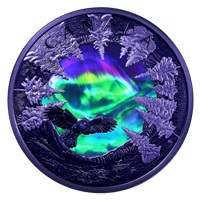
The reverse design by Canadian artist Alexandra Lefort features a view of the aurora borealis (also known as the northern lights) in the night sky above the Canadian wilderness. While a selective application of colour re-creates the ethereal green, pink and purple hues that form one of nature’s most breathtaking phenomena, the embedded blacklight technology amplifies those colours when activated by the flashlight (included). For a more immersive 360-degree perspective, a panoramic view of the surrounding mountains and boreal forest—the home of the Great Grey Owl (Strix nebulosa)—is engraved around the edge, resulting in a more realistic night scene when viewed under the blacklight flashlight, with the towering treetops appearing as imposing shapes that rise up toward the colourful sky. The obverse features the effigy of His Majesty King Charles III by Canadian artist Steven Rosati.
Alexandra Lefort, Artist … I first saw the northern lights through a plane window while flying over Northern Canada—I spent most of that flight watching the bright green, white and purple curtains of light dancing in the night sky until they slowly disappeared in the golden light of dawn. As we flew over mountains and forests, I tried to picture how the northern lights would be perceived from down there, and how nocturnal animals were living their lives under the colourful sky. I drew on that magical experience to design this coin. Since I wanted the scene to be representative of a large number of areas in Canada, I chose to represent a Great Grey Owl, sometimes called “Phantom of the North,” which lives in the boreal forests of central, western and northern Canada.
Randy Attwood, FRASC, Royal Astronomical Society of Canada, Executive Director from 2014 to 2019 … One of the most majestic spectacles in the night sky is a full-sky auroral display. The shimmering waves of blue, purple, red, and green happen when charged particles emitted by the Sun interact with Earth’s magnetosphere. When atoms such as oxygen and nitrogen in Earth’s upper atmosphere interact with these charged particles near Earth’s magnetic poles, the atoms emit the colourful light. The colours depend not only on the atoms, but on the altitude of the atoms, as well. The northern lights, or aurora borealis, are best seen in northern latitudes, making Canada a perfect place to see them.
Dancing Ammolite: Elements of Nature
– Earth – Fine Silver Coin
www.mint.ca
The second Dancing Ammolite coin continues the series’ celebration of nature’s most fundamental elements by focusing on the one that grounds and nourishes us all: Earth. The life-sustaining element that lies beneath our feet is beautifully represented here by the blossoming motif that evokes nature’s cyclical rebirth and renewal, and by the branches and roots that are symbolic of steadfast, enduring growth. Selectively plated with yellow gold on the coin’s reverse, these engraved elements surround the ammolite mounted at the centre, where the rare Canadian gemstone embodies the rhythm of life, bouncing and flashing its lively colours with every movement.

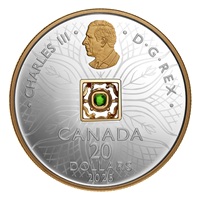
Face Value: $20 … Composition: 99.99% pure silver with selective yellow gold plating and an ammolite gemstone; Mintage: 950; Weight: 20.86 g; Diameter: 36.07 mm; Edge: Serrated; Finish: Proof; Artist: Mariya Olshevska (reverse), Steven Rosati (obverse); Packaging: Black clamshell with graphic beauty box.
DID YOU KNOW? … ***Earth, as an elemental force, is key to the formation of ammolite. This rare, organic gemstone is cut from fossilized shells of prehistoric marine creatures (ammonites) excavated from Alberta’s Bearpaw Geological Formation, which is composed primarily of shale. Alberta is the only place in the world where ammolite—the province’s official gemstone—is mined commercially.
Enhanced with selective gold plating, the reverse design by Canadian artist Mariya Olshevska is a representation of the Earth element in nature. A spring blossom contained within a bulb-like shape symbolizes nature’s cyclical renewal; as a repeating motif, it forms the petals of a larger flower shape, while the overlapping arrangement of tree branches and roots is representative of steadfast growth. At the centre, a standard grade ammolite that has been ethically sourced from Alberta’s Bearpaw Geological Formation is set in a 3D mount fashioned by Canadian jewellery manufacturer Beverly Hills Jewellers; the gold-plated setting allows the suspended gemstone to “dance” at the slightest movement of the coin base. The obverse features a stylized version of the engraved reverse, as well as the gold-plated effigy of His Majesty King Charles III by Canadian artist Steven Rosati.
Mariya Olshevska, Artist … For this coin design, I envisioned earth elements growing outwards from the central ammolite gemstone. I found inspiration both from the steadfast growth of tree branches and roots, as well as the more swift and ephemeral sprouting of flowers in the springtime. In experimenting with various shapes, I was delighted that the blossoming motif could be expressed both in the up-close details of each individual flower and echoed in the prevailing silhouette of the coin design, as observed from a distance.
Alex Tirabasso, Engraver-3D Artist … As engravers, we have to dance between aesthetics and manufacturability while creating a complex coin—it can’t just function in terms of manufacturing and telling the story, the sculpting also has to have a nice form. The focal point here is the gold-plated cage that carries the ammolite and is supported by the low relief, which has been optimized for gold plating. I leveraged this feature to create maximum contrast in the branch-and-roots section, where the foreground elements have a shiny finish while the ones in the background feature a more muted, frosted finish. The artist, Mariya, created a very symmetrical and balanced layout in which each element – specifically, the flower and branch motifs – were perfectly rotated 30 degrees apart from each other, and this kind of precision lends itself well to the overarching theme, which ultimately celebrates the unique beauty and symmetry in nature.